
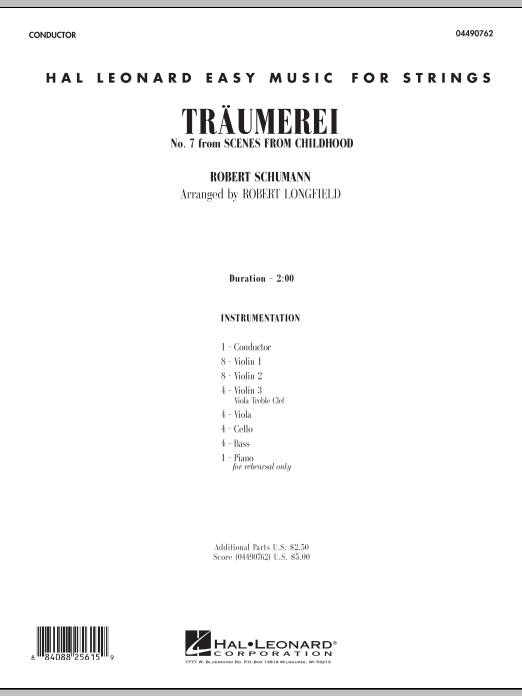

Traumerei: String Orchestra Conductor Score & Parts
By Robert Schumann / Arranged by Robert Longfield
Grade: 2-3
Item: 35-PK00117250
$40.00
Pickup currently not available
Buy Extra Parts (Digital PDF Download)
| Product | Price | Quantity |
|---|---|---|
| Traumerei - Full Score | $6.00 | |
| Traumerei - Violin 1 | $7.00 | |
| Traumerei - Violin 2 | $7.00 | |
| Traumerei - Violin 3 (Viola Treble Clef) | $7.00 | |
| Traumerei - Viola | $7.00 | |
| Traumerei - Cello | $7.00 | |
| Traumerei - Bass | $7.00 | |
| Traumerei - Piano | $7.00 |
Parts Added to Cart!
Description
Here's a short, lyric movement that is rich with a memorable melody and important moving lines within the inner parts. Robert's arrangement is also detailed with musical nuances that give ample opportunity to teach expressive playing in a ensemble setting. A wonderful edition for developing string groups. Dur: 2:00


Traumerei: String Orchestra Conductor Score & Parts isn't in MakeMusic Cloud just yet...but it could be. Let us know you'd like to see it, and you'll help shape what comes next. In the meantime, start a free trial and dive into thousands of interactive titles your students can play along with today.
Request This Title
Tell us you want it.
Start Your Free Trial
Explore everything that's ready to play right now.
Sample Audio
No sample audio found.
Sample Video
No sample videos found.
Additional Details
Publisher:
Hal Leonard
SKU:
35-PK00117250
More about this title
About the Composer: Robert Schumann
Robert Schumann (1810–1856) was a titan of Romantic music whose gift for lyrical melody shaped the emotional landscape of 19th-century composition. His piano works especially reveal his mastery of intimate, songlike expression, and Traumerei stands as one of his most beloved miniatures.
Schumann's approach to composition emphasized the singing quality of melody and the independence of inner voices, both principles that make his music invaluable for teaching string players how to shape phrases expressively and listen to ensemble color. His works have remained central to music education because they reward both technical discipline and genuine musical sensitivity.
Why we love this
Longfield's string arrangement preserves the song-like quality that makes Traumerei instantly recognizable while distributing the musical interest across all parts. The inner voice detail transforms what could be a simple melody-and-accompaniment texture into a genuine ensemble experience, giving every player something meaningful to attend to.
What to expect
Dreamlike and intimate, with an unhurried pulse that lets the melody breathe. The piece unfolds gently, drawing the listener inward; there's a tenderness in the way the inner voices move that creates subtle warmth without drama.
Who it's for
This arrangement suits developing string orchestras ready to move beyond melody-driven pieces into works where every section has real musical responsibility. It works equally well for middle school groups hitting the Grade 2-3 range and younger high school ensembles building their foundation in phrasing and expressive control.
How to get the most out of it
- Shape the primary melody as if singing it aloud; Schumann wrote in the Romantic tradition where every phrase needs a gentle arch and a destination, not just notes in succession.
- Balance the inner parts so they support without overwhelming the top line. Use dynamics and bow control to help second violins and violas maintain their voice without forcing.
- Take time with the fermatas and rests; silence is part of the emotional architecture here, and rushing past the space weakens the piece's introspection.
- Establish a consistent vibrato standard in rehearsal so the ensemble blends warmth without sounding tremolo-heavy. At this level, a lighter hand often works best.
How to use it
Place this in a chamber music or "Romantic small forms" concert to showcase how your developing players handle expression and ensemble balance. Its two-minute length makes it an ideal companion to longer contemporary works or a closing gesture before intermission, leaving audiences with a moment of reflection.
Skills your students will build
- Sustaining lyrical phrasing across complete harmonic phrases
- Balancing inner voice independence with overall ensemble coherence
- Using dynamic nuance and vibrato control to shape ensemble color
- Responding to fermatas and rests as essential musical punctuation
- Reading and interpreting detailed articulation and expression markings