
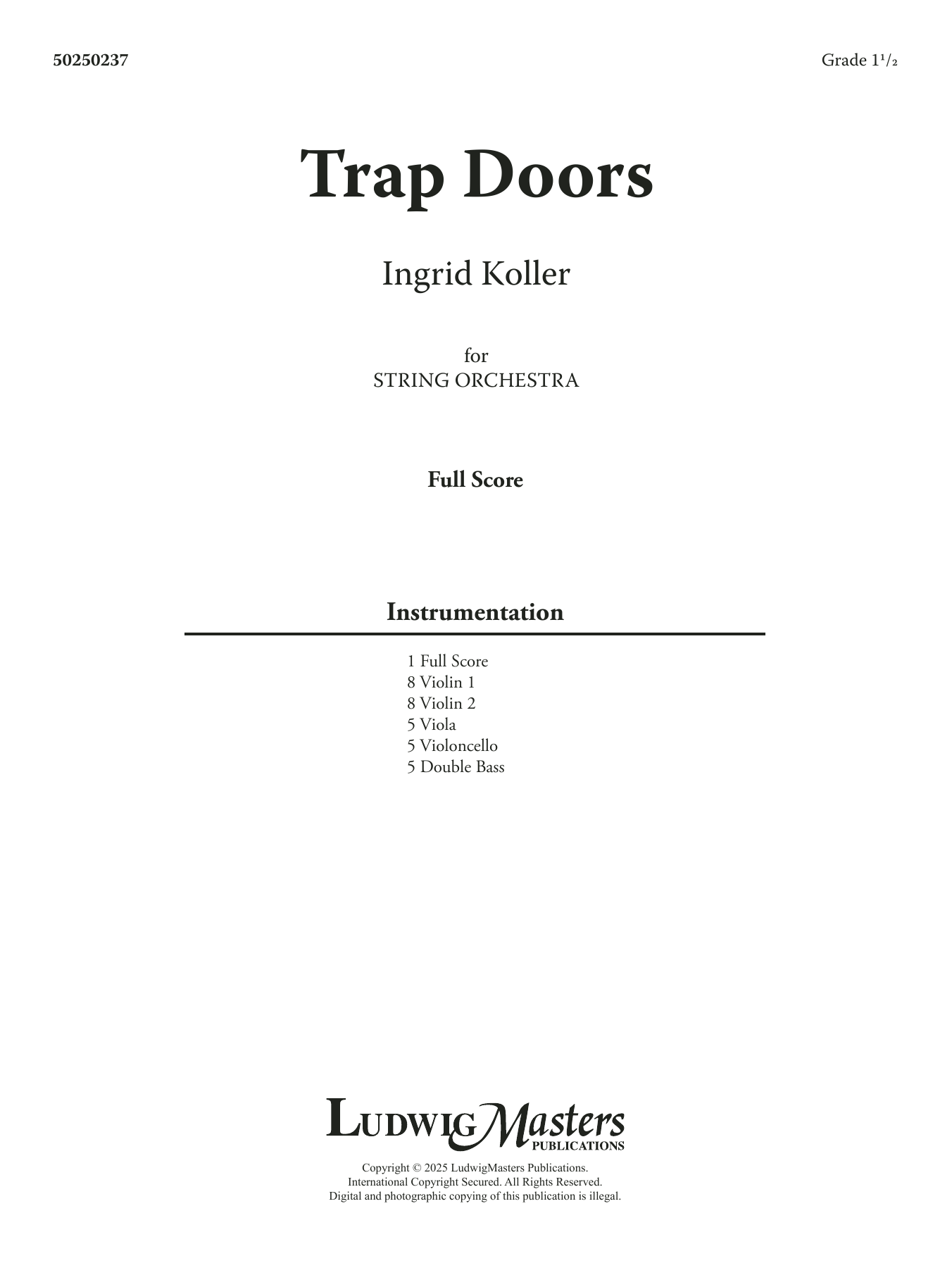

Trap Doors: String Orchestra Conductor Score & Parts
By Ingrid Koller
Grade: 1.5
Item: 35-PK01699079
$40.00
Pickup currently not available
Buy Extra Parts (Digital PDF Download)
| Product | Price | Quantity |
|---|---|---|
| Trap Doors - Full Score | $6.00 | |
| Trap Doors - Violin 1 | $2.50 | |
| Trap Doors - Violin 2 | $2.50 | |
| Trap Doors - Viola | $2.50 | |
| Trap Doors - Cello | $2.50 | |
| Trap Doors - Bass | $2.50 |
Parts Added to Cart!
Description
This clever intermediate level string orchestra piece will have your students on the edge of their seats as they count carefully so as not to "fall into" the rests. Everyone gets a chance to play the lively G Major melody and every section is tested by surprising rests. There are also tutti sections that provide a fun counting challenge for the entire orchestra. This piece teaches the all-important skills of counting carefully and watching the conductor.


Trap Doors: String Orchestra Conductor Score & Parts isn't in MakeMusic Cloud just yet...but it could be. Let us know you'd like to see it, and you'll help shape what comes next. In the meantime, start a free trial and dive into thousands of interactive titles your students can play along with today.
Request This Title
Tell us you want it.
Start Your Free Trial
Explore everything that's ready to play right now.
Sample Audio
No sample audio found.
Sample Video
No sample videos found.
Additional Details
Publisher:
Hal Leonard
SKU:
35-PK01699079
More about this title
Why we love this
Koller has written a piece that uses a simple but effective pedagogical trick to sharpen your students' counting discipline. The G Major melody is accessible enough that every player gets genuine musical ownership, yet the strategically placed rests and tutti sections prevent the piece from ever becoming predictable or easy. Your orchestra will need to stay locked in with the baton from beginning to end.
What to expect
Brisk and playful, with moments of delightful suspense. The G Major tonality keeps things bright and forward-moving, but the rests create little pockets of uncertainty that make every entrance feel earned. There's a lighthearted challenge built into the piece: can you stay together when the music stops?
Who it's for
String orchestras at the early intermediate level who need a focused counting etude disguised as a concert piece. It works equally well for groups strengthening their rhythmic accuracy and conductors training students to watch rather than rely on their stand partners.
How to get the most out of it
- Establish a clear visual cue system before rehearsals begin. Since watching the conductor is the piece's core focus, students need to understand exactly what gesture means 'count silently' versus 'prepare to enter.' Practice these signals separately before combining them with the music.
- Mark the rests prominently in student parts during the first reading. Have players use a pencil to circle or box every rest that involves their section. This prevents the common mistake of losing track and entering early.
- Build tempo stability gradually. Once students are secure with pitch and entrances, work on maintaining a steady beat through the rests. Use a metronome or click track in rehearsal to help them feel the pulse during their silence.
- Record a performance and listen back as an ensemble. Students often don't realize how their collective attention shapes the piece's energy. Hearing themselves nail the tutti sections or group entrances reinforces why precision matters.
How to use it
This works beautifully as a concert opener where it immediately engages the audience with its rhythmic wit, or as a second piece on a program where it provides contrast to a slower work. It's also an excellent rehearsal diagnostic tool during the mid-year stretch when attention tends to wander.
Skills your students will build
- Counting through rests without losing place
- Responding to conductor cues with precision
- Maintaining pulse awareness during silent passages
- Ensemble unity in sudden entrances
- Listening to surrounding sections while following the beat