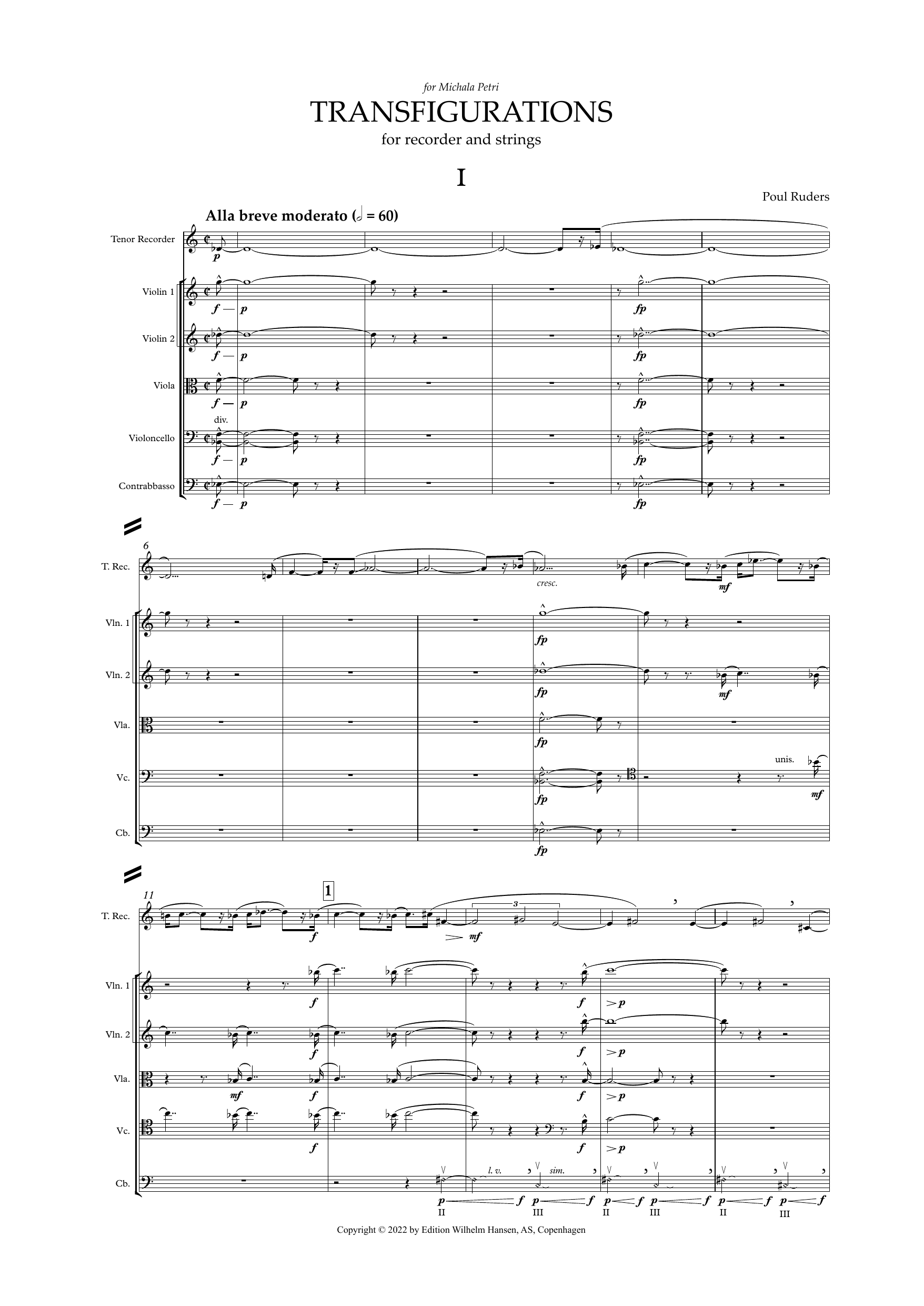
Transfigurations Concerto for Recorder and String Orchestra Sheet Music Preview

Transfigurations Concerto for Recorder and String Orchestra: String Orchestra Conductor Score & Parts

By Poul Ruders

Item: 35-PK01525351

Digital Download
$24.99

Buy Extra Parts (Digital PDF Download)

Parts Added to Cart!

Description
Transfigurations Concerto for Recorder and String Orchestra

Transfigurations Concerto for Recorder and String Orchestra: String Orchestra Conductor Score & Parts isn't in MakeMusic Cloud just yet...but it could be. Let us know you'd like to see it, and you'll help shape what comes next. In the meantime, start a free trial and dive into thousands of interactive titles your students can play along with today.

Sample Audio
No sample audio found.
Sample Video
Additional Details
Publisher: Hal Leonard
SKU: 35-PK01525351

More about this title

About the Composer: Poul Ruders

Poul Ruders stands among Denmark's most performed contemporary composers, with a catalog spanning orchestral works, concertos, operas, and chamber music. His writing combines modernist rigor with lyrical warmth, drawing on both Scandinavian musical traditions and international compositional techniques. Ruders has received commissions from major orchestras and festivals worldwide, and his works appear regularly on concert programs across Europe and North America.

For music educators, Ruders represents an accessible entry point into contemporary concert music. His orchestration is transparent and purposeful, his formal structures clear, and his harmonic language rewarding without being dogmatic. Works like the Transfigurations Concerto demonstrate how modern composition can challenge and engage student musicians while remaining genuinely performable.

Why we love this

Ruders writes with genuine affection for the recorder, treating it as a lyrical and virtuosic voice rather than a novelty. The concerto sits beautifully within the range of advanced student orchestras, offering soloists meaningful material while the string accompaniment provides both support and genuine musical dialogue.

What to expect

The piece inhabits a transparent, luminous sound world. The recorder emerges from and recedes into the string texture, sometimes soaring above it, sometimes blending into the fabric. Harmonies shift subtly, creating an atmospheric quality that feels less about dramatic gesture and more about transformation and subtle motion.

Who it's for

Advanced student string orchestras seeking repertoire that engages both ensemble and solo voice meaningfully. Recorder students ready for a substantial concerto role will find serious musical content here. This work suits orchestras with strong intonation and rhythmic coordination who want to tackle contemporary classical writing.

How to get the most out of it

  • Balance the recorder line by asking string sections to shape phrases around the soloist's contour rather than playing metronomically. This shared breathing creates coherence.
  • Attend to the harmonic language in the strings; Ruders often uses chromatic movement and quartal sonorities that need precise intonation to register clearly.
  • Work the recorder soloist on secure rhythmic placement within the ensemble, particularly in passage work where independence matters. The writing assumes technical assurance.
  • Conduct the transitions between sections with clear gestural prep; formal seams in modern works like this one benefit from conductor confidence.

How to use it

Program this alongside earlier Baroque or Classical recorder concertos to frame how the instrument's voice and role have evolved. It pairs well with other contemporary works that prioritize clarity and formal rigor. Consider using it as a featured soloist concert or as a centerpiece in a program exploring 20th and 21st century approaches to the concerto genre.

Skills your students will build

  • Ensemble balance with a prominent solo voice
  • Intonation in contemporary harmonic language
  • Conducting and cueing modern formal structures
  • Rhythmic precision in contemporary notation
  • Phrase shaping in non-Romantic musical contexts

You May Also Like