
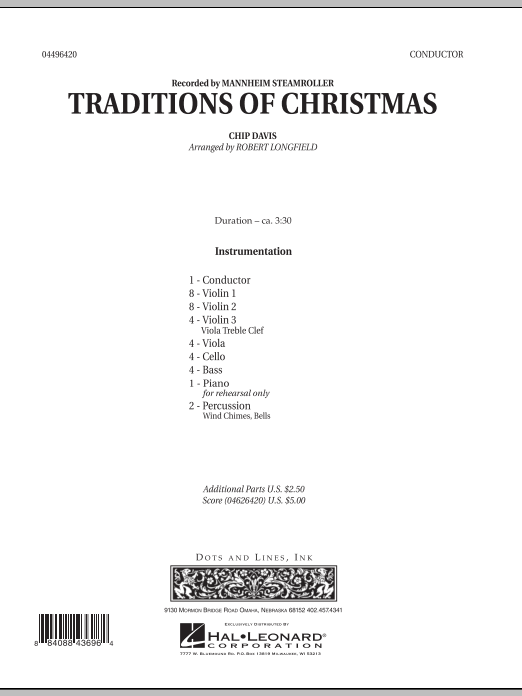

Traditions of Christmas: String Orchestra Conductor Score & Parts
As performed by Mannheim Steamroller / Arranged by Chip Davis
Grade: 3-4
Item: 35-PK00134909
$55.00
Pickup currently not available
Buy Extra Parts (Digital PDF Download)
| Product | Price | Quantity |
|---|---|---|
| Traditions of Christmas - Full Score | $6.00 | |
| Traditions of Christmas - Violin 1 | $7.00 | |
| Traditions of Christmas - Violin 2 | $7.00 | |
| Traditions of Christmas - Violin 3 (Viola Treble Clef) | $7.00 | |
| Traditions of Christmas - Viola | $7.00 | |
| Traditions of Christmas - Cello | $7.00 | |
| Traditions of Christmas - Bass | $7.00 | |
| Traditions of Christmas - Piano | $7.00 | |
| Traditions of Christmas - Percussion | $7.00 |
Parts Added to Cart!
Description
From Mannheim Steamroller's ever-popular "Fresh Aire" album, this is a wonderful change of mood with its gently flowing lines and peaceful atmosphere. Robert Longfield has skillfully adapted Chip Davis' simple melody into an approachable version that works ideally for string ensembles. Dur: 3:30


Traditions of Christmas: String Orchestra Conductor Score & Parts isn't in MakeMusic Cloud just yet...but it could be. Let us know you'd like to see it, and you'll help shape what comes next. In the meantime, start a free trial and dive into thousands of interactive titles your students can play along with today.
Request This Title
Tell us you want it.
Start Your Free Trial
Explore everything that's ready to play right now.
Sample Audio
No sample audio found.
Sample Video
No sample videos found.
Additional Details
Publisher:
Hal Leonard
SKU:
35-PK00134909
More about this title
About the Artist: Mannheim Steamroller
Mannheim Steamroller emerged in the 1980s as pioneers of contemporary instrumental music, blending classical composition with synthesizer-driven arrangements. Their "Fresh Aire" series became a defining sound for modern holiday music, reaching audiences far beyond traditional classical listeners and proving that ensemble music could be both accessible and artistically substantive.
Chip Davis founded the group with a vision to create orchestral music that felt fresh and immediate rather than reverent or distant. His work demonstrates how thoughtful composition and inventive arrangement can make classical forms speak to contemporary listeners without sacrificing musical integrity.
Why we love this
This arrangement captures what made "Fresh Aire" essential listening: a simple, memorable melody that unfolds naturally across the ensemble without demanding virtuosity from any single section. Longfield's adaptation respects Davis' compositional voice while making it genuinely playable for student orchestras, which means your students get to own a real piece of popular music history rather than a watered-down approximation.
What to expect
Quiet contemplation wrapped in warmth. The piece unfolds like a gentle meditation, with sustained harmonies and a melody that seems to float above without strain. It evokes the calm of a winter evening more than the bustle of holiday festivities, making it feel like a moment of peace within the season.
Who it's for
String orchestras at the intermediate level looking for repertoire that feels contemporary and rewarding without excessive technical demands. This works equally well for directors programming holiday concerts or seeking a mood piece that contrasts with more energetic seasonal selections.
How to get the most out of it
- Shape the opening melody with gentle dynamic swells rather than staying at a flat mezzo-piano; the gently flowing character depends on subtle breath and phrasing, not uniformity.
- Balance the accompaniment sections so they support rather than shadow the melodic line; sustained harmonic textures should recede slightly as the tune moves through the ensemble.
- Take time with the tempo to let the peaceful atmosphere settle; resist the urge to push forward, as restraint is what makes this arrangement feel serene.
- Mark entrance cues clearly in the parts so transitions between instrumental groups feel seamless rather than tentative.
How to use it
Place this as a quieter moment in a holiday concert, perhaps after something more celebratory to give audiences a chance to settle. It also serves well as a concert opener, establishing an intimate atmosphere before moving into other selections. The three-and-a-half minute duration makes it ideal for filling programming slots or creating a well-paced concert arc.
Skills your students will build
- Sustaining long tones with consistent tone quality and intonation
- Balancing within an ensemble where multiple sections carry harmonic material
- Shaping melodic lines through subtle dynamic variation rather than dramatic contrast
- Reading and executing cues across different instrumental groups
- Maintaining musical cohesion at slower tempi