
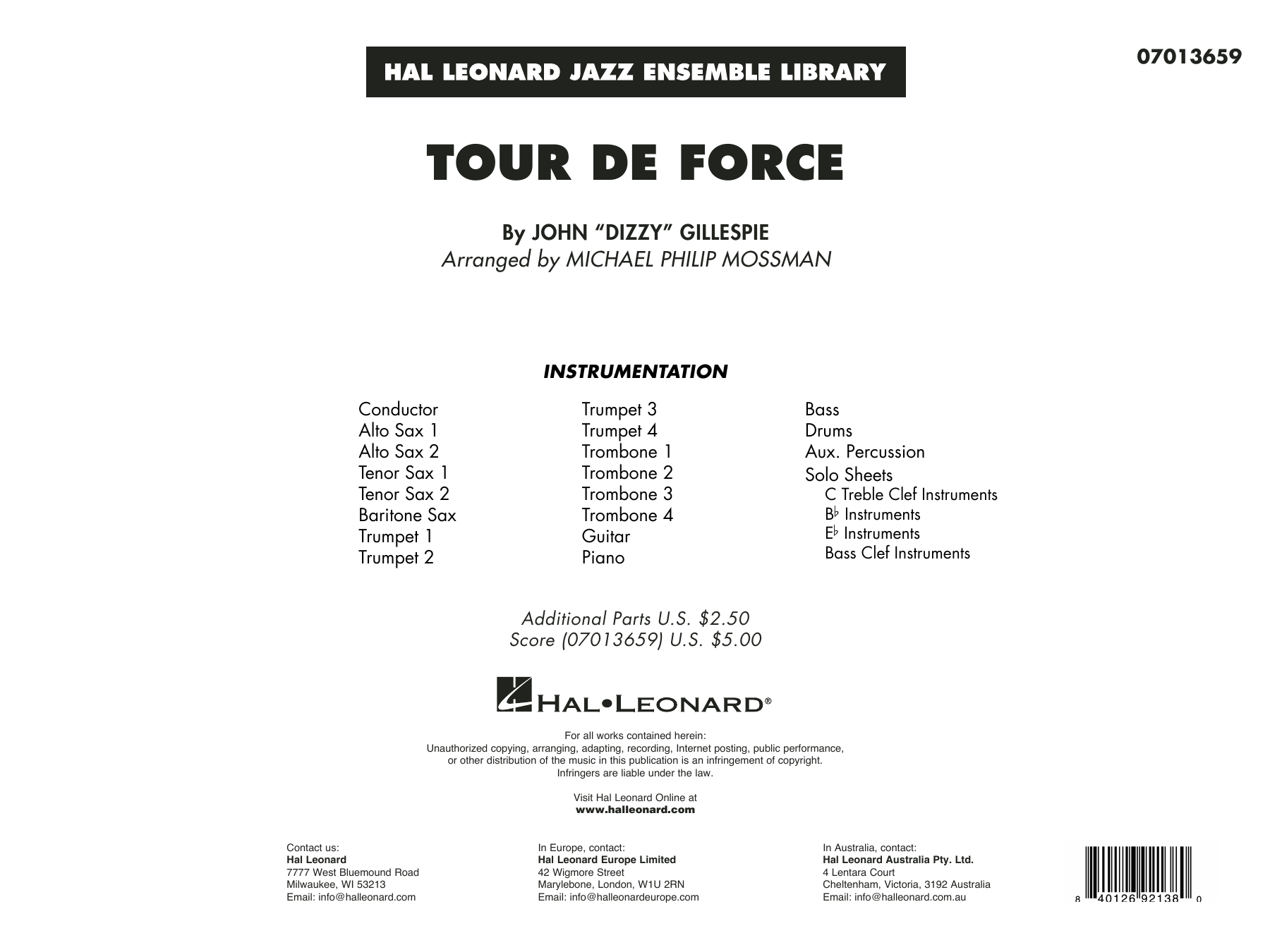

Tour De Force (arr. Michael Philip Mossman): Jazz Ensemble Conductor Score & Parts
As performed by Dizzy Gillespie / Arranged by Michael Philip Mossman
Grade: 4
Item: 35-PK00480153
$55.00
Pickup currently not available
Buy Extra Parts (Digital PDF Download)
Parts Added to Cart!
Description
Composed by jazz master Dizzy Gillespie, and arranged here by Latin master Michael Mossman, this appealing chart features a comfortable cha-cha groove, a distinctive harmonic progression, and a tuneful melody suitable for young players. Every section has an interesting and important role to play, and solos (written or ad lib) are featured for trumpet and tenor sax.


Tour De Force (arr. Michael Philip Mossman): Jazz Ensemble Conductor Score & Parts isn't in MakeMusic Cloud just yet...but it could be. Let us know you'd like to see it, and you'll help shape what comes next. In the meantime, start a free trial and dive into thousands of interactive titles your students can play along with today.
Request This Title
Tell us you want it.
Start Your Free Trial
Explore everything that's ready to play right now.
Sample Audio
No sample audio found.
Sample Video
No sample videos found.
Additional Details
Publisher:
Hal Leonard
SKU:
35-PK00480153
More about this title
About the Artist: Dizzy Gillespie
Dizzy Gillespie revolutionized jazz trumpet playing and composition throughout the mid-20th century, pioneering bebop alongside Charlie Parker and Thelonious Monk. His harmonic innovations, virtuosic technique, and fearless approach to melody shaped modern jazz language and influenced generations of improvisers across all instruments.
Beyond the United States, Gillespie championed Afro-Cuban jazz, collaborating with conga master Chano Pozo and exploring rhythmic possibilities that expanded jazz beyond its American roots. His compositions remain central to jazz education because they balance sophistication with approachability, offering players meaningful challenges without sacrificing musicality.
Why we love this
Mossman's arrangement respects Gillespie's melodic gift while making the chart genuinely playable for developing ensembles. The cha-cha groove gives students a rhythmic foundation they can lock into immediately, and the sectional writing ensures nobody gets sidelined; even when soloists take the spotlight, every player has moments that matter.
What to expect
Warm, propulsive, and surprisingly sophisticated. The cha-cha groove creates an inviting rhythmic bed that feels both contemporary and timeless, while the harmonic colors underneath give the melody room to breathe and the improvising soloists something genuinely interesting to explore.
Who it's for
Jazz ensembles at the intermediate level who are ready to move beyond basic blues changes and explore Latin jazz vocabulary. This chart works well for students who have fundamental swing feel and basic improvisation experience but haven't yet tackled more complex harmonic environments.
How to get the most out of it
- Establish the cha-cha pulse early in rehearsal by having the rhythm section play the groove independently for several run-throughs before adding the melody. Pocket feel matters more here than mathematical precision.
- Shape the harmonic progression by encouraging soloists to listen deeply to the changes during rehearsals; even written solos benefit from personal interpretation and phrasing choices.
- Balance trumpet and tenor sax solos by checking dynamics during full ensemble passages surrounding them. Make sure the comping voices stay conversational, not competitive.
- Count off with the characteristic bounce of the cha-cha rhythm, not a straight four. The ensemble will lock in faster if you guide them into the actual groove from measure one.
How to use it
Feature this as a standalone item on a jazz concert, or pair it with other Gillespie compositions to build a thematic set. It also fits naturally into a Latin jazz concert segment where you want something accessible but not simplistic, bridging the gap between rhythm section technique and full ensemble musicality.
Skills your students will build
- Cha-cha rhythmic vocabulary and Latin jazz accompaniment patterns
- Listening and responding to improvised solos within ensemble settings
- Harmonic navigation beyond simple blues progressions
- Sectional independence and balance within an ensemble texture
- Phrasing and melodic interpretation in the bebop tradition