
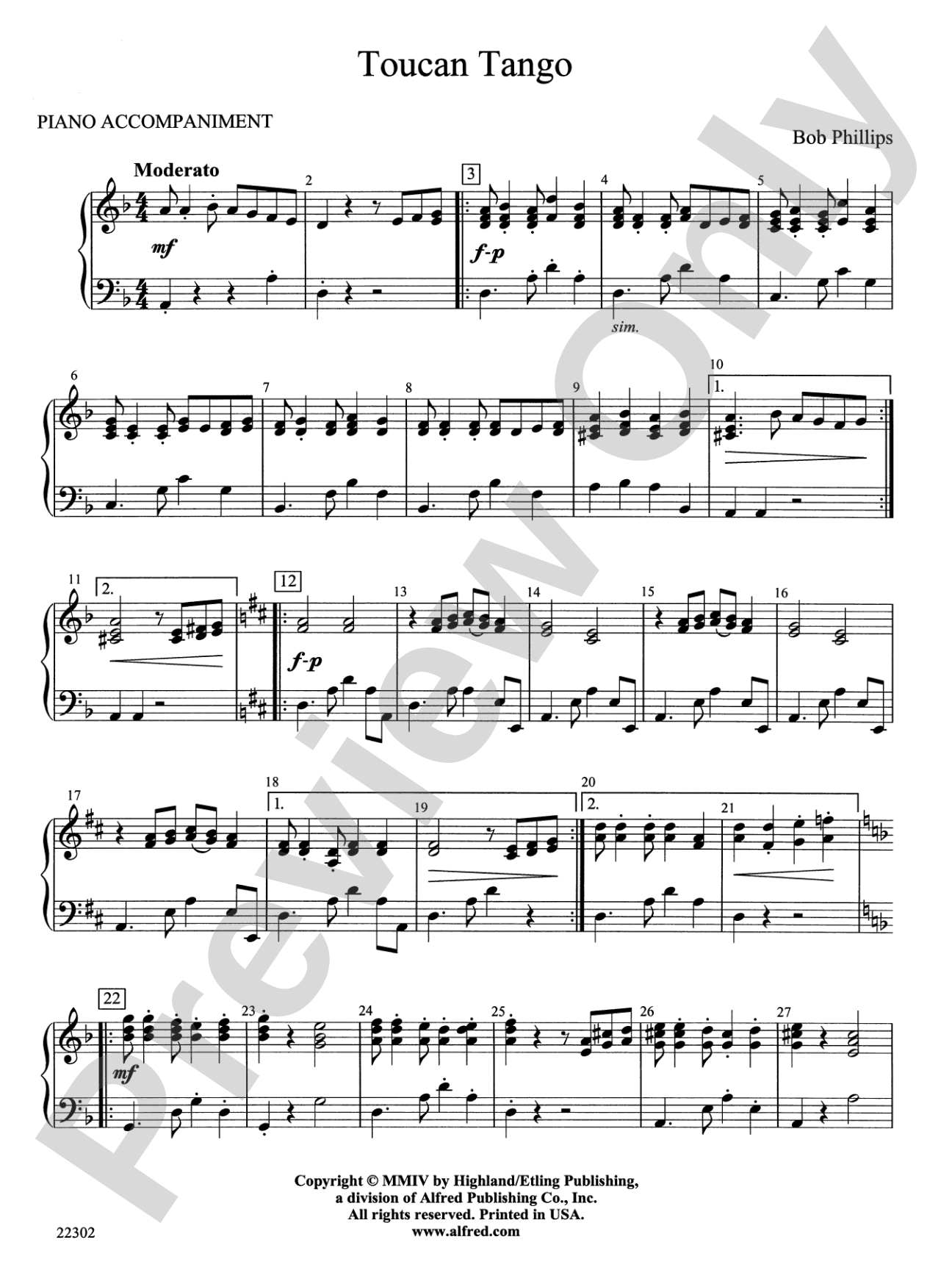

Toucan Tango: Piano Accompaniment
By Bob Phillips
Grade: 2
Item: 00-PC-0000551_K
$5.99
Pickup currently not available
Description
Written in the style of an Argentinean tango and featuring strong rhythmic underpinning, violins, violas and cellos each have a turn at playing the original melody while the basses play a tango rhythm. Alternating between the keys of D minor and D major, Toucan Tango is designed to make an intermediate or advance beginning orchestra sound its best. In first position with no shifting, two (or more) really can tango! (2:53)


Don't just read it, hear it, play along with it, and watch your students grow with it. In MakeMusic Cloud, Toucan Tango: Piano Accompaniment comes alive with professional accompaniment, adjustable tempo, and built-in practice tools that turn solo practice into real progress.
Open in the Player
Jump straight in and assign it today.
Start Your Free Trial
Open this title and explore the full library in minutes.
Sample Audio
1
Audio File
--:--
0:00
0:00
Sample Video
Additional Details
Series:
Highland/Etling String Explorer
Publisher:
Alfred Music
Page Count:
74
SKU:
00-PC-0000551_K
More about this title
About the Composer: Bob Phillips

Bob Phillips has spent decades establishing himself as a driving force in string music education. Since 1953, he has created an extensive catalog of works and instructional materials performed by thousands of young musicians annually; his publications span 25+ book series, including Sound Innovations and the eclectic style collections (Jazz Philharmonic, Rock Philharmonic, Mariachi Philharmonic, and others). Over 200 of his compositions for orchestras and bands have been published, and his work has earned him recognition as an ASCAP award-winning composer with regular performances at the Midwest Clinic.
For 27 years in Saline, Michigan, Phillips built and directed a string program of over 700 students that became a national benchmark for excellence across classical and contemporary styles. He founded the Saline Fiddlers Philharmonic, which performed internationally and at the White House, and has served as resident conductor, arranger, and clinician for youth orchestras and all-state programs across the country, including appearances at Interlochen, Blue Lake Fine Arts Camp, and the Queensland Honour Ensemble Program.
Why we love this
Phillips delivers exactly what Grade 2 orchestras need: a piece that sounds polished and ensemble-focused without demanding technical gymnastics. The tango idiom gives students a genre to sink their teeth into, and the strategic melody rotation across sections keeps everyone engaged while building confidence in your less-frequently featured voices.
What to expect
Toucan Tango captures the energy and syncopation of Argentinean tango while maintaining the lightness appropriate to its grade level. As the melody passes among sections, the piece feels conversational and alive, with a rhythmic backbone that makes young players feel like real musicians playing real music.
Who it's for
String orchestras at the Grade 2 level will find a piece that challenges them musically while remaining accessible in terms of technique. The first-position-only writing and simple rhythmic demands make this ideal for intermediate or strong beginning groups ready to explore style and ensemble balance.
How to get the most out of it
- Lock in the bass line first. The tango rhythm is the structural backbone; once cellos and basses establish the pulse with security, the melodic exchanges between sections will sit naturally on top.
- Shape the melody with dynamic clarity when it passes between sections. Mark where each group takes over, and use subtle swells to signal the handoff so the audience hears the orchestration as intentional rather than accidental.
- Emphasize the D minor to D major harmonic shifts without exaggerating them. Let the key change do its work; your musicians will feel the brightness when they land on the major chord if you've settled the minor section first.
- Keep the tempo steady and dance-like. This piece lives in the groove; resist the urge to slow down during rests or transitions, or the tango character evaporates.
How to use it
This piece works beautifully as a concert opener or closer for a spring or festival program focused on Latin and world music styles. The bright tango character and brief runtime (2:53) make it an excellent anchor for a thematic set or as a palate-cleanser between heavier classical selections.
Skills your students will build
- Maintaining steady rhythm in tango syncopation and off-beat accompaniment patterns
- Following melody exchanges across sections with rhythmic precision
- Reading and executing the D minor/D major harmonic shift
- Balancing melodic solos within section with accompaniment figures
- Responding to conductor cueing during section-to-section handoffs