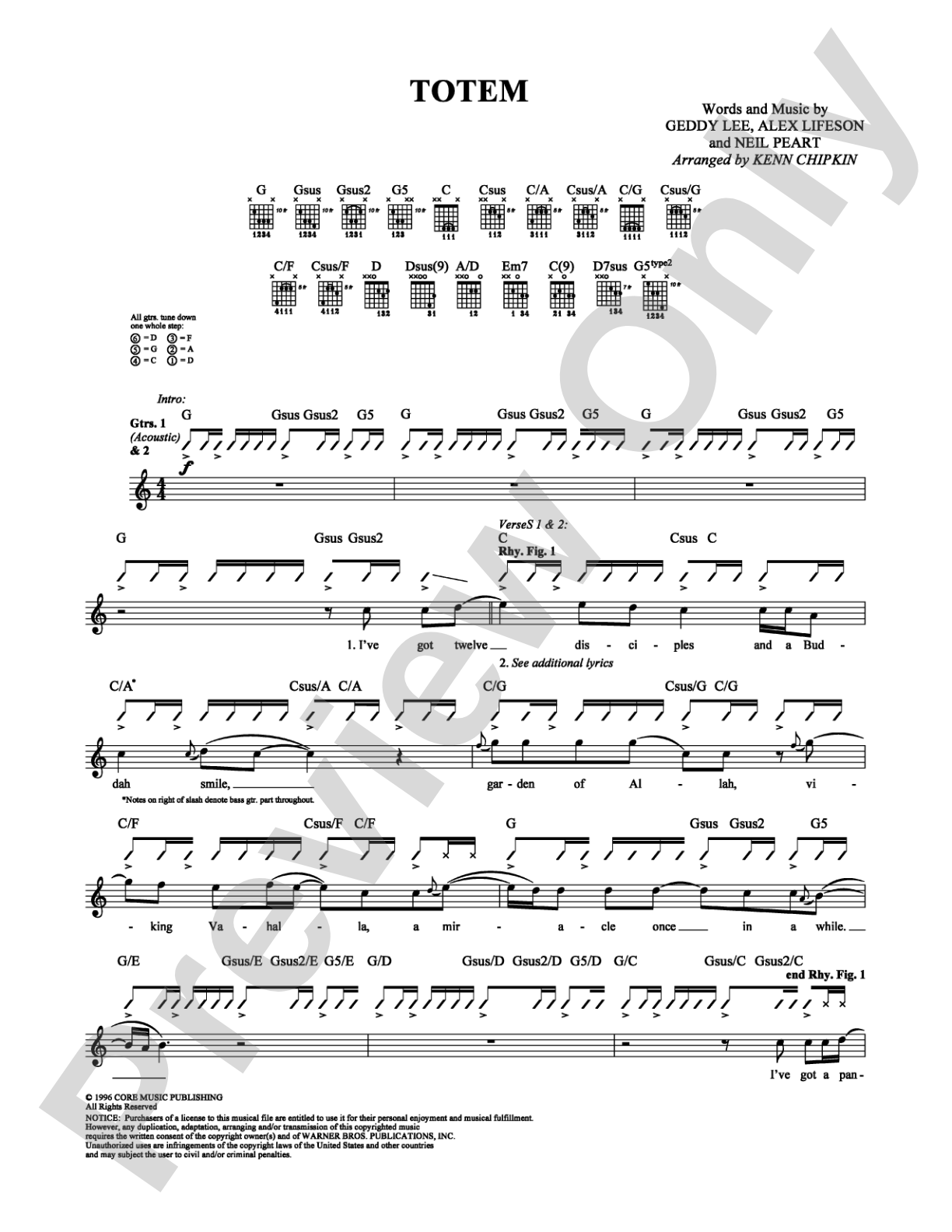
Totem: Guitar TAB Digital Sheet Music

Totem: Guitar TAB Digital Sheet Music

Rush, Geddy Lee, Neil Peart, Alex Lifeson

Item: 00-PS-0001227

Digital Download
$2.99
Description

Totem: Guitar TAB Digital Sheet Music isn't in MakeMusic Cloud just yet...but it could be. Let us know you'd like to see it, and you'll help shape what comes next. In the meantime, start a free trial and dive into thousands of interactive titles your students can play along with today.

Sample Audio
No sample audio found.
Sample Video
Additional Details
SKU: 00-PS-0001227

More about this title

About the Artist: Rush

Rush stands as one of rock's most technically demanding and intellectually ambitious bands. Formed in Toronto in 1968, the trio of Geddy Lee, Alex Lifeson, and Neil Peart built a legacy on instrumental virtuosity, complex time signatures, and progressive arrangements that pushed the boundaries of what rock music could accomplish. Their influence on guitar playing spans decades, with Lifeson's innovative use of effects and unconventional harmonic approaches inspiring generations of musicians.

For music educators, Rush represents a masterclass in musicianship at the highest level. Their catalog rewards close listening and serious study, offering guitarists a pathway to understanding advanced technique, odd meters, and the marriage of melody with technical complexity. Teaching Rush material helps students recognize that technical difficulty serves musical expression rather than existing for its own sake.

Why we love this

Totem captures Rush's signature sound of intricate fretwork and atmospheric layering in a piece that challenges without overwhelming. The TAB format makes this notoriously complex band's work accessible to intermediate and advancing players, allowing guitarists to decode the artistry behind every note rather than guess their way through by ear.

What to expect

Totem moves with purposeful momentum and intricate detail, balancing moments of clarity and spaciousness against tightly woven harmonic passages. The piece carries Rush's characteristic blend of intellectual structure and emotional directness, inviting players into a world where precision and musicality are inseparable.

Who it's for

Guitarists with solid intermediate technique who are ready to tackle Rush's harmonic vocabulary and rhythmic sophistication. This TAB works for self-directed study, private lessons, or ensemble contexts where one guitarist features the material. Students drawn to progressive rock and players seeking to expand their technical and stylistic range will find genuine reward here.

How to get the most out of it

  • Map out the meter changes before playing; this piece sits comfortably in standard time but the rhythmic phrasing often tricks the ear. Lock the pulse before adding any expression.
  • Use the recorded version as a reference for tone and space. Rush's production choices are integral to the composition; capturing the resonance and sustain matters as much as hitting the right frets.
  • Practice the picking patterns on muted strings first to isolate rhythm from pitch. The syncopation between melody and accompaniment figures needs precision to land cleanly.
  • Balance clarity against the temptation to rush. This material has internal momentum but requires patient, articulate playing to unfold properly.

How to use it

Feature this in a recital or concert where you want to showcase advanced guitar work and introduce audiences to progressive rock as a legitimate art form. It pairs well alongside classical guitar repertoire in programs that explore technique across genres, or stands alone as a solo feature demonstrating what contemporary rock music demands from serious players.

Skills your students will build

  • Reading and executing complex picking patterns and syncopated rhythms
  • Navigating unconventional harmonic progressions and chord voicings
  • Understanding how effects and tone shaping contribute to compositional intent
  • Developing left-hand precision and right-hand dexterity under technical demands
  • Analyzing the relationship between rhythm section and melodic movement in progressive arrangements

You May Also Like