Tota pulchra es (after Jean Mouton) Sheet Music Preview

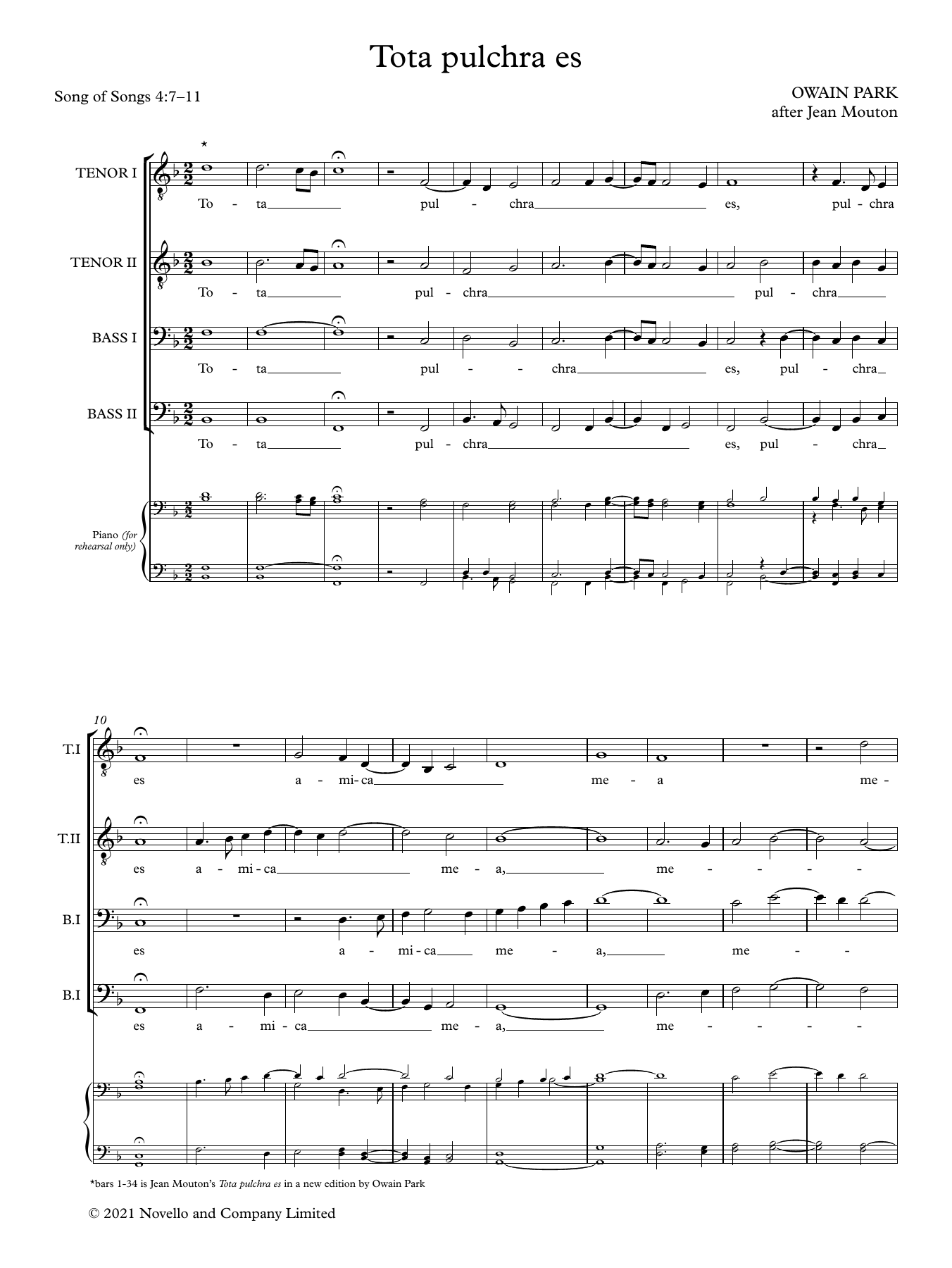
Tota pulchra es (after Jean Mouton): Choral Octavo

By Owain Park / By Song of Songs

Item: 35-DS01525311

Digital Download
$4.95
Description

Tota pulchra es (after Jean Mouton): Choral Octavo isn't in MakeMusic Cloud just yet...but it could be. Let us know you'd like to see it, and you'll help shape what comes next. In the meantime, start a free trial and dive into thousands of interactive titles your students can play along with today.

Sample Audio
No sample audio found.
Sample Video
Additional Details
Publisher: Hal Leonard
Page Count: 9
SKU: 35-DS01525311

More about this title

About the Composer: Owain Park

Owain Park is a Welsh composer whose choral works have earned recognition for their lyrical sensibility and careful text setting. His compositions span sacred and secular repertoire, with a particular gift for reimagining established works through fresh harmonic and structural lenses.

Why we love this

Park's response to Mouton's Renaissance masterpiece respects the source material while introducing modern harmonic language that feels both inevitable and surprising. The piece rewards singers with gratifying voice leading and gives your ensemble a substantial work that sits comfortably in intermediate-to-advanced ranges.

What to expect

The work unfolds with contemplative richness, its harmonic palette creating luminous moments alongside darker, introspective passages. Singers experience the text from Song of Songs as something intimate yet grand, shaped by Park's attention to vowel color and phrase contour.

Who it's for

This octavo serves choirs with solid sightreading skills and access to regular rehearsal time. Directors seeking a modern choral work rooted in classical tradition will find it both artistically fulfilling and achievable within a season's preparation.

How to get the most out of it

  • Balance the layered vocal lines by thinking of the piece as a dialogue between registers rather than a single unified texture. Isolate each voice part in sectional rehearsals to build independence.
  • Shape phrases by attending to the text declamation; let the words breathe naturally rather than forcing them into a predetermined tempo. This creates intimacy without sacrificing clarity.
  • Mark the moments where harmonic language shifts in character. These transitions anchor the form and give singers a roadmap through the nine-page span.

How to use it

Pair this with other works exploring sacred or courtly love texts from different periods to create a thematic concert arc. Its moderate length makes it an excellent anchor for a program built around Renaissance traditions reimagined for contemporary ensembles.

Skills your students will build

  • Reading extended harmonic vocabulary beyond diatonic tonality
  • Sustaining independence in a four or five-voice texture
  • Interpreting text expression within modern compositional language
  • Maintaining intonation through chromatic voice leading

You May Also Like