
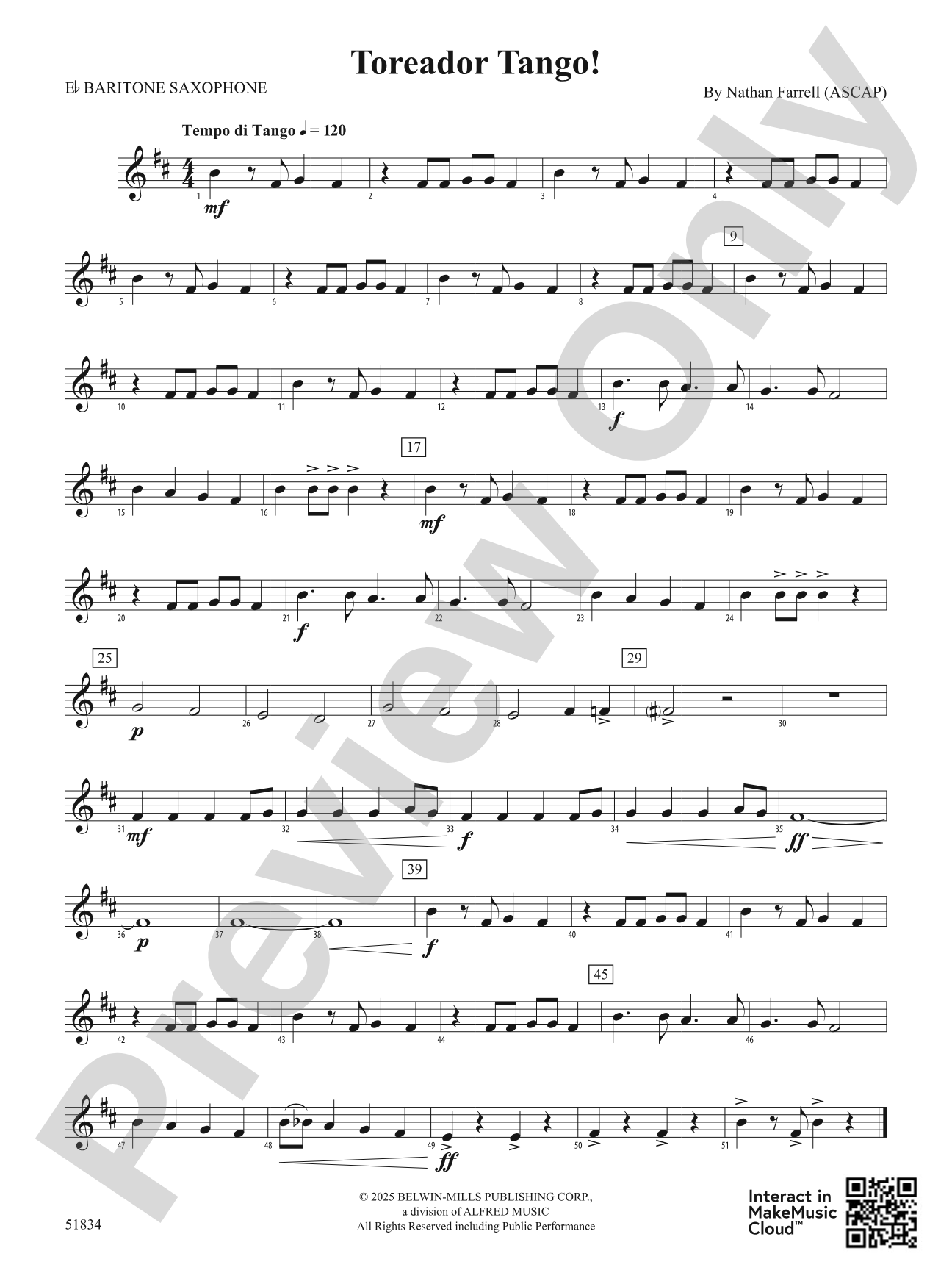

Toreador Tango!: E-flat Baritone Saxophone
By Nathan Farrell
Grade: 1.5
Item: 00-PC-0019518_BTX
$3.00
Pickup currently not available
Description
Experience the "olé" moments of Toreador Tango!, a fiery piece for young concert bands by Nathan Farrell that captures the heart of a Spanish bullfight. This caliente composition dances with dynamic melodies and rhythms, featuring a brief but bold trumpet solo that takes center stage like a true matador. With iconic strains of "España Cañí" woven in, Toreador Tango! brings the drama and passion of the arena to life, making your audience shout "bravo!" (1:50)


Don't just read it, hear it, play along with it, and watch your students grow with it. In MakeMusic Cloud, Toreador Tango!: E-flat Baritone Saxophone comes alive with professional accompaniment, adjustable tempo, and built-in practice tools that turn solo practice into real progress.
Open in the Player
Jump straight in and assign it today.
Start Your Free Trial
Open this title and explore the full library in minutes.
Sample Audio
1
Audio File
--:--
0:00
0:00
Sample Video
Additional Details
Series:
Belwin Beginning Band
Publisher:
Alfred Music
SKU:
00-PC-0019518_BTX
More about this title
About the Composer: Nathan Farrell

Nathan Farrell brings nearly three decades of classroom experience to his work as a composer and educator. His compositions for band and choir are published by Curnow Music Press, Excelcia Music Publishing, The Salvation Army, and Alfred Music, and have earned recognition including selection to the J.W. Pepper Editor's Choice List. His "Fanfare Brillante" was chosen as a test piece for the International Trombone Association quartet contest.
Farrell studied composition with James Curnow at Asbury University and earned his Master of Education degree from the University of South Florida. Beyond composing, he has directed the marching band at Northside Christian School to nine Florida state championships and was inducted into the Florida Marching Band Championship Hall of Fame. His approach to music education prioritizes creative energy and engagement, qualities that shine through in every score he writes.
Why we love this
Farrell's gift for capturing cultural color without sacrificing playability is on full display here. The trumpet solo gives your players a genuine moment in the spotlight rather than tucking the spotlight away, and the incorporation of "España Cañí" feels organic rather than pasted on. At Grade 1.5, this brings orchestral drama and audience appeal to a level where young bands genuinely need both.
What to expect
Spanish heat meets concert hall energy. The piece swells with confident melodies and dancing rhythms that feel celebratory rather than fragile, giving young musicians permission to play with genuine expression. When the trumpet steps into the light, it's a pure moment of bravura.
Who it's for
Grade 1.5 concert bands seeking repertoire that delivers theatrical impact without requiring advanced technique. This works equally well for groups developing their rhythmic precision and those looking for an audience-friendly contest or festival selection that celebrates cultural music.
How to get the most out of it
- Balance the trumpet solo by pulling back your ensemble just enough to let it soar; the matador doesn't need to shout over the crowd to be heard.
- Nail the rhythmic precision in the opening. Latin music lives and dies by confident, tight ensemble rhythm; even at this accessible level, groove matters enormously.
- Shape the dynamic arc across the full 1:50 duration so the ending feels like a genuine climax, not just the stopping point. The drama is earned through momentum, not accident.
- Highlight the color changes when "España Cañí" enters. Students will hear the moment; make sure they're driving it forward with intention.
How to use it
Program this alongside other culturally rooted works to build a concert theme around world music traditions, or pair it with a slower Spanish or Latin selection for contrast. Its 1:50 runtime makes it ideal for festival competitions where time constraints matter, and its theatrical nature gives opening or closing slot weight.
Skills your students will build
- Latin rhythmic feel and swing articulation
- Dynamic contrast and terraced shaping across a complete arc
- Ensemble balance when accompanying a solo voice
- Rhythmic precision in syncopated passages
- Sustaining tone quality through sustained harmony parts