Toreador: Double Bass Sheet Music Preview

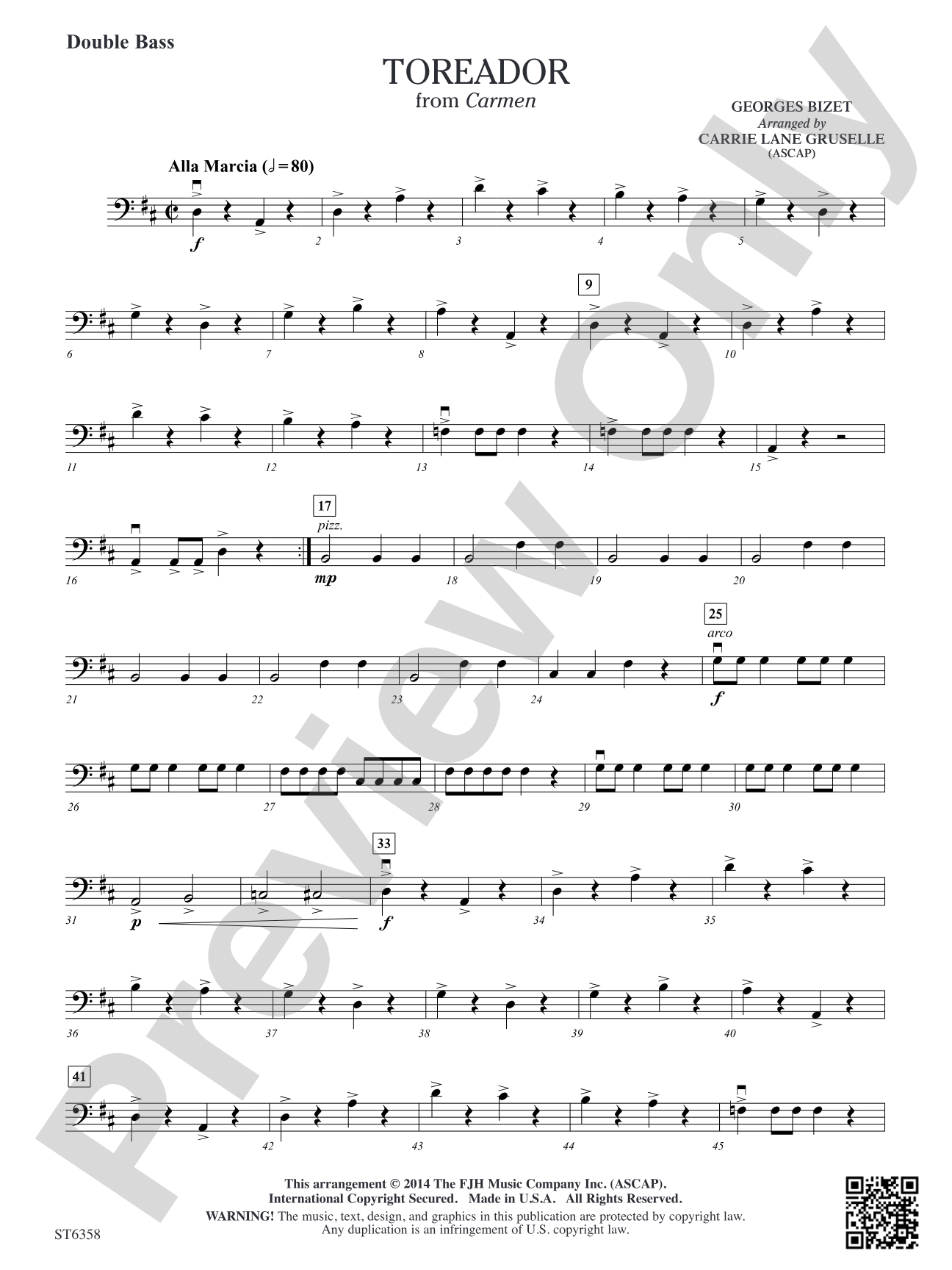
Toreador: Double Bass

By Georges Bizet / arr. Carrie Lane Gruselle

Grade: 2.5

Item: 98-PC-DST6358_SB

Digital Download
$7.00
Description
This thoughtful arrangement from Carmen captures both the opening theme and the toreador's aria, which is initially presented by the cello and bass voices. The entire arrangement remains in the key of D, making this quite accessible to young performers while covering some of the most beloved themes from the opera.

Don't just read it, hear it, play along with it, and watch your students grow with it. In MakeMusic Cloud, Toreador: Double Bass comes alive with professional accompaniment, adjustable tempo, and built-in practice tools that turn solo practice into real progress.

Sample Audio
0:00
0:00
Sample Video
Additional Details
Series: FJH Developing Strings
Publisher: The FJH Music Company, Inc.
SKU: 98-PC-DST6358_SB

More about this title

About the Composer: Georges Bizet

Georges Bizet (1838-1875) was a French composer whose operatic works remain central to the international repertoire. His gift for memorable melody and dramatic storytelling secured Carmen as one of the most frequently performed operas worldwide, and its themes have become touchstones for music education across all levels.

Bizet's melodies from Carmen are particularly valuable in educational settings because of their immediate appeal and structural clarity. Young musicians recognize these themes instantly, which builds their confidence and connection to the classical canon.

Why we love this

Carrie Lane Gruselle's arrangement captures the dramatic essence of Carmen without overwhelming Grade 2-3 players. The decision to keep everything in D major and feature the cello and bass voices on the toreador's aria gives lower strings genuine melodic authority, which is precisely what young string players need to feel invested in their parts.

What to expect

The opening theme arrives with swagger and energy, declaring itself without pretense. When the cello and bass voices enter with the toreador's aria, the character shifts to something more lyrical and dignified, giving the lower strings a moment of genuine musical storytelling.

Who it's for

This arrangement works for middle school orchestras, youth ensemble programs, and any Grade 2-3 string group ready to explore operatic repertoire. It appeals equally to directors building toward their first concert featuring canonical masterworks and to teachers seeking material with immediate musical payoff for young performers.

How to get the most out of it

  • Balance the opening theme across the ensemble so it sings without overshadowing the inner voices. The melody should feel supported rather than driven.
  • When the cello and bass introduce the toreador's aria, anchor the rhythm section (violas and second violins) so those lower voices can float the melody with confidence.
  • Shape the phrasing in four-bar units to maintain the opera's vocal character. Let the melody breathe at natural cadences rather than pushing relentlessly forward.
  • Maintain steady tempo throughout the transitions between sections. Any tempo shift will fracture the continuity of these famous melodies.

How to use it

Open a concert with this piece to immediately engage your audience with recognizable, crowd-pleasing material while demonstrating your ensemble's capabilities at the Grade 2-3 level. It also pairs well in a thematic program exploring opera, Spanish musical traditions, or orchestral arrangements of famous vocal music.

Skills your students will build

  • Sustaining lyrical lines with consistent tone and intonation
  • Supporting a melodic voice while maintaining rhythmic precision in accompaniment figures
  • Navigating major key tonality and functional harmony in D major
  • Recognizing and executing stylistic contrasts between thematic statements and secondary material

You May Also Like