
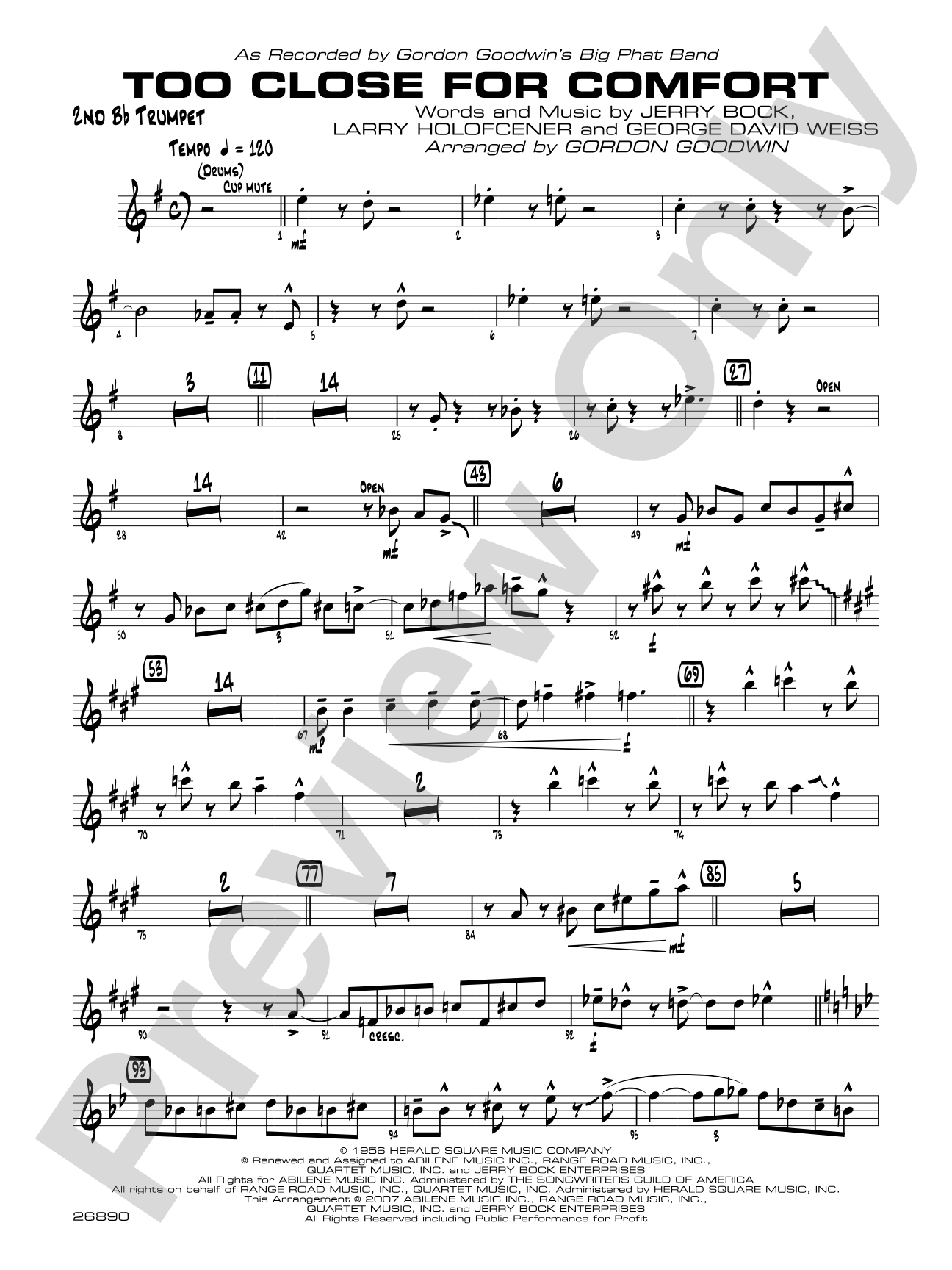

Too Close for Comfort: 2nd B-flat Trumpet
Words and music by Jerry Bock, Larry Holofcener and George David Weiss / arr. Gordon Goodwin
Grade: 5 (Advanced / Difficult)
Item: 00-PC-0017288_T2
$3.00
Pickup currently not available
Description
A Gordon Goodwin vocal chart! In addition to the vocal part, there are solo lead sheets for alto sax, tenor sax, trumpet and trombone. Gordon has conceived this chart with the vocal intertwined into the fabric of the chart. Vocal keys are F, G and A-flat with modulations. Vocal range is low E below middle C to E-flat fourth space. As recorded on The Phat Pack CD. Outstanding! This title is available in MakeMusic Cloud.


Don't just read it, hear it, play along with it, and watch your students grow with it. In MakeMusic Cloud, Too Close for Comfort: 2nd B-flat Trumpet comes alive with professional accompaniment, adjustable tempo, and built-in practice tools that turn solo practice into real progress.
Open in the Player
Jump straight in and assign it today.
Start Your Free Trial
Open this title and explore the full library in minutes.
Sample Audio
1
Audio File
--:--
0:00
0:00
Sample Video
No sample videos found.
Additional Details
Series:
Gordon Goodwin Series
Publisher:
Alfred Music
Page Count:
90
SKU:
00-PC-0017288_T2
More about this title
About the Composer: Jerry Bock
Jerry Bock (1928-2010) was an American composer whose work defined the Broadway musical sound of the 1950s and 1960s. His collaborations with lyricist Sheldon Harnick produced some of theater's most enduring scores, including Fiorello!, She Loves Me, and Fiddler on the Roof. Bock's melodic gift and sophisticated harmonic language made his songs natural vehicles for jazz interpretation and ensemble reimagining.
In the context of jazz education, Bock's Broadway compositions offer rich harmonic content and memorable melodic lines that translate beautifully into big band settings. Gordon Goodwin's arrangement of "Too Close for Comfort" demonstrates how Bock's theater music can anchor a contemporary jazz ensemble chart that balances vocal storytelling with instrumental sophistication.
Why we love this
Gordon Goodwin's treatment weaves the vocal seamlessly into the ensemble texture rather than sitting it on top, creating a collaborative sound that keeps student musicians engaged throughout. The multiple vocal keys (F, G, and A-flat) with modulations challenge singers while giving directors flexibility to suit ensemble capabilities. At Grade 5, this delivers the harmonic depth and rhythmic sophistication that advanced jazz ensembles crave without sacrificing the visceral fun of a Goodwin chart.
What to expect
Sleek and intimate despite the ensemble size. The vocal melody has warmth and interpretive room, while the horns provide modern harmonic color and rhythmic drive. There's a conversational quality to how Goodwin has written the vocal into the chart, making it feel like the singer and ensemble are in dialogue rather than performer and accompaniment.
Who it's for
Advanced jazz ensemble directors and vocalists who want to program a Broadway standard with contemporary big band sophistication. This chart works for ensembles with a capable vocalist and solid section players ready to handle Grade 5 complexity and multiple key areas.
How to get the most out of it
- Balance the vocal line against the ensemble by rehearsing sections with the vocalist singing while instrumentalists play at dynamic pianissimo. The vocal should cut through without the ensemble needing to pull back artificially.
- Spend time on the modulations between keys. Mark them clearly in parts and conduct the transitions with visible gesture changes so the ensemble anticipates the key shift rather than reacting to it.
- Use the solo lead sheets for alto sax, tenor sax, trumpet, and trombone as rehearsal tools early on. Have soloists play through their charts independently first, then layer them back into the full ensemble so everyone understands how the solos sit within the arrangement.
- Check intonation carefully in the upper register of the vocal part, especially around the E-flat in the fourth space. This sits where the voice can tire or drift, particularly on repeated performances.
How to use it
Program this as a headliner on a jazz ensemble concert where you want to showcase both vocal talent and advanced ensemble musicianship. It pairs well alongside other Gordon Goodwin charts or contemporary big band standards, giving the audience a recognizable Broadway melody filtered through modern jazz sensibility. The theatrical origin and sophisticated arranging make it a strong choice for spring concerts or festival appearances.
Skills your students will build
- Reading and executing key modulations (F to G to A-flat) with clean, centered intonation
- Balancing ensemble dynamics to support a featured vocalist
- Jazz time-feel and rhythmic precision at an advanced level
- Listening to and responding to solo instrumental lines within a full ensemble context
- Vocal range extension and control across nearly two octaves (low E to E-flat fourth space)