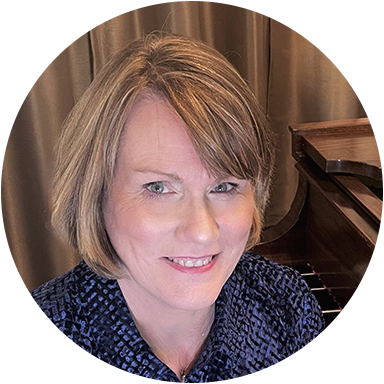
Jennifer Linn brings three decades of teaching experience and over 300 published compositions to her work as a pianist, composer, and arranger. Her career spans independent studio instruction across all age levels, university-level piano pedagogy, and extensive clinician work throughout North America and India. She earned her B.M. with distinction and M.M. in piano performance from the UMKC Conservatory of Music, where she won the Concerto-Aria competition and received the Vice Chancellor's award for academic excellence and service.
During her tenure as Manager of Educational Piano for Hal Leonard (2009-2019), Linn shaped the publisher's approach to student repertoire, creating pieces that balance musical substance with pedagogical clarity. Her work has been published by Alfred, G. Schirmer, Hal Leonard, and Music Sales America. In 2013, UMKC named her their Alumni of the Year, and in 2020 she received the Albert Nelson Marquis Lifetime Achievement Award for her contributions to music education.
Why we love this
Linn's writing here captures dramatic atmosphere without requiring technical fireworks, making it ideal for students ready to move beyond early elementary material but still building foundational skills. The title promises vivid imagery, and the piece delivers genuine character that holds listeners' attention during a student recital. You'll find the balance between engagement and accessibility that makes students actually want to practice.
What to expect
The music conjures open plains and gathering storm clouds, with rhythmic momentum that suggests inevitable motion toward something powerful. Linn uses harmonic color and textural variety to paint this landscape, creating an arc of tension and release that feels substantial in just three pages. The overall effect is atmospheric and engaging without veering into histrionics.
Who it's for
Students in the intermediate early-intermediate range who have secure hand position and basic fingering facility. The piece rewards performers who understand phrasing and can sustain musical intention across a short span. It works especially well for students seeking recital material with personality and narrative drive.
How to get the most out of it
Shape the opening melodic gesture with a slight lean into the first note, allowing the phrase to unfold naturally rather than attacking it uniformly.
Use dynamic contrast to heighten the sense of approaching drama; resist the urge to stay at one volume level throughout the middle section.
Find the underlying pulse in your body before playing, ensuring that rhythmic security translates into confident execution of any syncopation or offbeat figures.
Let silence work for you. Any moments of rest or space are opportunities to build anticipation before the next arrival.
How to use it
This works beautifully as a solo number in a student recital where you want to showcase range beyond classical or romantic standards. It pairs well alongside folk-inspired or descriptive pieces in a concert program, offering contemporary sensibility without abandoning pianistic tradition. Consider pairing it with other character pieces to demonstrate how modern composers approach storytelling at the keyboard.
Skills your students will build
Dynamic shaping and musical phrasing across a complete piece
Reading and executing rhythmic variety within a consistent harmonic language
Sustaining melodic interest while managing left-hand accompaniment patterns
Conveying character and atmosphere through informed interpretation rather than virtuosity
You May Also Like
Scan to Complete Your Purchase
Use your phone's camera to scan the code below
You'll log in on your phone and the order will be added to your account