
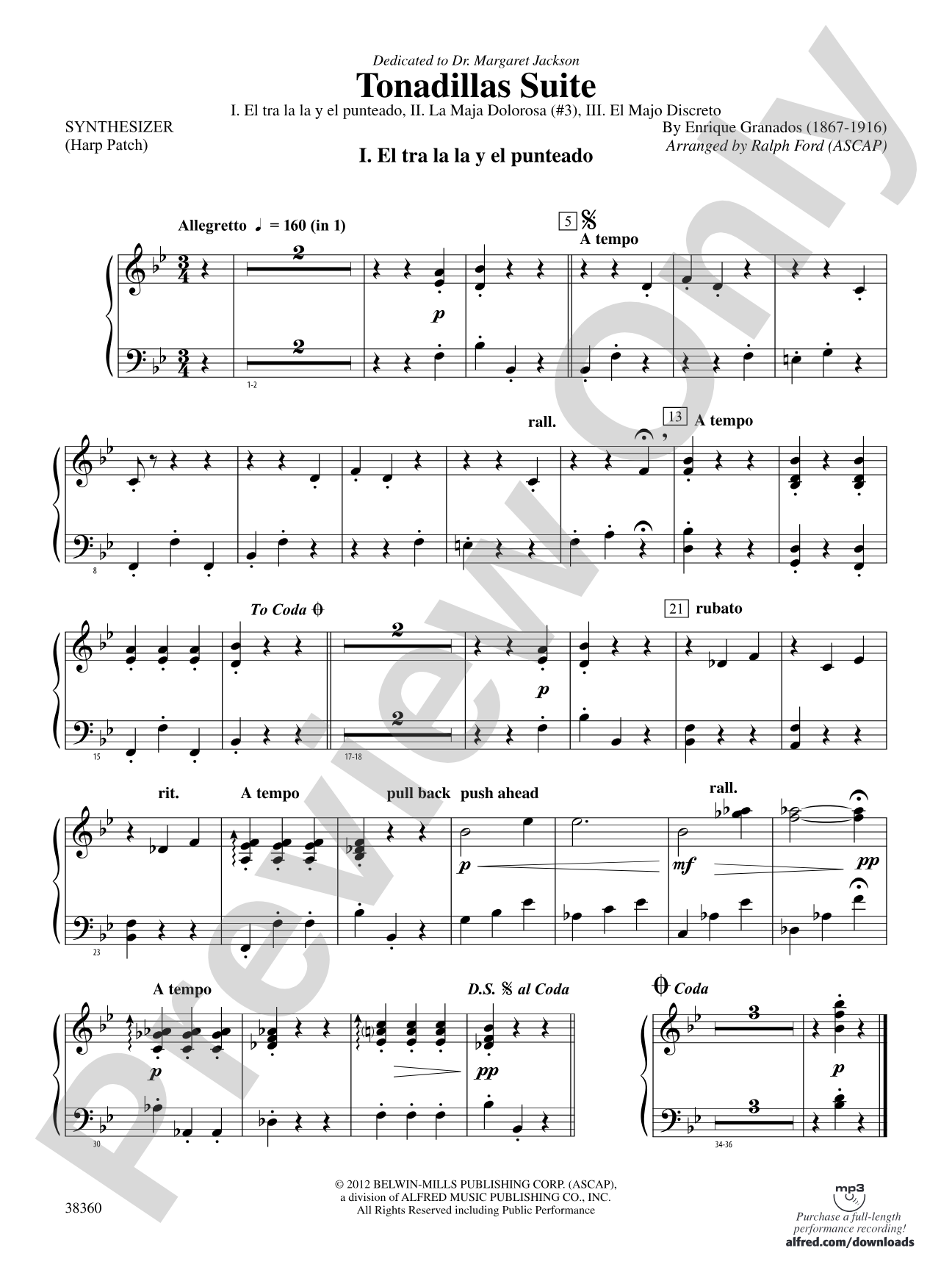

Tonadillas Suite: Synthesizer
By Enrique Granados / arr. Ralph Ford
Grade: 3.5 (Medium Easy to Medium)
Item: 00-PC-0015446_SYN
$3.00
Pickup currently not available
Description
Recognized as one of Spain's most important nationalistic composers, this contrasting collection of three of Enrique Granados' songs, originally composed for piano and voice, is transparent in nature, and an emotional contribution to the literature. Bravo! (4:30) This title is available in MakeMusic Cloud.


Don't just read it, hear it, play along with it, and watch your students grow with it. In MakeMusic Cloud, Tonadillas Suite: Synthesizer comes alive with professional accompaniment, adjustable tempo, and built-in practice tools that turn solo practice into real progress.
Open in the Player
Jump straight in and assign it today.
Start Your Free Trial
Open this title and explore the full library in minutes.
Sample Audio
1
Audio File
--:--
0:00
0:00
Sample Video
No sample videos found.
Additional Details
Series:
Belwin Concert Band
Publisher:
Alfred Music
Page Count:
236
SKU:
00-PC-0015446_SYN
More about this title
About the Composer: Enrique Granados
Enrique Granados (1867-1916) stands as one of Spain's most significant nationalist composers, deeply rooted in the musical traditions of his homeland while maintaining a refined European sensibility. His piano works, especially the celebrated Goyescas suite, earned him international recognition and established him as a bridge between Spanish folk idioms and concert hall sophistication. Though his life was cut short by tragedy during World War I, his compositions remain cornerstones of the Spanish classical music tradition and continue to inspire arrangements across multiple genres and ensembles.
Why we love this
Ralph Ford's arrangement captures the lyrical intimacy of Granados' original piano-vocal writing while opening it up for full band sonority without sacrificing transparency or emotional directness. The three tonadillas (Spanish art songs) work beautifully as a curated set, offering contrast in mood and tempo while remaining approachable at the Grade 3.5 level. Programming this suite signals sophistication and cultural breadth to your audience, and the modest performance time makes it an elegant choice for opening or closing a concert.
What to expect
These three pieces unfold with the warmth and grace of a Spanish evening, intimate yet richly colored. The modal harmonies and lyrical melodic contours evoke both folk tradition and concert hall elegance, creating an atmosphere of quiet sophistication that engages listeners who might be unfamiliar with Granados' name but recognize the beauty of authentic Spanish musical expression.
Who it's for
This arrangement suits concert bands seeking substantive repertoire that balances accessibility with artistic merit. It works equally well for skilled Grade 3 ensembles stretching upward and comfortable Grade 4 groups wanting something refined and rewarding to prepare without excessive technical demands.
How to get the most out of it
- Treat phrase shapes as vocal lines even in instrumental passages. Granados' original settings were songs, so sustained tone and gentle rubato serve the music better than mechanical precision.
- Balance the transparent orchestration carefully during ensemble passages; each wind section should blend smoothly without one color overwhelming another.
- Attend to the harmonic language, which is richer than typical Grade 3.5 concert band fare. Intonation in the inner voices becomes essential to achieving the emotional warmth Granados intended.
- Use the dynamic range available to you. The contrasts between soft, intimate moments and fuller textures are vital to the suite's emotional arc.
How to use it
The 4:30 duration and moderate difficulty make this ideal as a concert opener that establishes an artistic tone, or as a mid-program centerpiece between more energetic contemporary works. Consider pairing it with other nationalist or European masterwork arrangements to build a thematic evening, or program it on a pops concert where cultural diversity strengthens the overall impact.
Skills your students will build
- Balancing blend and balance across multiple sustained lines
- Shaping extended melodic phrases with sensitivity to harmonic rhythm
- Interpreting modal and chromatic harmony at the ensemble level
- Responding to flexible tempo and rubato in a sectional context
- Distinguishing between Spanish nationalist idioms and European classical traditions