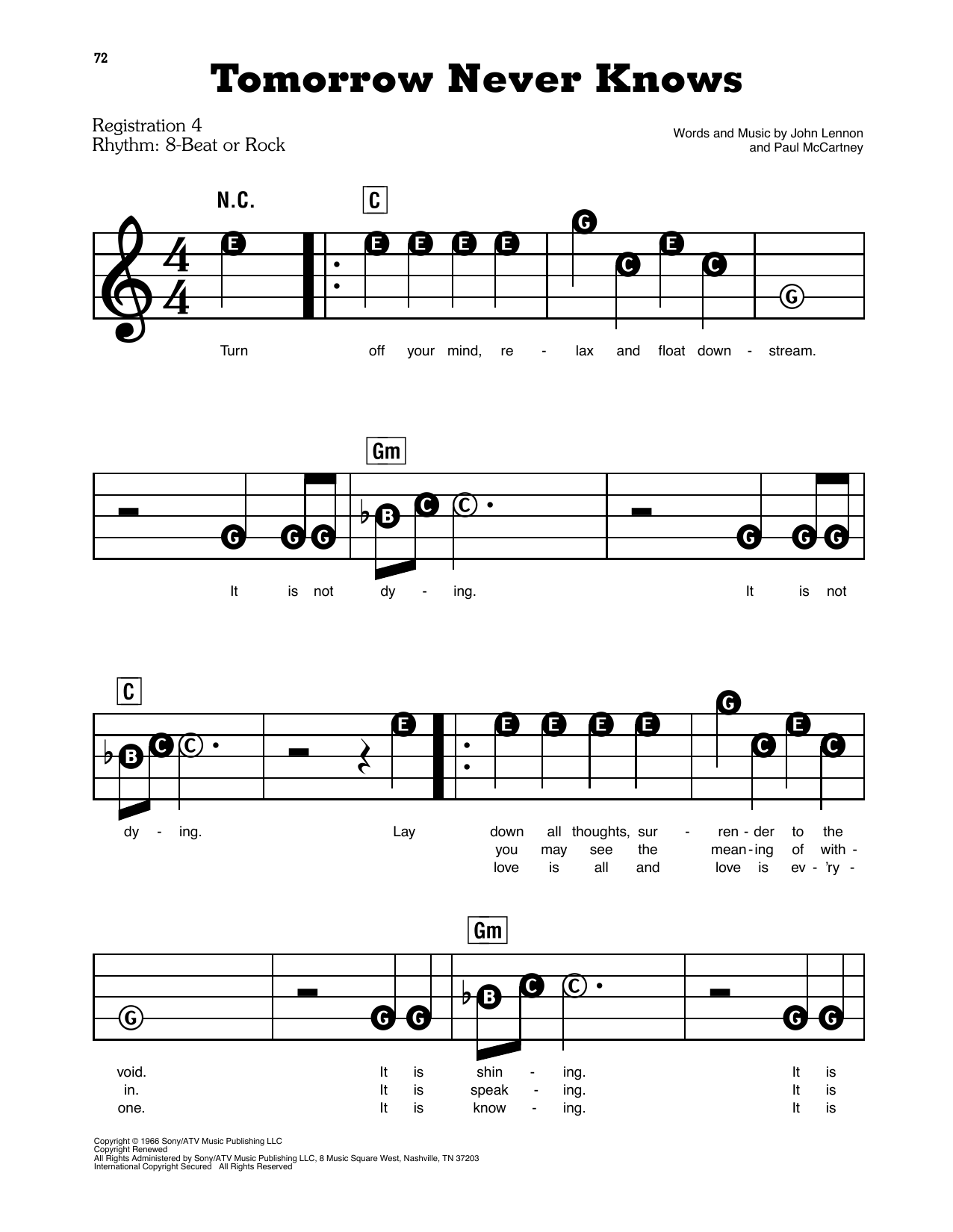
Tomorrow Never Knows: E-Z Play Today

As performed by The Beatles

Item: 35-DS01868846

Digital Download
$4.99
Description

Tomorrow Never Knows: E-Z Play Today isn't in MakeMusic Cloud just yet...but it could be. Let us know you'd like to see it, and you'll help shape what comes next. In the meantime, start a free trial and dive into thousands of interactive titles your students can play along with today.

Sample Audio
No sample audio found.
Sample Video
Additional Details
Publisher: Hal Leonard
Page Count: 2
SKU: 35-DS01868846

More about this title

About the Artist: The Beatles

The Beatles fundamentally reshaped popular music in the 1960s, moving beyond the three-chord foundation of early rock and roll to embrace sophisticated harmonic language, studio innovation, and conceptual ambition. Their work spans from straightforward pop songs to psychedelic studio experiments, making them an essential reference point for understanding how popular music can engage serious compositional and production thinking.

For music educators, The Beatles offer an accessible entry point into non-classical repertoire that still rewards close listening and technical engagement. Students encounter real harmony, song form, and the relationship between melody and accompaniment without the barrier of classical notation tradition.

Why we love this

This arrangement strips the track to its essential piano foundation, letting students access one of rock's most philosophically intriguing songs without needing a full band setup. The E-Z Play reduction makes a track famous for its studio production accessible at the keyboard, where players can focus on the harmonic movement and the song's meditative quality rather than getting lost in arrangement complexity.

What to expect

Hypnotic and introspective, the song pulls you into a contemplative space despite its pop origins. There's an unusual stillness here, achieved through repetition and harmonic color rather than momentum or virtuosity.

Who it's for

Piano students exploring rock and pop repertoire beyond classical tradition, and ensemble directors looking for a recognizable song that teaches harmonic listening without excessive technical demand. This works well for students beginning to develop interpretive choices within popular music.

How to get the most out of it

  • Pay attention to the chord changes rather than playing mechanically through the form. This song rewards harmonic awareness; the progressions are deliberate and worth hearing clearly.
  • Let the tempo breathe slightly. The original has a floating quality that rigid timekeeping can flatten.
  • Experiment with touch and dynamics to find the meditative mood rather than treating it as an upbeat pop piece.

How to use it

Use this as a bridge between classical and contemporary music exploration, or as a standalone pop selection in a mixed program. It's substantial enough for a recital without requiring orchestral backing, making it practical for solo piano concerts or school assemblies.

Skills your students will build

  • Harmonic progression recognition and voice leading
  • Interpreting rock and pop notation formats
  • Touch and tone control for non-classical idioms
  • Maintaining steady accompaniment patterns while shaping the melody

You May Also Like