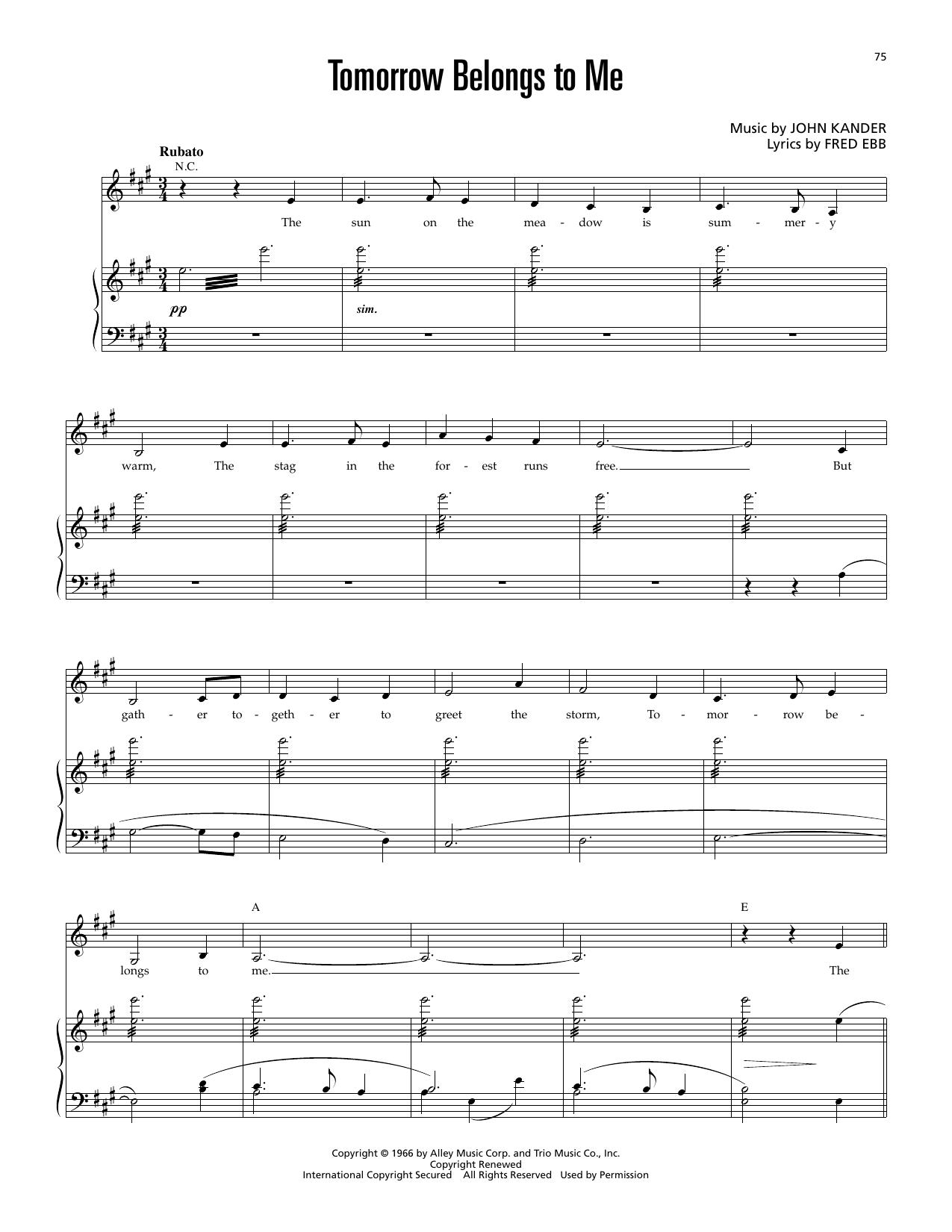
John Kander and Fred Ebb wrote the score for Cabaret, the 1966 musical that defined a generation's understanding of Weimar Germany. Kander's music ranges from bitter cabaret numbers to moments of haunting beauty, while Ebb's lyrics cut straight to the bone with wit and heartbreak. Together they created one of Broadway's most enduring works, a show that refuses sentimentality even as it breaks your heart.
Why we love this
This song sits in that uncomfortable space where melody and menace coexist, making it invaluable for singers who need to explore subtext and dramatic irony. The piano part is accessible but demands control; it won't forgive rushing or imprecision, which makes it an excellent tool for building interpretive maturity. Programming it means inviting your audience into a darker corner of musical theater that too many singers never inhabit.
What to expect
A lullaby wrapped in dread. The melody is deceptively gentle, almost naive, but it carries an undertone of propaganda and false promise. Singing this means inhabiting the perspective of someone who believes something beautiful, even as the audience knows better.
Who it's for
Singers ready to tackle material with genuine dramatic complexity; programs that include 20th century musical theater or German cabaret song; advanced high school and college vocalists who can handle the psychological weight alongside the technical demands.
How to get the most out of it
Resist the urge to make this innocent. The deceptive simplicity of the melody is part of what makes it unsettling; lean into the contrast between the pretty tune and what the character actually represents.
Lock the accompaniment to a steady, almost mechanical pulse. Any rubato or flexibility undermines the song's power and its historical weight.
Shape the vocal line with precision rather than emotion. Let the words do the disturbing work; the voice should stay controlled and clean.
Pay attention to the piano's harmonic movement underneath the melody. The accompaniment tells you where the dramatic tension lives.
How to use it
Pair it with other songs that explore the darker side of musical theater history, or use it to anchor a set list that moves from accessible Broadway into more challenging contemporary or historical material. It works as a standalone audition piece for singers who want to demonstrate range and interpretive depth, or as part of a thematic program exploring how music can obscure dangerous ideas.
Skills your students will build
Distinguishing between what a melody suggests emotionally and what the lyrics and context actually demand
Maintaining rhythmic precision in a relatively simple accompaniment pattern
Sustaining a neutral, controlled vocal quality while singing material with disturbing implications
Recognizing and responding to harmonic tension in the piano part
You May Also Like
Scan to Complete Your Purchase
Use your phone's camera to scan the code below
You'll log in on your phone and the order will be added to your account