
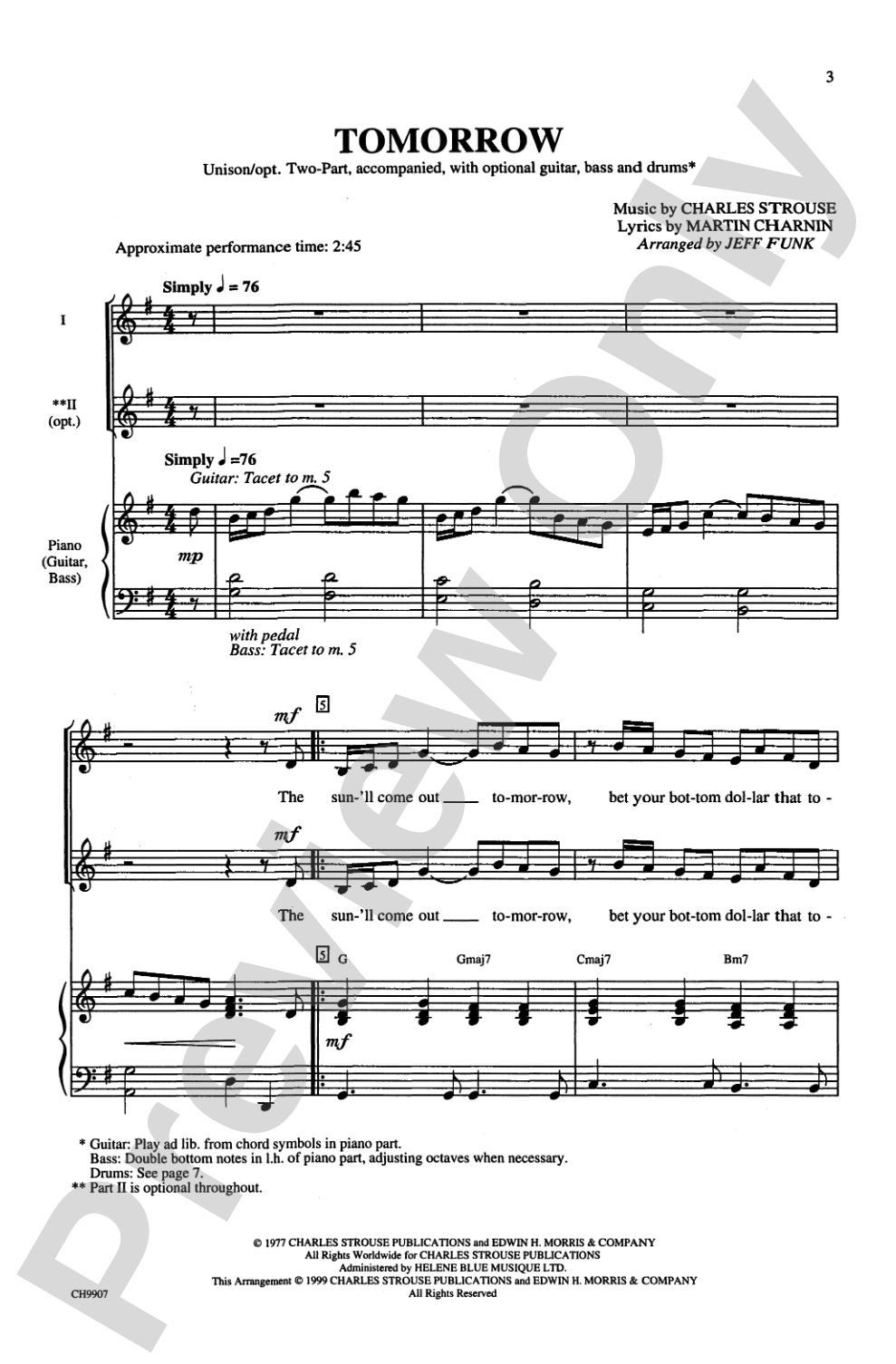

Tomorrow: 2-Part Choral Octavo
Music by Charles Strouse, lyrics by Martin Charnin / arr. Jeff Funk
Item: 00-PO-0002524
$2.25
Minimum order quantity: 20 copies
One moment…
Description
From our new Spotlight on Kids series, this classic show tune from both the Broadway and movie versions of Annie is ideal for young singers. Watch for more new releases in this outstanding new series.


Tomorrow: 2-Part Choral Octavo isn't in MakeMusic Cloud just yet...but it could be. Let us know you'd like to see it, and you'll help shape what comes next. In the meantime, start a free trial and dive into thousands of interactive titles your students can play along with today.
Request This Title
Tell us you want it.
Start Your Free Trial
Explore everything that's ready to play right now.
Sample Audio
No sample audio found.
Sample Video
No sample videos found.
Additional Details
Series:
Alfred Archive Edition: Alfred Pop Choral Series
Publisher:
Alfred Music
Page Count:
8
SKU:
00-PO-0002524
More about this title
About the Composer: Charles Strouse
Charles Strouse (1928-2022) composed some of the most enduring melodies in American musical theater, with a gift for writing songs that lodge themselves in listeners' minds for decades. His collaboration with lyricist Martin Charnin on Annie produced a score that has become a cornerstone of youth theater and school choral programs, introducing generations of young performers to sophisticated harmonies and memorable hooks.
Beyond Annie, Strouse's Broadway credits include Applause, Golden Boy, and Bye Bye Birdie, each showcasing his ability to craft music that works equally well on the concert stage and in intimate rehearsal spaces. His melodies balance accessibility with genuine musical substance, making his work especially valuable for music educators seeking repertoire that respects students' intelligence while remaining joyful and singable.
Why we love this
This arrangement captures the emotional directness that makes Tomorrow such a powerful moment in Annie, while keeping the vocal writing well within the range and ability of young singers. Jeff Funk's setting respects Strouse's original melodic gift and allows the message of hope to land without oversinging, making it a repertoire choice that works for both concert and community theater settings.
What to expect
Tomorrow carries genuine optimism without sentimentality. The melody unfolds simply and directly, inviting singers to invest in the lyrical message of hope and resilience. Even in a two-part setting, the harmonic framework feels complete and satisfying, never thin or underdone.
Who it's for
Young singers in grades 3-8 who have some choral experience and can manage two-part harmony with confidence. This arrangement works well for singers new to musical theater repertoire and those building expressive phrasing skills. The accessible range and straightforward voicing make it suitable for mixed-age youth choirs and elementary school mixed chorus programs.
How to get the most out of it
- Balance the melody between parts with care; the song's power comes from singers genuinely believing in the lyrical content, not from pushing volume. Let the recorded accompaniment do the harmonic work while singers focus on phrase shape and emotional clarity.
- Shape each phrase with a slight crescendo toward its center, then ease back as it resolves. This prevents the piece from feeling static and mirrors how the melody naturally breathes.
- Establish a warm, connected vocal tone that sits forward in the mix. The simplicity of the arrangement means every vowel sound and entrance is audible; uniform vowel shapes across the section make a dramatic difference.
- Pay attention to consonant clarity on words like 'sun' and 'day' without letting them distract from the legato line. These small articulations anchor the text without interrupting flow.
How to use it
Program this as an encore or closing piece for concerts where warmth and audience connection matter; the song's earnest hopefulness creates a memorable final impression. It pairs well with other contemporary and musical theater selections for younger singers, and works equally effectively in school assemblies, community performances, or theater-adjacent choral showcases.
Skills your students will build
- Two-part harmonic independence and blend in major key tonality
- Sustained legato phrasing over 8-bar melodic units
- Dynamic shaping that reflects emotional content of text
- Singing with clarity and conviction on simple, direct melodies
- Coordinate with recorded accompaniment and maintain steady tempo across phrase boundaries