
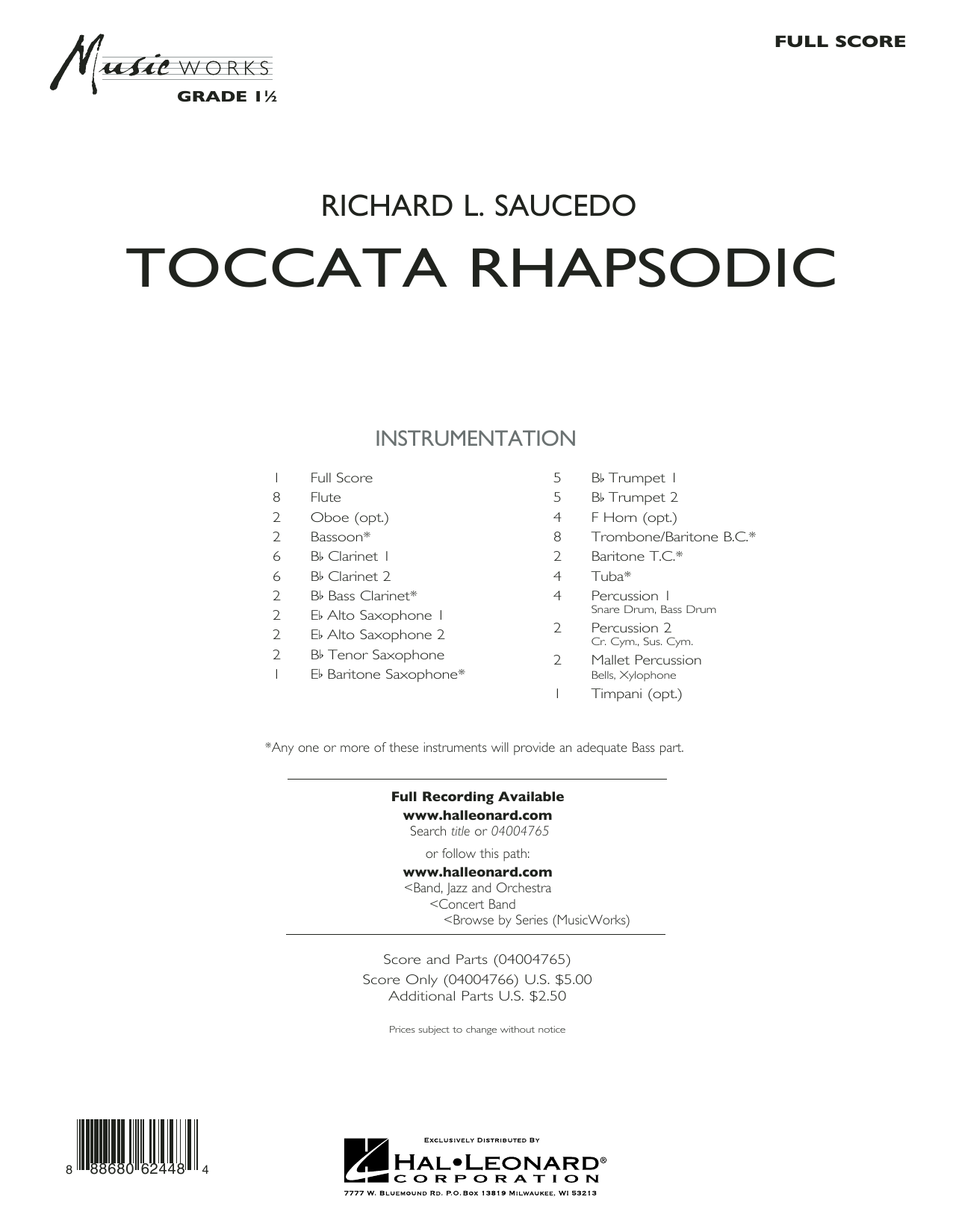

Toccata Rhapsodic: Concert Band Conductor Score & Parts
By Richard L. Saucedo
Grade: 1.5
Item: 35-PK00346380
$45.00
Pickup currently not available
Buy Extra Parts (Digital PDF Download)
Parts Added to Cart!
Description
Composed using a single moderate tempo, "Toccata Rhapsodic" is a study in articulation and phrasing for second year players. The piece cleverly combines elements of staccato at the same time other players are playing legato phrases, and encourages students to listen for the difference. This can be effective used either as a "teaching piece" or as an appealing concert number. Dur: 2:25


Toccata Rhapsodic: Concert Band Conductor Score & Parts isn't in MakeMusic Cloud just yet...but it could be. Let us know you'd like to see it, and you'll help shape what comes next. In the meantime, start a free trial and dive into thousands of interactive titles your students can play along with today.
Request This Title
Tell us you want it.
Start Your Free Trial
Explore everything that's ready to play right now.
Sample Audio
No sample audio found.
Sample Video
No sample videos found.
Additional Details
Publisher:
Hal Leonard
SKU:
35-PK00346380
More about this title
About the Composer: Richard L. Saucedo

Richard L. Saucedo spent 31 years as Director of Bands and Chairman of the Performing Arts Department at Carmel High School in Indiana, building one of the nation's most decorated band programs. His ensembles earned repeated recognition at state, regional, and national competitions across concert, jazz, and marching categories; Carmel's Wind Symphony performed at the Music for All National Concert Band Festival three times and claimed the Indiana State Championship in 2013, while the Marching Greyhounds appeared in the top ten at the Bands of America Grand National Championship for 17 consecutive years, winning national titles in 2005 and 2012.
Saucedo's contributions to music education extend well beyond his classroom. He was named Indiana's Bandmaster of the Year in 1999 and Outstanding Music Educator in 2010, and he earned induction into both the Music for All Hall of Fame and the Drum Corps International Hall of Fame. As a freelance composer and arranger, he creates works for marching bands, concert bands, choral ensembles, and orchestras. He served as Brass Arranger and Composer for the Cavaliers Drum Corps, contributing to five DCI world championships, and currently serves as music ensemble coordinator for the Blue Devils. He holds membership in the American Bandmasters Association and serves as Senior Educational Consultant for Music for All and Bands of America.
Why we love this
Saucedo targets a real rehearsal challenge with this piece: getting second year players to hear and execute the difference between staccato and legato articulation simultaneously across the band. Rather than isolating articulation into drills, he embeds it into a musical narrative that holds students' attention and rewards ensemble listening.
What to expect
Energetic and rhythmically engaging, with a flowing moderate tempo that propels the piece forward. The interplay between crisp staccato figures and sustained legato lines creates textural interest that keeps both performers and audiences engaged across its compact two and a half minutes.
Who it's for
Second year players who are ready to refine articulation and phrasing but still benefit from a moderate tempo that allows for thoughtful execution. Directors seeking a concert piece that doubles as effective pedagogy without feeling like a classroom exercise.
How to get the most out of it
- Record a sectional rehearsal focused on the legato passages alone, then another with the staccato lines. Play both recordings back to back so students hear the textural contrast clearly before attempting to balance them together.
- Mark the score where staccato voices begin and where legato voices enter, creating visual cues during the first read-through so your attention stays on conducting rather than interrupting for corrections.
- Balance the two articulation types by letting the legato phrases rise slightly in dynamic; staccato lines naturally project with their rhythmic definition, so they need less volume to cut through.
How to use it
Pair this early on your concert to establish a collaborative tone and demonstrate what your ensemble has learned about balance and articulation. The moderate length and approachable level make it ideal for a festival program where you want a confident opener before tackling more demanding repertoire.
Skills your students will build
- Distinguishing and executing contrasting articulations (staccato and legato) within the same ensemble texture
- Active listening to other sections while maintaining their own articulation precision
- Phrasing within a moderate tempo framework without relying on extreme dynamics
- Ensemble balance between complementary rhythmic and melodic lines