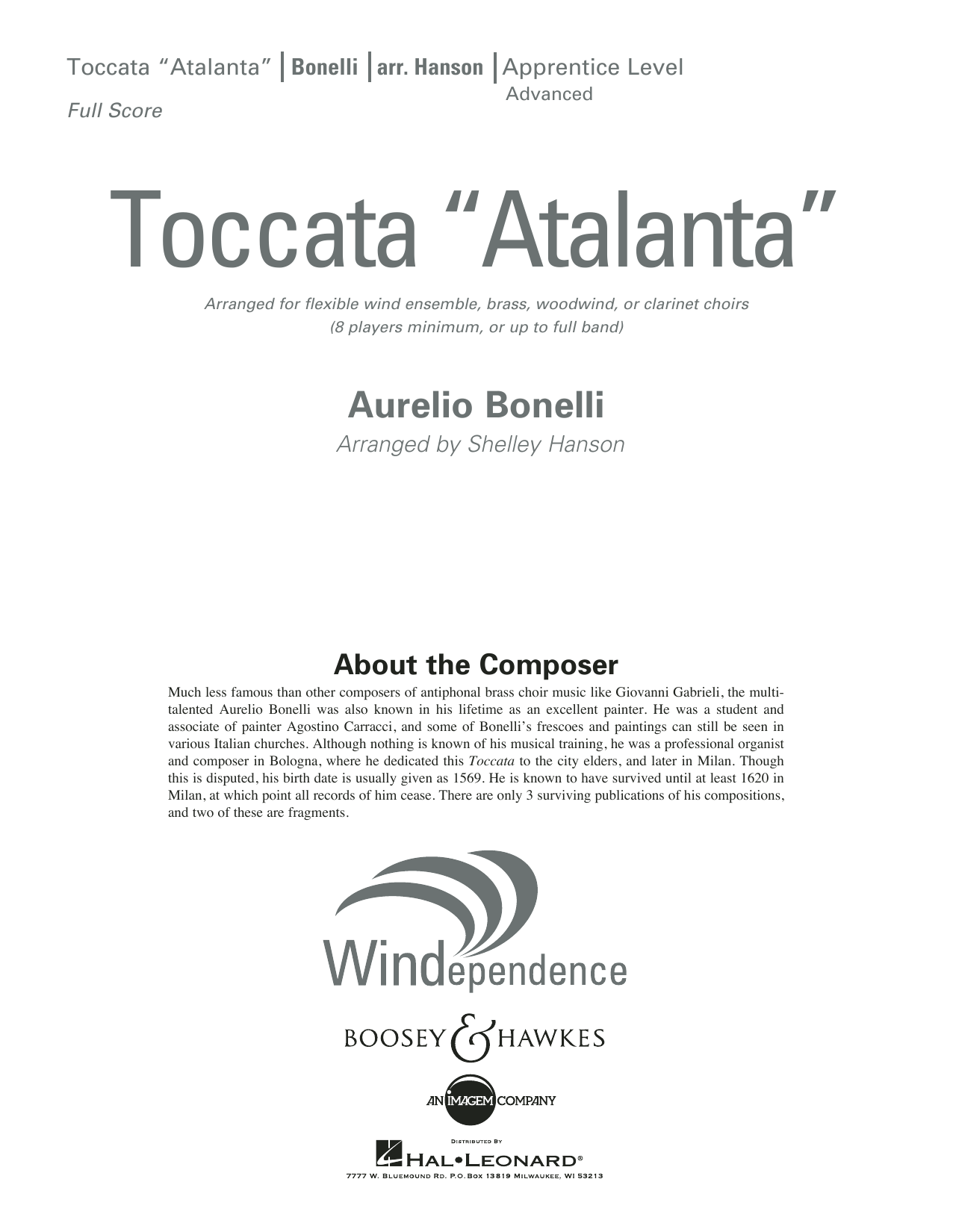
Toccata ("Atalanta"): Concert Band Conductor Score & Parts
By Aurelio Bonelli / Arranged by Shelley Hanson
Grade: 3
Item: 35-PK00391153
Digital Download
$65.00
One moment…
Description
"Woodwind and percussion players usually are unfamiliar with the antiphonal brass choir tradition. I made this modern, more easily readable version of Bonelli's classic 1600 Toccata for flexible wind ensemble with optional percussion, so that as few as 8 players up to full symphonic band could play in this style. I've used it as a dramatic concert opener, with the second, smaller group positioned behind the audience."-Shelley Hanson
Dur: 3:00
Discover MakeMusic Cloud: thousands of interactive titles your students can play along with today.
Aurelio Bonelli was an Italian composer and organist active in the early Baroque period, working primarily in the 1600s. His toccatas represent an important moment in the development of keyboard and ensemble music, blending virtuosic figuration with the antiphonal practices that defined much of the era's sacred and concert music.
Why we love this
Hanson's reconception of this 1600 toccata opens Baroque antiphonal writing to modern wind ensembles without sacrificing the style's drama or architectural logic. The flexibility of instrumentation means you can perform it with a small ensemble or build it to full band strength, making it genuinely useful across different program contexts and ensemble sizes.
What to expect
Bright and stately, with the ceremonial grandeur of Renaissance court music. The back-and-forth exchange between choirs creates architectural tension that pulls listeners into the formal beauty of the writing, each group answering the other like voices in conversation.
Who it's for
Directors who want to introduce or reinforce Baroque style in a Grade 3 band with clear pedagogical intent. It works especially well for groups with strong brass sections and enough woodwind players to balance antiphonal exchanges.
How to get the most out of it
Separate the two choirs spatially if possible. Placing one group behind the audience (as Hanson suggests) creates genuine antiphonal dialogue rather than competing sonorities from the same location.
Balance the conversation between groups carefully in rehearsal. The back choir should project clearly without overwhelming the front; ask the first group to listen actively rather than play louder.
Shape the phrase arcs within each choir's material. Baroque toccatas rely on momentum and harmonic movement, not expressive rubato, so lock into the ensemble's pulse while still breathing at natural cadential points.
Ensure your percussion reinforces rather than clutters the brass antiphony. The optional percussion works best when it punctuates the dialogue, not fills every measure.
How to use it
Open a concert with this to establish classical grounding and showcase your ensemble's ability to manage spatial effects and stylistic clarity. It pairs well with later Classical or early Romantic works since it establishes a historical anchor for the program.
Skills your students will build
Identifying and performing antiphonal brass choir writing
Responding to visual cues from a conductor managing spatially separated groups
Sustaining tone quality and balance in call-and-response textures
Understanding Baroque harmonic movement and phrase structure
Coordinating ensemble timing across distances
You May Also Like
Scan to Complete Your Purchase
Use your phone's camera to scan the code below
You'll log in on your phone and the order will be added to your account