
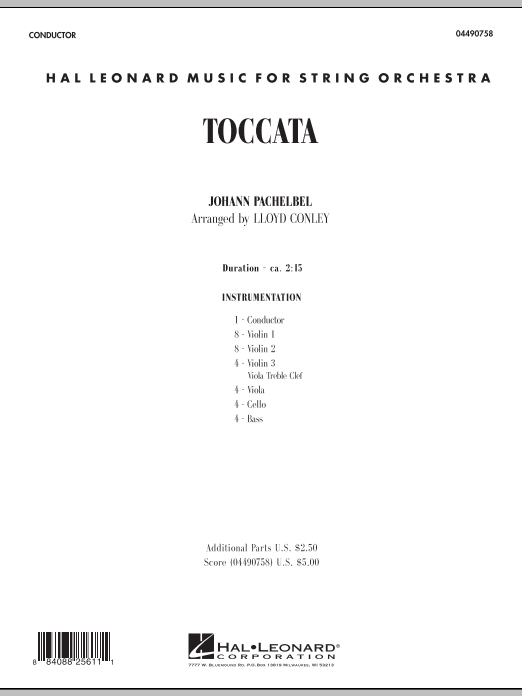

Toccata: String Orchestra Conductor Score & Parts
By Johann Pachelbel / Arranged by Lloyd Conley
Grade: 3-4
Item: 35-PK00117249
$45.00
Pickup currently not available
Buy Extra Parts (Digital PDF Download)
| Product | Price | Quantity |
|---|---|---|
| Toccata - Full Score | $6.00 | |
| Toccata - Violin 1 | $7.00 | |
| Toccata - Violin 2 | $7.00 | |
| Toccata - Violin 3 (Viola Treble Clef) | $7.00 | |
| Toccata - Viola | $7.00 | |
| Toccata - Cello | $7.00 | |
| Toccata - Bass | $7.00 |
Parts Added to Cart!
Description
Most commonly known for his famous "Canon in D," Johann Pachelbel was an organ virtuoso and composed many works, including several toccatas. This toccata has been carefully adapted for strings into the key of D, with some added dynamics, but with the original tempo variations and ornamentation preserved. An ideal teaching and performance piece from master arranger Lloyd Conley. Dur: 2:15


Toccata: String Orchestra Conductor Score & Parts isn't in MakeMusic Cloud just yet...but it could be. Let us know you'd like to see it, and you'll help shape what comes next. In the meantime, start a free trial and dive into thousands of interactive titles your students can play along with today.
Request This Title
Tell us you want it.
Start Your Free Trial
Explore everything that's ready to play right now.
Sample Audio
No sample audio found.
Sample Video
No sample videos found.
Additional Details
Publisher:
Hal Leonard
SKU:
35-PK00117249
More about this title
About the Composer: Johann Pachelbel
Johann Pachelbel (1653–1706) shaped the musical landscape of the German Baroque through his mastery of keyboard writing and his prolific output across multiple genres. While his Canon in D remains his most recognizable work, Pachelbel's true legacy lies in his sophisticated toccatas, fugues, and chorale preludes for organ, which influenced generations of composers including Bach. His keyboard works showcase virtuosic figuration, harmonic clarity, and structural elegance that translates remarkably well to string writing.
For music educators, Pachelbel offers something increasingly rare: substantial teaching repertoire with genuine musical substance. His toccatas contain genuine virtuosity without requiring extreme technical demands from players, making them ideal for developing technique while preserving musical integrity.
Why we love this
Lloyd Conley's arrangement preserves the keyboard figuration's character while letting strings sing through the ornamentation and tempo variations of Pachelbel's original work. The key of D sits beautifully for string ensembles, and the modest two-minute duration makes this accessible for mid-level orchestras without oversimplifying the musical content.
What to expect
The toccata dances with keyboard energy and sparkle, moving through ornamented passages that seem to tumble effortlessly from one figure to the next. Despite its baroque language, the piece never feels static or academic; instead, it captures the virtuosic exuberance of a master organist at work, translated into the warmth and resonance of an ensemble sound.
Who it's for
String orchestras at the Grade 3-4 level looking for baroque repertoire that demonstrates real compositional craft without excessive technical hurdles. This arrangement works equally well for concert performance or for building musicianship through structured keyboard-inspired writing.
How to get the most out of it
- Balance the ornamental passagework against the harmonic foundation; the toccata's brilliance emerges when decorative figures remain transparent rather than drowning out the underlying architecture.
- Respect Pachelbel's tempo variations as written. These shifts create structural energy and prevent the piece from settling into rhythmic predictability.
- Voice the section transitions carefully so that the handoff of musical material between first and second strings feels inevitable rather than abrupt.
- Shape phrases through bow weight and vibrato rather than relying on dynamics alone; baroque keyboard music translates best to strings when phrasing comes from articulation and tone color.
How to use it
Pair this with other baroque works or use it as an opener that establishes classical elegance before moving into heavier repertoire. The two-minute runtime makes it suitable for fill programming or as a concert interlude, and its German baroque lineage complements programming around Bach or Handel.
Skills your students will build
- Baroque articulation and ornamentation
- Transparent ensemble balance with active inner voices
- Coordinating tempo variations and structural shifts
- Translating keyboard figurations into idiomatic string writing
- Sustaining musical momentum through repeating harmonic structures