
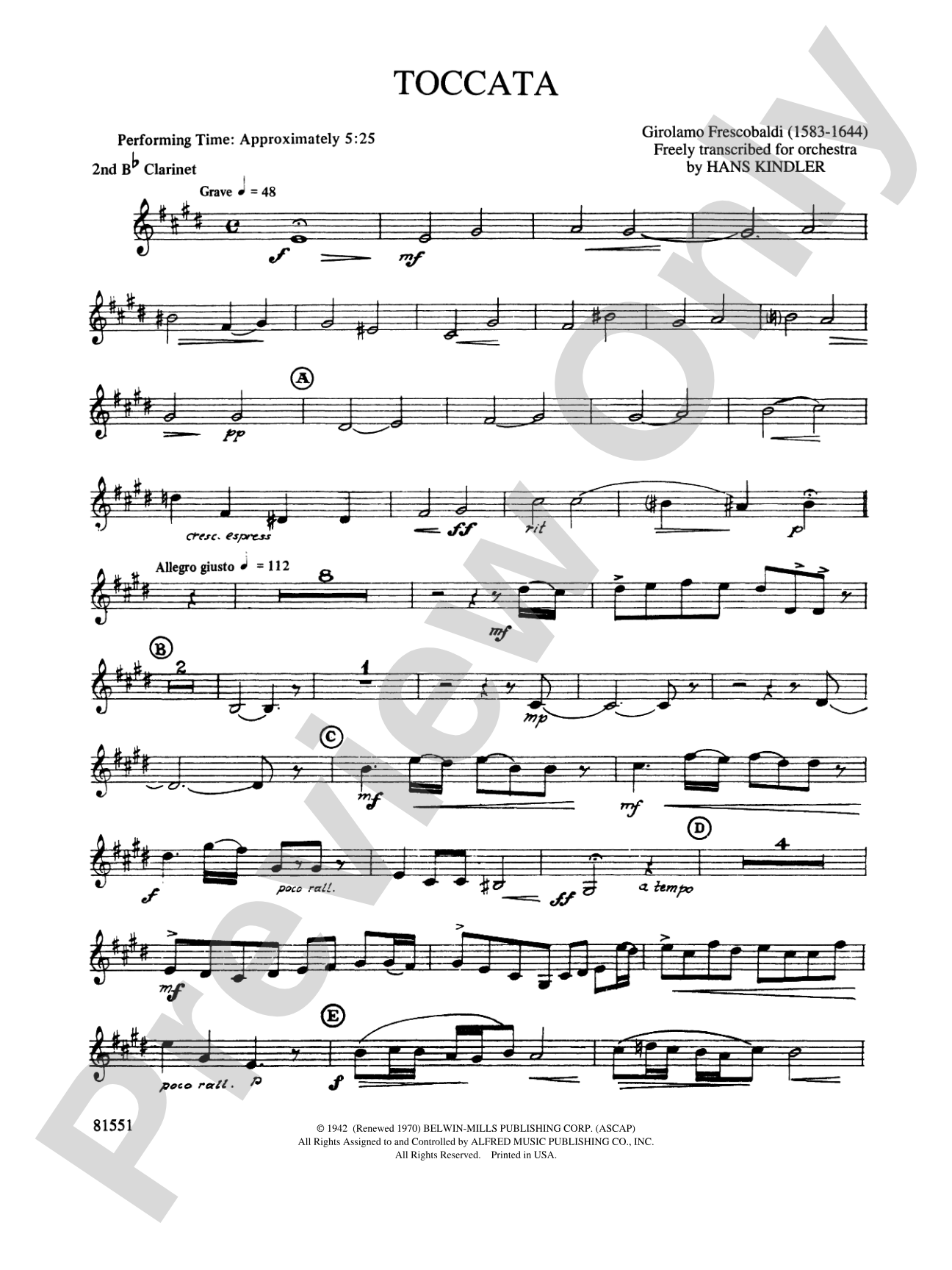

Toccata: 2nd B-flat Clarinet
By Girolamo Frescobaldi / transcr. Hans Kinder
Grade: 3.5
Item: 00-PC-0014639_C2
$3.00
Pickup currently not available
Description
Girolamo Frescobaldi composed this now famous melody in the 1600s . For 300 years, it has appeared on literally thousands of programs for solo instruments as well as almost every conceivable ensemble. Hans Kinder has transcribed the work for full orchestra and in this setting presents a bold rendition that uses broad harmonic support for the melody. (6:21) This title is available in MakeMusic Cloud.


Don't just read it, hear it, play along with it, and watch your students grow with it. In MakeMusic Cloud, Toccata: 2nd B-flat Clarinet comes alive with professional accompaniment, adjustable tempo, and built-in practice tools that turn solo practice into real progress.
Open in the Player
Jump straight in and assign it today.
Start Your Free Trial
Open this title and explore the full library in minutes.
Sample Audio
1
Audio File
--:--
0:00
0:00
Sample Video
No sample videos found.
Additional Details
Series:
Belwin Concert Full Orchestra
Publisher:
Alfred Music
Page Count:
166
SKU:
00-PC-0014639_C2
More about this title
About the Composer: Girolamo Frescobaldi
Girolamo Frescobaldi (1583-1643) stands as one of the most influential keyboard composers of the Baroque era. Working primarily in Rome and Florence, he revolutionized organ and harpsichord technique through his groundbreaking toccatas, ricercari, and variations, establishing keyboard performance as a virtuosic art form in its own right.
His Toccata in G minor became one of the most transcribed works in music history, crossing centuries and instrumental boundaries. The piece's expressive freedom, harmonic boldness, and architectural clarity made it equally at home in court performances, church services, and concert halls across Europe and beyond.
Why we love this
Kinder's orchestration captures the original keyboard work's improvisatory spirit while building something entirely new through thick harmonic textures and orchestral color. A Grade 3.5 arrangement that doesn't condescend to the score or audience, this version works beautifully on competition and concert programs where you need a substantial work that feels immediate and engaging. The 6-minute duration and full instrumentation make it a natural centerpiece without requiring advanced technical chops from every section.
What to expect
Stately and introspective, with moments of architectural grandeur. The piece unfolds with the unhurried dignity of a Baroque keyboard improvisation, letting harmonic colors bloom beneath a eloquent melodic line. There's an elegance and poise here that feels both timeless and immediate.
Who it's for
Conductors programming Grade 3-4 orchestras who want a recognized masterwork that feels fresh and substantial without overwhelming younger players. This arrangement works for ensembles that have solid fundamentals in intonation, balance, and sustained tone but may not yet handle extremely complex textures or extreme technical demands.
How to get the most out of it
- Shape the opening melody with the rubato and flexibility Frescobaldi's keyboard idiom demands; the accompaniment can breathe with the soloist rather than lock into metronomic precision.
- Balance the melodic line against the harmonic underpinnings so that Kinder's orchestration supports rather than obscures the Baroque voice. Woodwinds and strings should blend into a cohesive cushion.
- Attend to the harmonic rhythm and voice leading within each section; Baroque harmony rewards clarity and forward motion even when the melody pauses or ornaments.
- Use the score's dynamic markings as architectural signposts rather than literal instructions; allow the natural swell and recede that comes from orchestral orchestration.
How to use it
Place this as a concert opener or centerpiece where it can command full attention; its meditative quality and historical weight deserve a program slot free from competition. It pairs naturally with other Baroque arrangements or sits effectively between contemporary works as a stylistic anchor that reminds audiences where modern orchestration began.
Skills your students will build
- Baroque phrasing and ornamentation within an orchestral context
- Balancing a melodic line against harmonic support across multiple sections
- Sustained tone quality and intonation in slower harmonic movement
- Maintaining architectural structure across a longer single-movement work
- Reading a full orchestral score with period-appropriate articulation and style