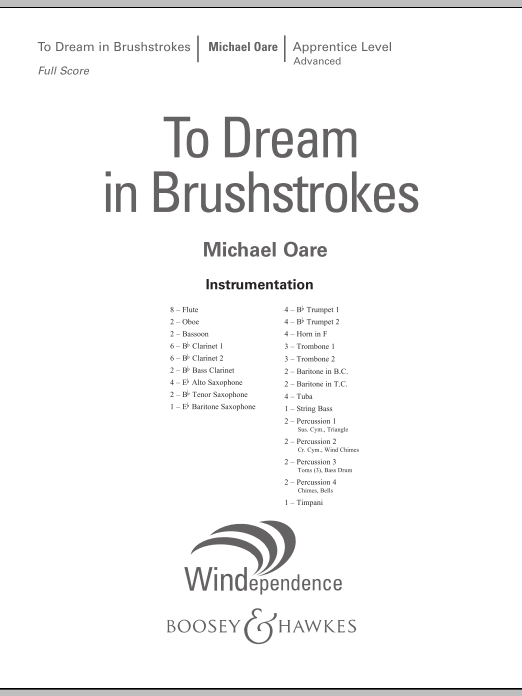
To Dream in Brushstrokes: Concert Band Conductor Score & Parts
By Michael Oare
Grade: 3
Item: 35-PK00129135
Digital Download
$65.00
One moment…
Description
Composed as a memorial, "To Dream in Brushstrokes" is a sensitive and lyrical setting for band filled with emotion as well as beauty. Contrasting colors and textures contribute to the overall effectiveness of this work for young bands. Dur: 4:30
Discover MakeMusic Cloud: thousands of interactive titles your students can play along with today.
Michael Oare studied composition and music education at Old Dominion University and has spent his career as both a skilled educator and prolific composer. For 33 years, he directed bands at Great Bridge Middle School in Chesapeake, Virginia, where his ensembles earned superior ratings at virtually every Virginia Concert Band Performance Assessment, including 30 consecutive years of top marks. His work has been recognized in GIA Publications' "Teaching Music Through Performance" series, and he received the 2016 Chesapeake Public Schools Middle School Teacher of the Year award along with two Citations of Excellence from the National Band Association.
Beyond the classroom, Oare has adjudicated festivals across his region, conducts the Bay Youth Orchestras of Virginia Concert Band, and performs with the Virginia Wind Symphony. He is an active member of ASCAP, Phi Beta Mu, and state and national music education organizations. His compositions for young bands balance technical accessibility with genuine artistic depth, a philosophy shaped by decades of direct experience with student musicians.
Why we love this
Oare writes with remarkable restraint and clarity at the Grade 3 level. Rather than relying on bombast or technical display, he builds emotional impact through deliberate orchestration choices and melodic purity, letting young musicians discover that serious musical expression doesn't require advanced technique. The contrasting colors and textures keep the piece engaging for both rehearsal and performance without becoming unwieldy for developing ensembles.
What to expect
The piece unfolds with quiet dignity and warmth. Lyrical melodies drift across the band while tasteful orchestration creates shifting colors, much like brushstrokes building a subtle image. There is introspection here and genuine feeling, but never sentimentality; instead, the music invites contemplation and care.
Who it's for
Grade 3 concert bands looking for repertoire that honors artistic integrity without overwhelming developing musicians. This work suits directors who want their students to explore nuanced interpretation and emotional communication early in their musical training.
How to get the most out of it
Balance the lyrical passages by asking your woodwinds to sing with legit vibrato in the sustained sections; this elevates the emotional resonance without requiring faster passagework.
Shape the dynamic arc across the full 4:30. Identify the piece's emotional peak and plan your rehearsal strategy around building toward that moment rather than treating it as several disconnected sections.
Pay attention to how the textural contrasts land. When the orchestration shifts between full band and smaller groupings, let those moments breathe so listeners absorb the change in color.
Trust the material. This is a memorial work, and the composition reflects that intent. Your phrasing choices and attention to expression will matter more than any technical facility.
How to use it
Program this as a centerpiece for a concert focused on serious, character-driven works at the Grade 3 level. The 4:30 duration and reflective nature make it an excellent choice to open the second half of a concert, allowing the audience to settle into a more introspective mood before continuing with livelier selections.
Skills your students will build
Phrase shaping in lyrical melodic lines
Listening to orchestrational balance across different instrumental combinations
Interpreting dynamic and expressive markings as storytelling tools
Sustaining focused attention through longer, slower-moving works
Responding to contrasts in musical texture and color
You May Also Like
Scan to Complete Your Purchase
Use your phone's camera to scan the code below
You'll log in on your phone and the order will be added to your account