To Conquer the Skies: 2nd Percussion Sheet Music Preview

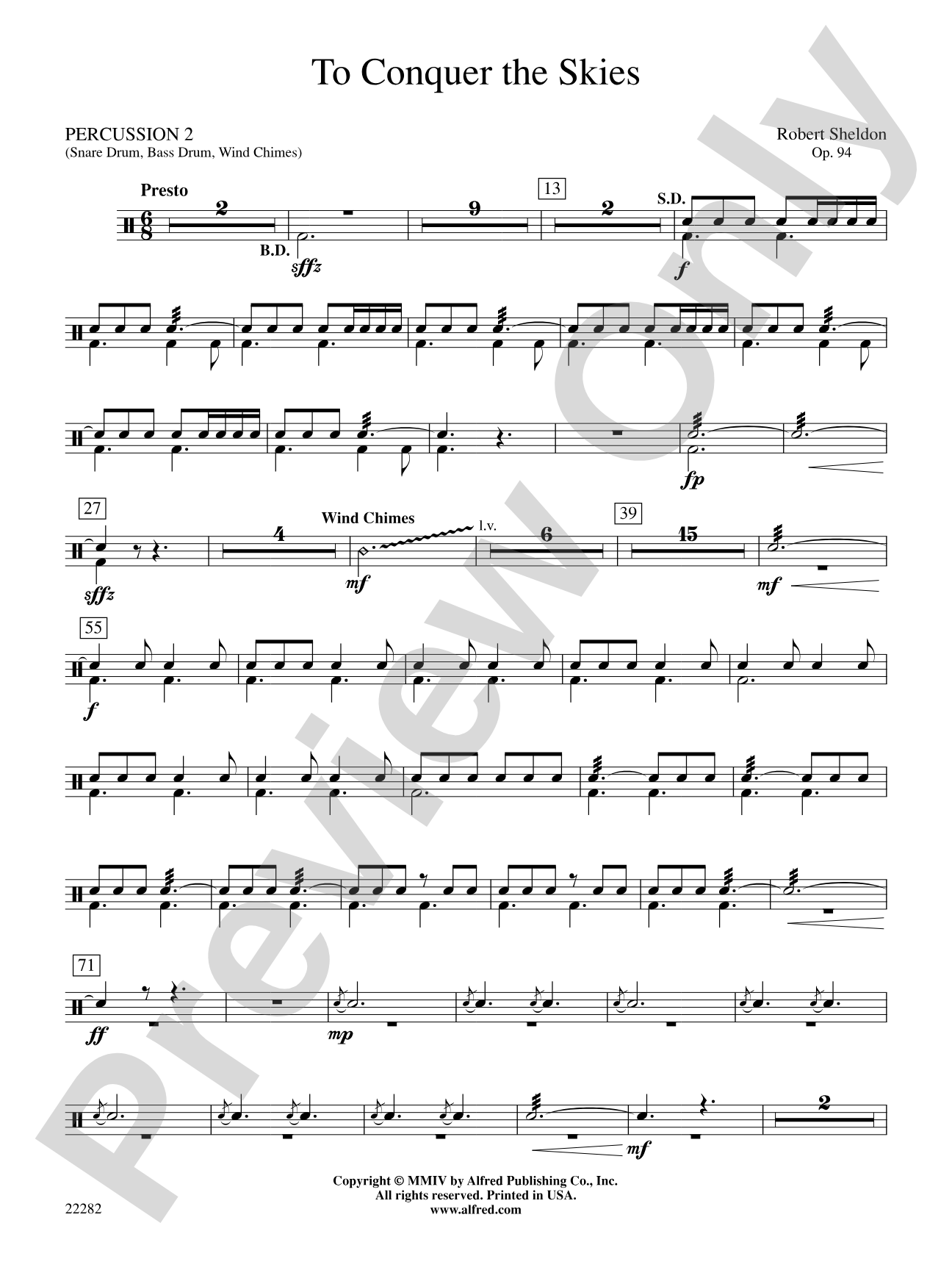
To Conquer the Skies: 2nd Percussion

Music by Robert Sheldon

Grade: 4 (Medium Difficult)

Item: 00-PC-0000536_PC2

Digital Download
$3.00
Description
To Conquer the Skies was written to honor the intellectual creativity of Orville and Wilbur Wright, and is a timely tribute to the 100th anniversary of their twelve-second flight at Kitty Hawk. Images of flight are conjured through the composer's creative use of rhythm and tempo. Robert Sheldon's trademark scoring and beautiful melodies make this an excellent choice for your more advanced concert band. This title is available in MakeMusic Cloud.

Don't just read it, hear it, play along with it, and watch your students grow with it. In MakeMusic Cloud, To Conquer the Skies: 2nd Percussion comes alive with professional accompaniment, adjustable tempo, and built-in practice tools that turn solo practice into real progress.

Sample Audio
0:00
0:00
Sample Video
Additional Details
Series: Alfred Concert Band
Publisher: Alfred Music
Page Count: 4
SKU: 00-PC-0000536_PC2

More about this title

About the Composer: Robert Sheldon

Robert Sheldon

Robert Sheldon's compositions appear on contest lists and concert programs across the globe, performed by ensembles at every level. His work has earned recognition from the American School Band Directors Association, Phi Beta Mu, and ASCAP, and his music reaches audiences in venues ranging from Carnegie Hall to the Sydney Opera House. He is the lead author of Sound Innovations for Concert Band and maintains an active schedule as a guest conductor for All-State and Regional Honor Bands.

Sheldon regularly commissions new works and produces substantial publications for concert band annually. He has conducted and taught in the United States, Japan, Canada, Italy, Germany, Australia, and China, bringing his expertise to college and university clinics as well as state music education conferences. VanderCook College of Music awarded him an honorary doctorate in 2020.

Why we love this

Sheldon crafts inventive rhythmic textures and lyrical writing that elevate Grade 4 material without sacrificing playability. The piece merges thematic substance with accessible orchestration, allowing strong intermediate ensembles to access genuine musical expression while maintaining the technical clarity that makes contest performances successful.

What to expect

Restless energy and upward trajectories define this work. Rhythmic drive propels the ensemble forward while carefully crafted melodic arcs evoke the wonder and audacity of human flight, creating a soundscape that feels both grounded and weightless.

Who it's for

Advanced Grade 4 concert bands with solid fundamentals and the ability to balance rhythmic precision with expressive phrasing. This work suits ensembles preparing for festival performance or seeking contest material with musical substance beyond technical display.

How to get the most out of it

  • Articulate the rhythmic figures crisply to emphasize the forward momentum that suggests flight; clarity in the section work strengthens the kinetic energy Sheldon builds.
  • Balance the melodic voices against the harmonic accompaniment so the soaring themes cut through without overshadowing the texture's layered construction.
  • Pay close attention to tempo transitions; these shifts in momentum directly parallel the compositional images of flight and should feel intentional rather than abrupt.
  • Encourage woodwind and brass sections to listen across the ensemble for ensemble blend, since Sheldon's voicing often places primary material in unexpected registers.

How to use it

Program this as a substantial centerpiece for a concert celebrating American achievement or engineering innovation. Its four-page length and Festival/Contest designation make it equally suited to festival competition or a concert program where you want to feature your ensemble's technical growth and musical maturity.

Skills your students will build

  • Rhythmic independence and precision in complex meters and syncopated passages
  • Melodic balance across varied instrumental groupings
  • Ensemble blend and sectional listening in Sheldon's layered textures
  • Expressive control through dynamic shaping and tempo flexibility
  • Reading and executing articulation markings that define the piece's character

You May Also Like