
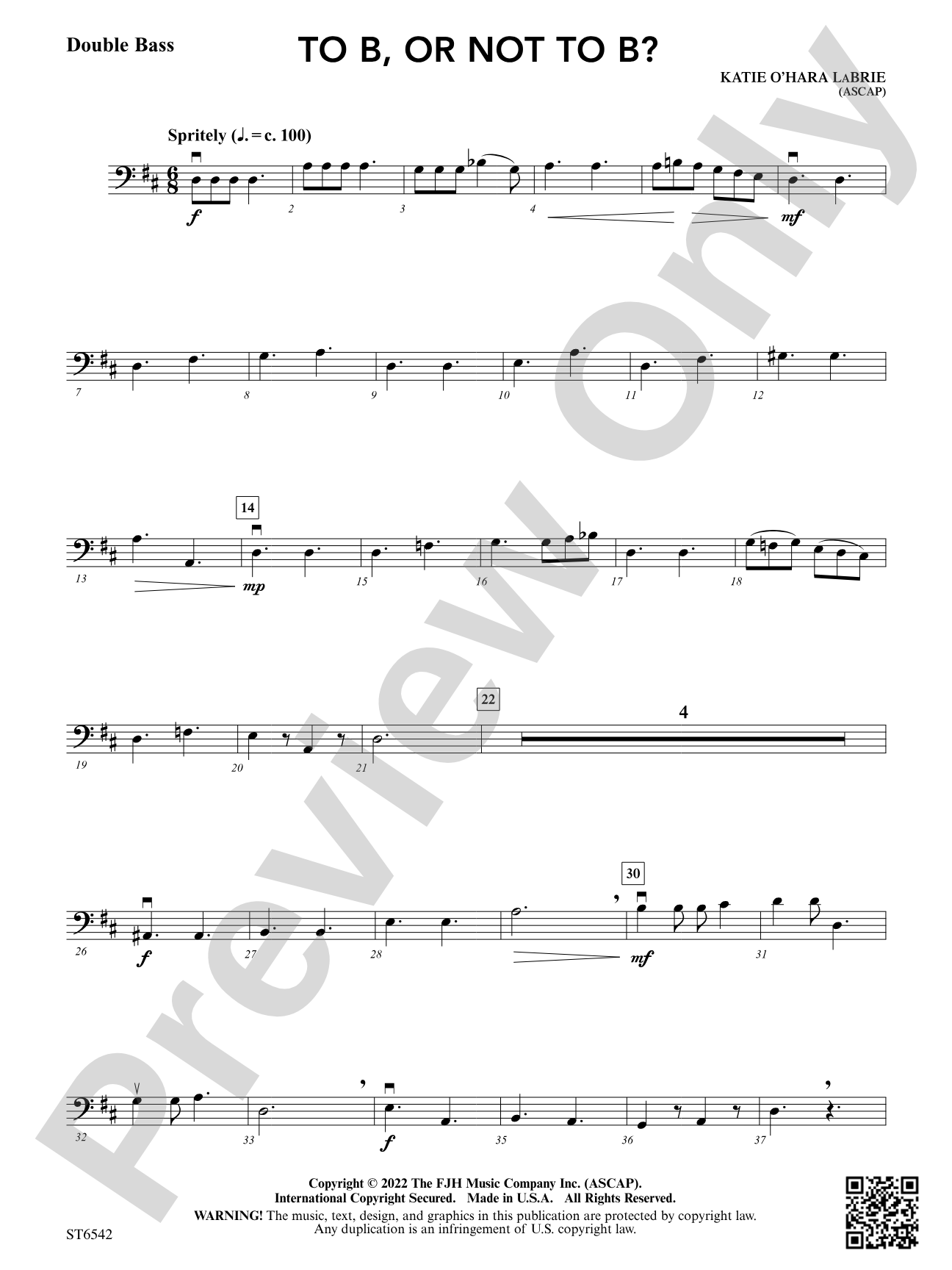

To B, or Not to B?: Double Bass
By Katie O'Hara LaBrie
Grade: 2.5
Item: 98-PC-DST6542_SB
$7.00
Pickup currently not available
Description
Major or minor? Natural or harmonic? B? or B?? These are the questions posed in this jaunty 6/8 tune that explores contrasting D Major and D minor modalities. In addition to its musical value, use this work to teach advanced finger patterns that will provide students with a solid understanding of the fingerboard and accidentals. A lively and spirited work that is sure to keep your students and audience engaged and entertained.


Don't just read it, hear it, play along with it, and watch your students grow with it. In MakeMusic Cloud, To B, or Not to B?: Double Bass comes alive with professional accompaniment, adjustable tempo, and built-in practice tools that turn solo practice into real progress.
Open in the Player
Jump straight in and assign it today.
Start Your Free Trial
Open this title and explore the full library in minutes.
Sample Audio
1
Audio File
--:--
0:00
0:00
Sample Video
Additional Details
Series:
FJH Developing Strings
Publisher:
The FJH Music Company, Inc.
SKU:
98-PC-DST6542_SB
More about this title
About the Composer: Katie O'Hara LaBrie

Katie O'Hara LaBrie is a composer, conductor, and cellist based in Northern Virginia whose work is shaped by her deep roots in music education. After spending 15 years teaching orchestra in Fairfax County schools, she brought those classroom experiences directly into her compositional voice. She holds a Bachelor of Music in Music Education from St. Olaf College and a Master of Music in Instrumental Conducting from George Mason University, where she studied with Anthony Maiello.
LaBrie's compositions consistently balance educational purpose with genuine musical substance and performer enjoyment. Her work has earned multiple J.W. Pepper Editor's Choice selections and performances at the Midwest Band and Orchestra Directors Clinic and American String Teachers Association Conference. In 2022, Yamaha recognized her as one of their "40 Under 40" honorees for her impact on music education. She founded the Fairfax Chamber Players and co-created "the Big IDEA" practice method.
Why we love this
The premise alone deserves a laugh at the first rehearsal: a playful exploration of B natural and B flat wrapped in an engaging 6/8 tune that never sacrifices musicality for novelty. LaBrie uses the contrasting D Major and D minor tonalities as a genuine teaching tool, giving students repeated exposure to these accidentals in context rather than drilling them in isolation. Your ensemble will finish this work with both sharper fingerboard awareness and the memory of having had fun doing it.
What to expect
Charming and spirited, with a conversational tone that makes the musical questions feel playful rather than academic. The bright 6/8 rhythmic energy carries the listener through the D Major sections, while the shifts to D minor add subtle depth and keep the ear engaged. It's the kind of work that makes students grin when they finally execute a passage cleanly, and audiences leave the concert smiling.
Who it's for
String orchestras at the upper elementary and middle school level who are ready to tackle fingering challenges with real musical payoff. This work suits ensembles preparing for festivals or concert performances where a memorable, lighter piece balances more serious repertoire. It works equally well for groups seeking to deepen their understanding of modal relationships and accidental reading without relying on repetitive technical exercises.
How to get the most out of it
- Isolate the modulations between D Major and D minor in sectional rehearsals; have students sing the passages aloud to internalize the color shift and lock the intonation before adding technical complexity.
- Mark the accidentals in pencil before the first read-through so students focus on the musical line rather than hunting for sharps and flats mid-phrase.
- Emphasize the rhythmic drive of the 6/8 meter; this piece thrives on forward motion and buoyancy, so keep the pulse consistent across tempo variations.
- Use the key shifts as musical landmarks during rehearsal: "When we modulate to D minor here, the character brightens despite the darker key—bring out that contrast."
How to use it
Place this work as a mid-concert piece to lighten the emotional arc and showcase your ensemble's improving technical facility. Its contest/festival credentials make it a natural choice for festival programs, where the combination of musicality and pedagogical honesty appeals to adjudicators. The novelty element also pairs well with a thematic program exploring compositional techniques or different approaches to familiar harmonic concepts.
Skills your students will build
- Reading and executing B natural and B flat in the context of D Major and D minor keys
- Understanding modal contrast and modal relationships through performance
- Navigating extended fingerboard patterns with accuracy and musical awareness
- Maintaining rhythmic precision and ensemble cohesion in 6/8 meter
- Executing key modulations with clarity and intentional tonal control