
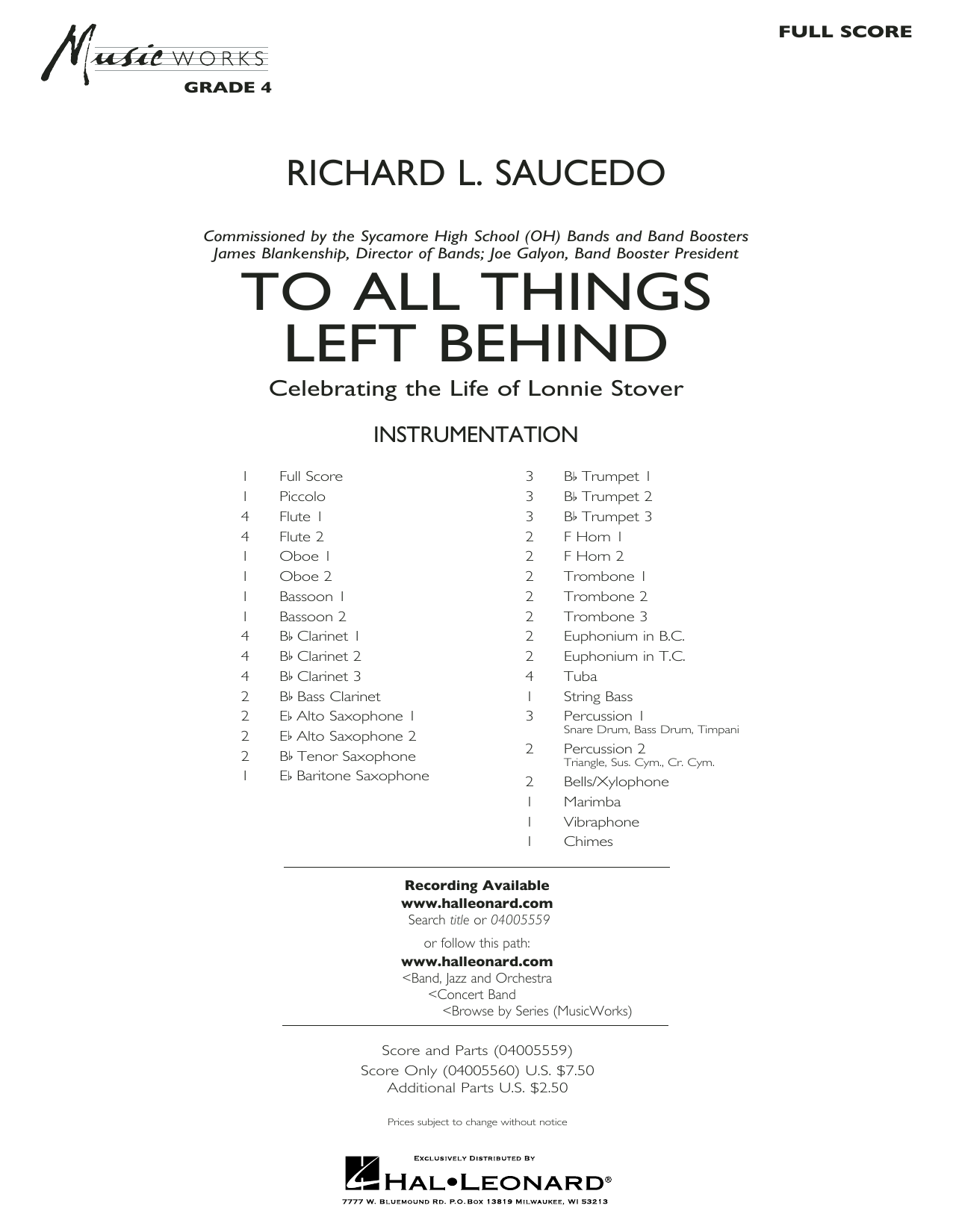

To All Things Left Behind: Concert Band Conductor Score & Parts
Grade: 4
Item: 35-PK00419094
$75.00
Pickup currently not available
Buy Extra Parts (Digital PDF Download)
Parts Added to Cart!
Description
This poignant and lyrical work by Richard Saucedo utilizes sections of transparent beauty, with only a few instruments playing, contrasted with sections of dramatic emotional performed by the entire ensemble. Featuring long phrases and sustained intensity, this is a challenging yet rewarding work for mature bands. Dur: 6:00


To All Things Left Behind: Concert Band Conductor Score & Parts isn't in MakeMusic Cloud just yet...but it could be. Let us know you'd like to see it, and you'll help shape what comes next. In the meantime, start a free trial and dive into thousands of interactive titles your students can play along with today.
Request This Title
Tell us you want it.
Start Your Free Trial
Explore everything that's ready to play right now.
Sample Audio
No sample audio found.
Sample Video
No sample videos found.
Additional Details
Publisher:
Hal Leonard
SKU:
35-PK00419094
More about this title
About the Creator: Richard Saucedo
Richard Saucedo brings a composer's ear for orchestration and a conductor's understanding of ensemble capability to his concert band works. His music balances technical sophistication with accessibility, creating pieces that challenge musicians while remaining performable by groups at realistic levels.
Why we love this
Saucedo's approach to dynamic contrast feels earned rather than imposed. The transparent passages demand genuine musical maturity from your ensemble, and when the full band enters after those delicate moments, the emotional weight lands with real impact. It's the kind of piece that reminds musicians why they joined band in the first place.
What to expect
The piece unfolds like a conversation with memory: intimate and reflective in its sparse moments, then swelling with poignancy as the full ensemble joins. There's contemplative beauty in the transparent sections and genuine emotional resonance when the band comes together, creating a musical journey that feels both introspective and ultimately cathartic.
Who it's for
Bands at the Grade 4 level with the musical maturity to sustain long lines and the ensemble cohesion to balance detailed texture work. This is ideal for groups that have moved beyond learning fundamentals and are ready to explore lyrical depth and interpretive nuance.
How to get the most out of it
- Shape the solo and chamber passages with vocal phrasing; resist the impulse to fill silence. Let the sustained lines breathe across their full length.
- Balance the dramatic sections by thinking orchestrally rather than volumetrically. Dynamics in depth (moving certain voices forward or back) create power without blunt loudness.
- Mark the transitions between sparse and full textures in rehearsal so players understand their role in building emotional architecture, whether they're contributing one line or part of the ensemble fabric.
- Work sectionally on the sustained intensity passages to ensure ensemble locks without mechanical precision; the music needs to float, not march.
How to use it
Consider placing this as the centerpiece of a thematic concert exploring reflection or loss. Its six minute duration makes it a substantial standalone work that can anchor a program, and its emotional depth pairs well with lighter opener or a contrasting upbeat closer. It's equally effective as a spring concert feature that gives your ensemble space to demonstrate musical sophistication.
Skills your students will build
- Sustaining long lyrical lines with consistent support and intonation
- Balancing transparent textures with precise ensemble listening
- Transitioning smoothly between sparse and full ensemble sections
- Shaping phrases dynamically without relying on tempo variation
- Reading and interpreting nuanced dynamic markings for musical effect