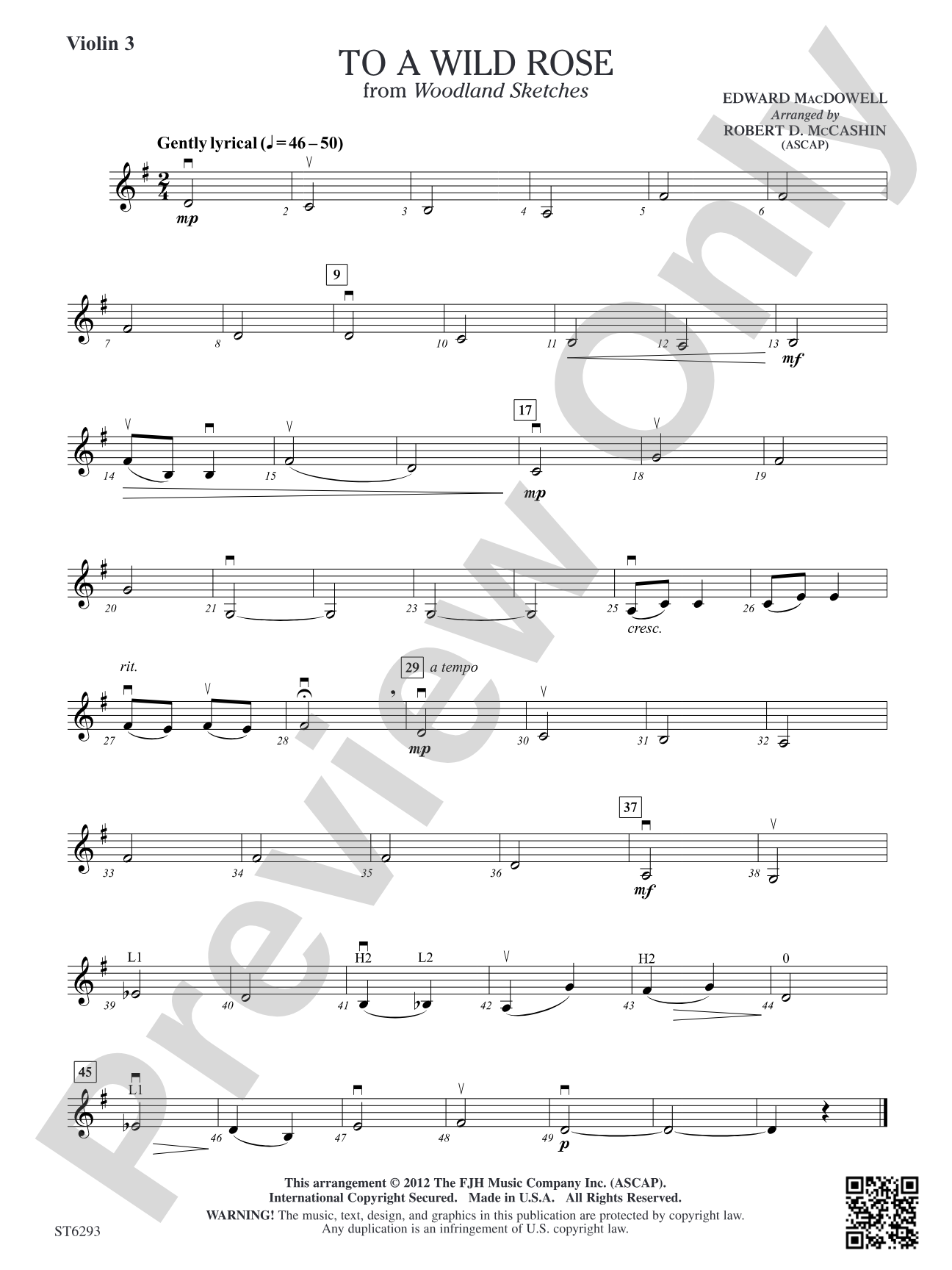
To A Wild Rose: Violin 3 (Viola T.C.) Sheet Music Preview

To A Wild Rose: Violin 3 (Viola T.C.)

Arranged by Robert D. McCashin

Grade: 1.5

Item: 98-PC-DST6293_VN3

Digital Download
$7.00
Description
Based on a simple diatonic melody, this delightful arrangement includes MacDowell's interesting and slightly chromatic twists. It offers beautiful content for the development of bow control, tone and intonation. Entrancing music that will be recognized and enjoyed by audiences everywhere.

To A Wild Rose: Violin 3 (Viola T.C.) isn't in MakeMusic Cloud just yet...but it could be. Let us know you'd like to see it, and you'll help shape what comes next. In the meantime, start a free trial and dive into thousands of interactive titles your students can play along with today.

Sample Audio
0:00
0:00
Sample Video
Additional Details
Series: FJH Beginning Strings
Publisher: The FJH Music Company, Inc.
SKU: 98-PC-DST6293_VN3

More about this title

About the Arranger: Robert D. McCashin

Robert D. McCashin

Robert D. McCashin brings four decades of string conducting and teaching to his work as a composer and arranger. A Doctor of Musical Arts in conducting from the University of Arizona and a violinist trained at Louisiana State University, McCashin directed orchestras at James Madison University for over two decades and has published nearly 80 educational works spanning Grades 1 through 5. His arrangements are recognized consistently as bestsellers and Editors' Choice selections in school music programs.

Beyond the university classroom, McCashin performed as a freelance violinist throughout North Texas, worked with regional orchestras including the Fort Worth Symphony and Wichita Falls Symphony, and founded the Arlington Youth Symphony. He co-authored the widely adopted string method series New Directions for Strings and A Scale in Time, bringing his deep understanding of student development into every pedagogical decision.

Why we love this

McCashin's treatment respects MacDowell's original lyric simplicity while strategically introducing the chromatic color and harmonic interest that make the piece rewarding to teach at this level. Students hear a recognizable masterwork that audiences genuinely love, yet the arrangement itself teaches bow control, tone production, and intonation without feeling like an etude. At Grade 1.5, this strikes the rare balance of being both musically substantial and genuinely playable.

What to expect

Gentle and introspective, yet alive with subtle harmonic color. MacDowell's melodic gift shines through immediately, but the chromatic touches add sophistication that invites students to listen more closely and play with greater intention. It feels like a song worth singing.

Who it's for

Beginning to early intermediate string orchestras that are ready for a work with genuine musical substance. This arrangement works equally well for school orchestras preparing a concert or chamber ensemble piece, and for festival/contest programming where judges expect polished musicianship on literature they recognize.

How to get the most out of it

  • Shape each phrase with a singing, legato bow stroke. The melody's simplicity demands that every note speak with warmth and direction, especially during sustained passages where intonation vulnerability surfaces.
  • Attend closely to MacDowell's chromatic moments. These small harmonic twists feel delicate and can easily sound uncertain without precise intonation and rhythmic clarity from the supporting voices.
  • Balance the texture so the melody remains the primary focus. With a Grade 1.5 ensemble, second violins and lower strings will naturally want to dominate; encourage them to sit dynamically back and support the song rather than compete with it.

How to use it

Program this as a concert centerpiece that audiences will recognize and appreciate, anchoring a program of contrasting pieces. It also works beautifully as a festival selection where recognizable literature and demonstrated musicianship matter equally, or as a mid-year repertoire choice after students have built foundational ensemble and intonation skills.

Skills your students will build

  • Legato bow control and sustained tone production
  • Intonation accuracy in chromatic passages
  • Phrase shaping and musical direction
  • Balance and texture awareness within ensemble
  • Recognizing and responding to harmonic movement

You May Also Like