
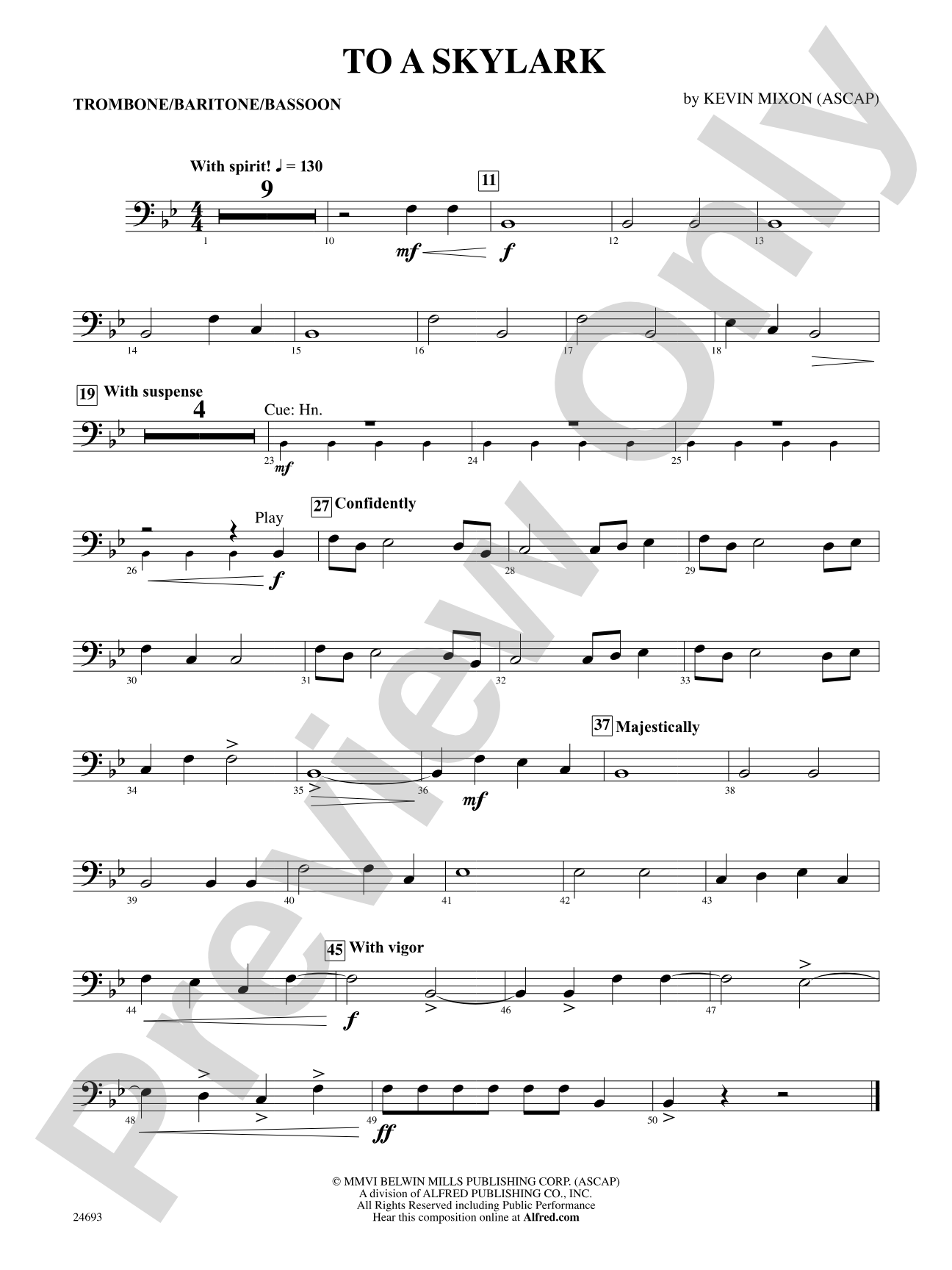

To a Skylark: 1st Trombone
By Kevin Mixon
Grade: 0.5 (Very Easy)
Item: 00-PC-0000855_TN1
$3.00
Pickup currently not available
Description
This rousing tune is filled with non-stop energy . . . and uses the only first five notes introduced in most method books (concert B-flat, C, D, E-flat, and F). Inspired by Shelley's famous poem of the same name, this energetic piece presents several opportunities for cross-curricular teaching. To a Skylark, is quality band music that beginning students will love!


Don't just read it, hear it, play along with it, and watch your students grow with it. In MakeMusic Cloud, To a Skylark: 1st Trombone comes alive with professional accompaniment, adjustable tempo, and built-in practice tools that turn solo practice into real progress.
Open in the Player
Jump straight in and assign it today.
Start Your Free Trial
Open this title and explore the full library in minutes.
Sample Audio
1
Audio File
--:--
0:00
0:00
Sample Video
No sample videos found.
Additional Details
Series:
Belwin Very Beginning Band
Publisher:
Alfred Music
Page Count:
142
SKU:
00-PC-0000855_TN1
More about this title
About the Composer: Kevin Mixon

Kevin Mixon directs instrumental music at Blodgett K-8 School in Syracuse City Schools, New York, where he has built a career focused on making music education accessible to all learners. His work has earned recognition at major conferences including the International Society for Music Education Convention, the Midwest International Band and Orchestra Clinic, and numerous state and regional gatherings, where he presents on topics ranging from urban education and special learners to multicultural music and percussion pedagogy.
Mixon holds degrees summa cum laude from Onondaga Community College, Syracuse University, and the University of Illinois (Urbana-Champaign), and has pursued advanced studies in Educational Leadership. His scholarship appears regularly in Music Educators Journal, Teaching Music, The Instrumentalist, and The National Band Association Journal. He authored Reaching and Teaching All Instrumental Music Students and co-authored Teaching Music in the Urban Classroom (MENC/Rowman & Littlefield Publications). As a published composer and arranger, Mixon writes music that reflects his deep understanding of what beginning students can achieve.
Why we love this
Mixon's restraint with note selection makes this piece feel liberated rather than limited. By sticking to the five notes every method book introduces first, he proves that genuine musicality and infectious energy don't require a larger palette. The Shelley connection opens doors for language arts collaboration, and your students will feel the momentum from start to finish without wrestling with technical barriers.
What to expect
Bright and buoyant, with an almost playful insistence on upward motion. The piece captures the restless, climbing energy of Shelley's skylark without sentimentality, landing instead in celebratory territory. Students feel accomplished the moment the opening phrase lands.
Who it's for
This is ideal for bands in their first year of study or for mixed-ability ensembles where newer players sit alongside experienced ones. It works equally well as early repertoire for a full beginner band or as a confidence builder alongside method book material in a heterogeneous section.
How to get the most out of it
- Maintain steady eighth-note momentum throughout; resist the urge to let energy sag between phrases.
- Use the conductor's score to balance the fuller passages so that all five note values remain clear even when textures thicken.
- Emphasize precision in attacks and releases, especially with beginning players; crisp articulation makes the energy feel intentional rather than chaotic.
- Connect the piece to Shelley's poem before rehearsal so students understand the soaring character they're creating, which often improves phrasing choices instinctively.
How to use it
Program this as an early concert piece for a beginning band festival or spring concert, pairing it with one or two other grade 0.5 selections to build confidence before tackling slightly harder material. It also works as a curriculum bridge in September or October, showing students that method book notes can become real music immediately.
Skills your students will build
- Reading and sustaining the five foundational pitches (concert B-flat, C, D, E-flat, F) in a musical context
- Playing with rhythmic consistency across simple note values
- Responding to conductor cues and maintaining ensemble synchronization
- Understanding programmatic music and text-to-music connections