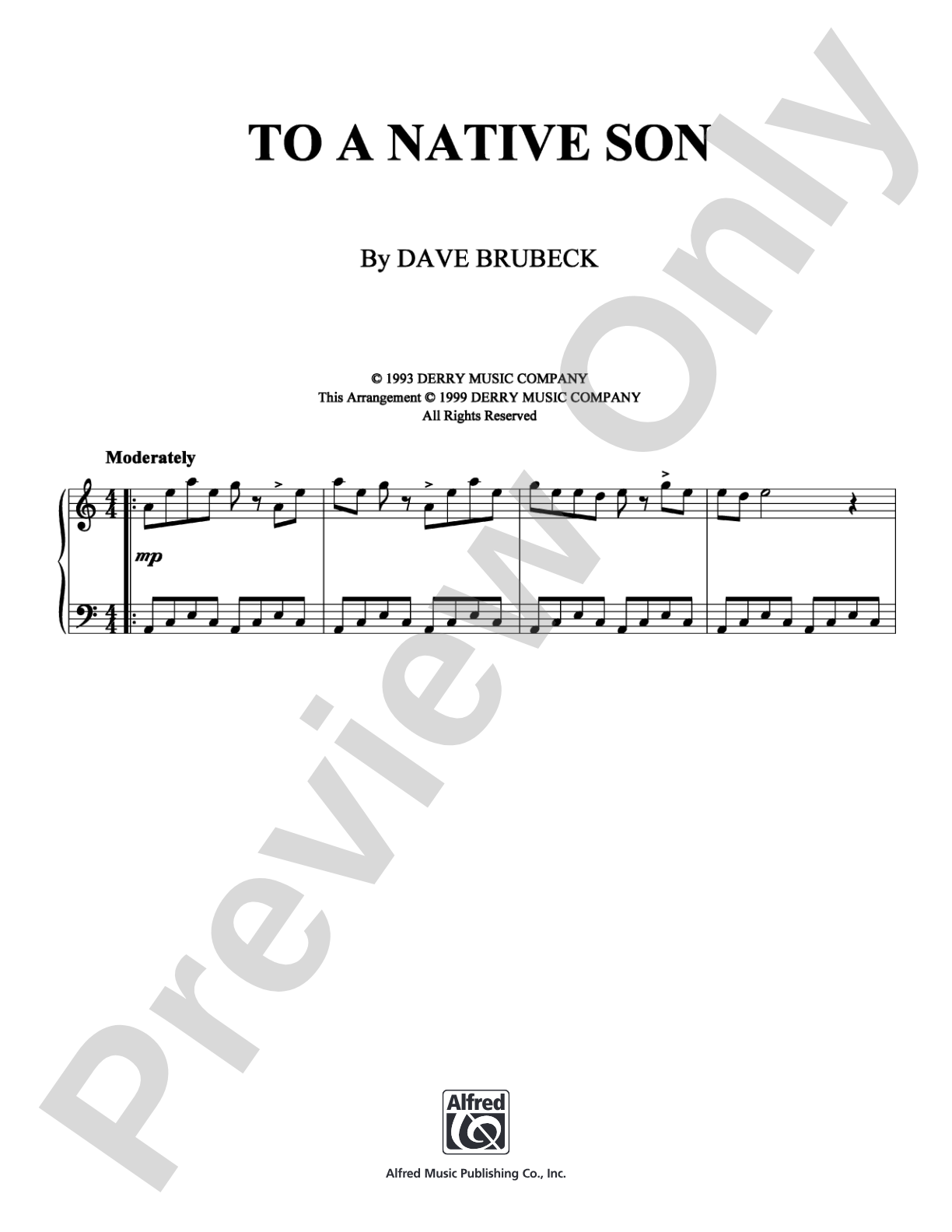
To A Native Son: Piano Digital Sheet Music

To A Native Son: Piano Digital Sheet Music

Dave Brubeck

Item: 00-PS-0008177

Digital Download
$3.99
Description

To A Native Son: Piano Digital Sheet Music isn't in MakeMusic Cloud just yet...but it could be. Let us know you'd like to see it, and you'll help shape what comes next. In the meantime, start a free trial and dive into thousands of interactive titles your students can play along with today.

Sample Audio
No sample audio found.
Sample Video
Additional Details
SKU: 00-PS-0008177

More about this title

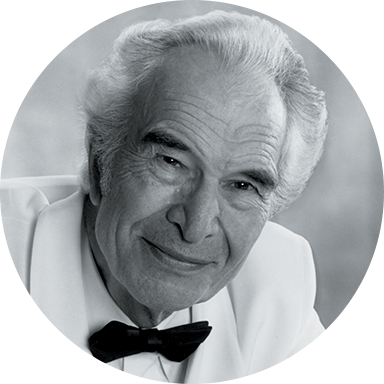
About the Artist: Dave Brubeck

Dave Brubeck

Dave Brubeck was a pianist whose voice bridged jazz improvisation and classical composition. Beyond his instrumental mastery, he wrote across an expansive range of forms: choral works, hymns, orchestral pieces, chamber music, ballets, and large-scale works for chorus and orchestra. His album Time Out became the first jazz recording to sell over a million copies, and "Take Five" remains iconic. Brubeck studied with Darius Milhaud at Mills College after World War II, and Milhaud's influence encouraged him to synthesize jazz language with classical structure throughout his compositional life.

Brubeck's impact extended far beyond the concert hall. He was a catalyzing figure in breaking racial barriers in mid-20th-century music and performance. His sacred works, including the mass To Hope! and the oratorios The Voice of the Holy Spirit and Beloved Son, have been performed and recorded internationally by ensembles ranging from cathedral choirs to the London Symphony Orchestra. He received the Presidential Medal of the Arts from President Clinton, a Grammy Lifetime Achievement Award, and was elected to the American Classical Music Hall of Fame in 2003.

Why we love this

Brubeck's piano compositions occupy a rare space: they demand jazz sensibility and improvisational fluency while remaining fully notated and accessible to serious students. This piece showcases his gift for writing music that sounds spontaneous and deeply personal, drawing pianists toward authentic interpretation rather than mechanical execution. Programming a work by a composer of Brubeck's stature and historical significance brings artistic credibility to a recital while honoring his legacy as both performer and composer.

What to expect

The work carries the warmth and humanity that mark Brubeck's best compositions. Its emotional directness is rooted in jazz vocabulary and the Blues, yet the construction is clear and classical in sensibility. Playing it feels both intimate and purposeful, as if the pianist is sharing something personal and fully considered.

Who it's for

This piece serves advanced students and professional pianists seeking substantial solo repertoire grounded in American jazz history. It also appeals to pianists looking to expand beyond European classical traditions into composed works that synthesize multiple musical languages.

How to get the most out of it

  • Honor the compositional specificity even as you personalize phrasing. Brubeck's notated works are not templates for improvisation; they are finished pieces that repay close attention to detail.
  • Listen closely to recordings of Brubeck's own playing to absorb his approach to touch, rubato, and harmonic color. His recorded interpretations offer insight into how he imagined these works being realized.
  • Shape phrases with the vocal quality that defines Brubeck's melodic writing. Think of the piano line as song, not decoration.

How to use it

Feature this in a recital exploring American composers or as a centerpiece for a program devoted to jazz-inflected concert music. It pairs naturally alongside other mid-20th-century American piano works that bridge vernacular and classical traditions.

Skills your students will build

  • Jazz harmonic language and reharmonization at the piano
  • Interpreting notated jazz with authentic inflection and phrasing
  • Understanding swing rhythm and syncopation in a composed context
  • Building pianistic fluency across Blues-based chord changes
  • Balance between written precision and interpretive liberty in jazz composition

You May Also Like