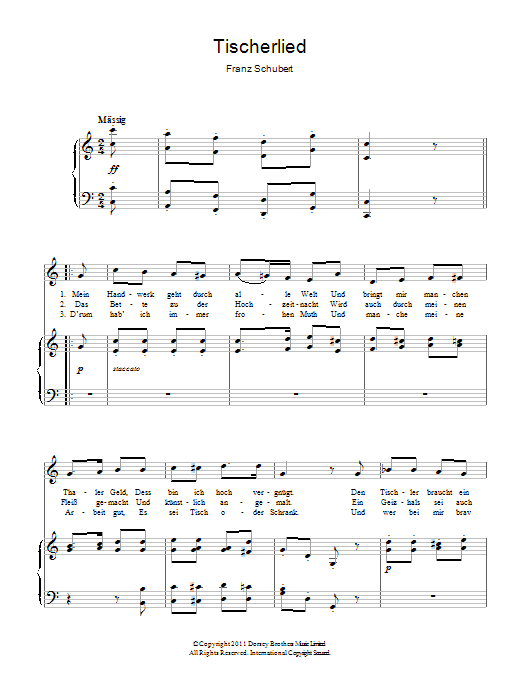
Tischlerlied Sheet Music Preview

Tischlerlied: Piano Vocal

As performed by Franz Schubert

Item: 35-DS00205517

Digital Download
$5.99
Description

Tischlerlied: Piano Vocal isn't in MakeMusic Cloud just yet...but it could be. Let us know you'd like to see it, and you'll help shape what comes next. In the meantime, start a free trial and dive into thousands of interactive titles your students can play along with today.

Sample Audio
No sample audio found.
Sample Video
Additional Details
Publisher: Hal Leonard
Page Count: 2
SKU: 35-DS00205517

More about this title

About the Artist: Franz Schubert

Franz Schubert (1797–1828) composed over 600 songs during his brief life, fundamentally reshaping what the art song could express. His gift for melody and harmonic subtlety allowed him to set poetry to music with unprecedented intimacy, creating works that demand nothing more than voice and piano yet contain entire emotional worlds. His influence on vocal music education remains absolute; his songs remain central to any serious study of the genre.

Why we love this

Schubert's songs reward singers who commit to text clarity and emotional directness. This intimate two-page work fits perfectly into recital programs, studio voice lessons, or art song units where you want repertoire that sounds deceptively simple but reveals its depth only through careful listening and honest interpretation.

What to expect

Intimate and conversational, with the quality of someone sharing a personal reflection rather than delivering a formal statement. The music unfolds naturally across just two pages, asking both performer and listener to lean in and pay close attention.

Who it's for

Intermediate to advanced pianists and singers studying art song literature, whether in applied lessons or ensemble settings. This work suits singers developing facility with German diction and pianists building their collaborative repertoire.

How to get the most out of it

  • Shape the melody through its natural phrase contours rather than forcing dramatic gestures; Schubert's writing often accomplishes more through restraint than climax.
  • Coordinate carefully with the pianist on tempo and rubato, especially if the accompaniment contains rhythmic independence that supports rather than doubles the vocal line.
  • Pay attention to Schubert's text painting in both the vocal melody and piano part; small harmonic or rhythmic choices often illuminate specific words or images in the poem.

How to use it

Include this in a recital program exploring Schubert's smaller works or in a thematic concert built around text and character. It also works well in studio classes or art song seminars where you want accessible yet substantive repertoire that demonstrates Schubert's compositional range.

Skills your students will build

  • German diction and lyrical text delivery
  • Nuanced dynamic control and phrasing in intimate context
  • Piano-vocal coordination and collaborative musicianship
  • Understanding harmonic language and its relationship to text setting

You May Also Like