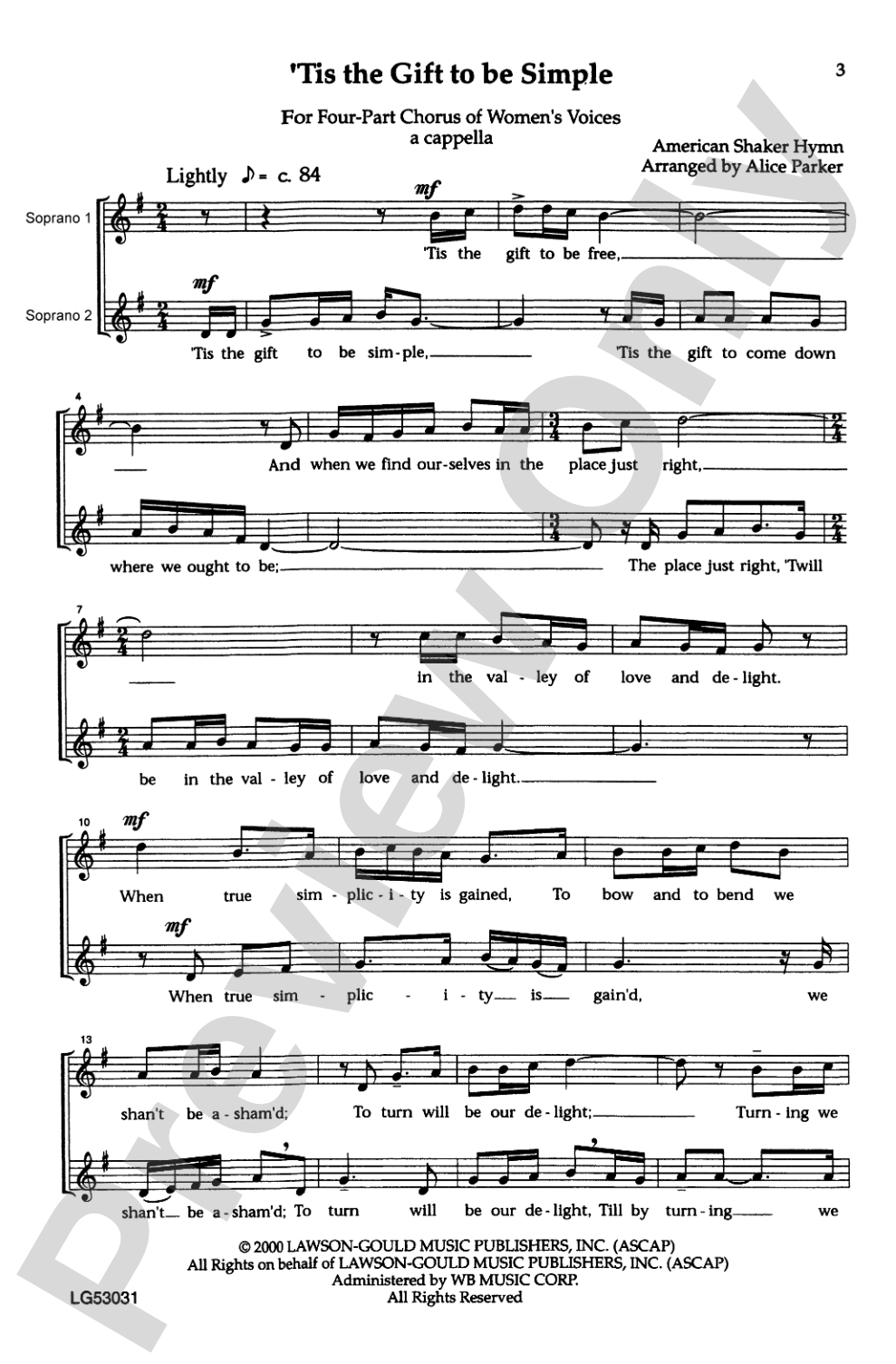
'Tis the Gift to Be Simple Sheet Music Preview

'Tis the Gift to Be Simple: SSAA, a cappella Choral Octavo

American Shaker Hymn, arr. Alice Parker

Item: 00-PO-0002684

Digital Download
$2.25

Minimum order quantity: 20 copies

Description
Alice Parker combines her incredible arranging skill together with her knowledge and understanding of American hymnody to bring us this wonderful setting of the ever-popular Shaker tune.

'Tis the Gift to Be Simple: SSAA, a cappella Choral Octavo isn't in MakeMusic Cloud just yet...but it could be. Let us know you'd like to see it, and you'll help shape what comes next. In the meantime, start a free trial and dive into thousands of interactive titles your students can play along with today.

Sample Audio
No sample audio found.
Sample Video
Additional Details
Series: Alfred Archive Edition: Lawson-Gould Music Publishers
Publisher: Alfred Music
Page Count: 8
SKU: 00-PO-0002684

More about this title

About the Arranger: Alice Parker

Alice Parker

Alice Parker's career bridged two worlds: the concert hall and the church. A student of composition and conducting at Smith College and Juilliard, she formed a transformative creative partnership with Robert Shaw that produced hundreds of arrangements of American folksongs, hymns, and spirituals. These settings became essential repertoire for choirs across North America and beyond.

Parker's published work exceeds five hundred compositions, encompassing operas, cantatas, song cycles, and individual anthems. In 1985, she founded Melodious Accord, Inc., dedicating herself to the study and practice of melody itself. She authored influential books on melodic technique, choral improvisation, and congregational singing, including the widely used "Melodious Accord: Good Singing in Church." Her honors include the Robert Shaw Award from the American Choral Directors Association, the Harvard Glee Club Foundation Medal, and six honorary doctorates. She served as Director Laureate of Chorus America and was named Distinguished Composer of the Year by the American Guild of Organists.

Why we love this

Parker's arrangement honors the austere beauty of this Shaker melody while creating genuine musical interest across four voices. The writing sits comfortably in treble ranges and moves with clarity, allowing the text and tune to remain front and center rather than buried in complex counterpoint. Directors return to this setting year after year because it sounds effortless when prepared and always moves audiences.

What to expect

The arrangement unfolds with meditative calm, honoring the tune's origins in Shaker worship while letting four-part harmony add gentle depth. There is nothing fussy here; instead, Parker creates space around the melody so each phrase lands with quiet purpose and the words ring clear.

Who it's for

This setting suits treble choirs of intermediate skill and above, from high school through community and professional ensembles. The SSAA voicing and eight-page length make it accessible for groups building their American folksong repertoire without requiring advanced harmonic reading.

How to get the most out of it

  • Let the melody breathe in the soprano line; resist the urge to rush through phrases even in homophonic sections.
  • Balance the lower voices carefully in the SSAA voicing so harmonic color emerges without overwhelming the tune.
  • Sing with a unified vowel throughout, especially on held notes, to achieve the seamless a cappella blend this arrangement requires.
  • Find the spiritual simplicity in the text; the Shaker origin deserves reverent, centered tone rather than theatrical delivery.

How to use it

Program this as a poignant anchor in an all-American concert, pairing it with spirituals or contemporary hymn settings to create thematic coherence. It also serves beautifully as a slower second piece on a mixed-genre program, offering audiences a moment of reflection.

Skills your students will build

  • Balancing soprano melody against supporting harmony in SSAA voicing
  • Achieving blend and intonation in a cappella singing without reliance on instruments
  • Interpreting and sustaining long melodic lines with proper breath placement
  • Understanding American hymn and folk melody traditions through performance

You May Also Like