
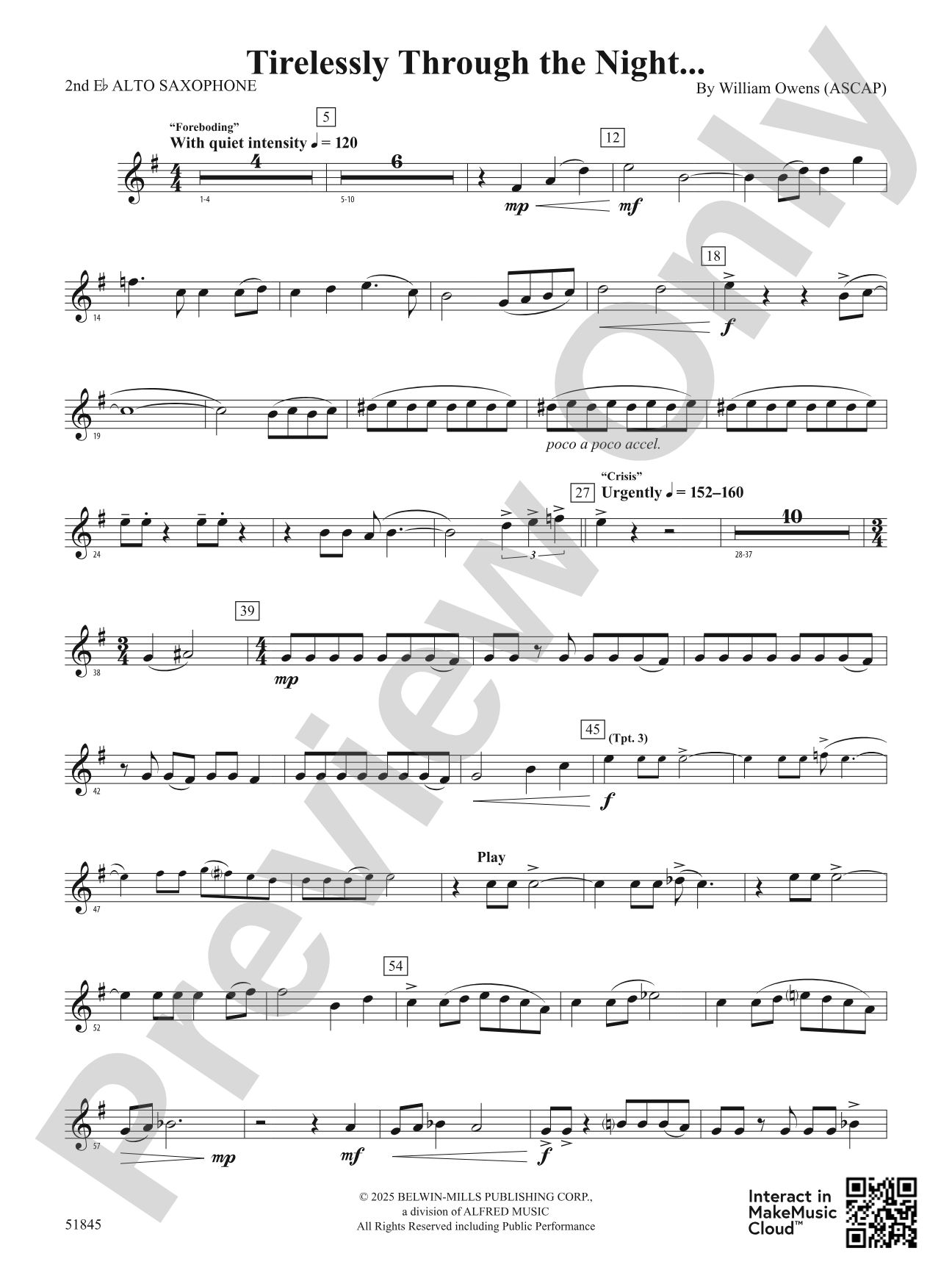

Tirelessly Through the Night...: 2nd E-flat Alto Saxophone
By William Owens
Grade: 3
Item: 00-PC-0019529_AX2
$3.00
Pickup currently not available
Description
William Owens' powerful, programmatic work, Tirelessly Through the Night..., is a musical depiction of the explosion that ravaged a small Texas community. Beginning softly and hauntingly, the "Foreboding" gradually intensifies as the destructive "Crisis" chaos ensues. The "Aftermath" and "Regenesis" segments offer hope and reassurance in the wake of tragedy. Serious music for serious ensembles! (4:00)


Tirelessly Through the Night...: 2nd E-flat Alto Saxophone isn't in MakeMusic Cloud just yet...but it could be. Let us know you'd like to see it, and you'll help shape what comes next. In the meantime, start a free trial and dive into thousands of interactive titles your students can play along with today.
Request This Title
Tell us you want it.
Start Your Free Trial
Explore everything that's ready to play right now.
Sample Audio
1
Audio File
--:--
0:00
0:00
Sample Video
Additional Details
Series:
Belwin Concert Band
Publisher:
Alfred Music
SKU:
00-PC-0019529_AX2
More about this title
About the Composer: William Owens
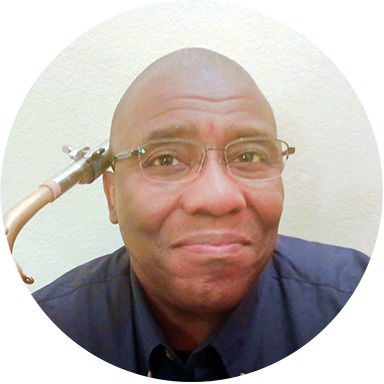
William Owens (b. 1963) grew up in Gary, Indiana, and graduated from Chicago's VanderCook College of Music in 1985. A prolific composer and respected music educator, he has created over 300 works for concert band, string orchestra, and small ensemble since 1993. His music appears on required lists across the country and has become central to young band repertoires at competitions and festivals nationwide.
Owens spent 30 years as a band director in Texas before retiring in 2014, bringing deep classroom experience to every score he writes. His compositional voice balances accessibility with substance, a hallmark that has earned him recognition as a Distinguished Alumnus of VanderCook and a recipient of the Texas Bandmasters Association's Meritorious Achievement Award. He holds memberships in ASCAP, TMEA, and Phi Beta Mu International, and has received commissions from major music organizations including the American Bandmasters Association.
Why we love this
Owens crafts narrative through orchestration with remarkable clarity at this level. A four-minute journey from ominous foreboding through catastrophe and into resilience gives your ensemble a genuine dramatic arc to explore, one that demands musical maturity without requiring advanced technical facility. Grade 3 ensembles rarely get repertoire this emotionally substantial.
What to expect
The music begins as a whisper of dread, then fractures into urgent chaos before settling into a reflective space that feels earned rather than imposed. Owens respects the weight of his subject while offering genuine closure, giving students the experience of performing something that matters.
Who it's for
This work suits Grade 3 concert bands ready to engage with serious subject matter and longer musical forms. It works equally well for ensembles preparing for contest or festival, and for directors seeking repertoire that challenges students emotionally and musically without exceeding their technical range.
How to get the most out of it
- Shape the opening section with patient breath control; the "Foreboding" establishes tension through restraint, not volume. Resist the urge to rush into the "Crisis."
- Balance the middle chaos carefully so the buildup registers as overwhelming intensity rather than muddy texture. Each section needs to hear its own layer.
- Treat "Aftermath" as genuine quiet, not simply soft dynamics. The contrast will deepen the impact of the return to hope in "Regenesis."
- Mark explicit cutoffs and breath points in the score before rehearsal. Programmatic music lives in its transitions.
How to use it
Program this as a centerpiece work on a concert dedicated to resilience or community, where its narrative arc anchors lighter surrounding pieces. It also serves as a standout contest selection that will hold judges' attention through its structural clarity and emotional intelligence.
Skills your students will build
- Sustaining soft dynamics with clarity and projection
- Balancing independent ensemble sections within programmatic contexts
- Interpreting conductor cues that signal major structural shifts
- Maintaining rhythmic precision through contrasting tempos and textures
- Understanding how orchestration creates narrative meaning