
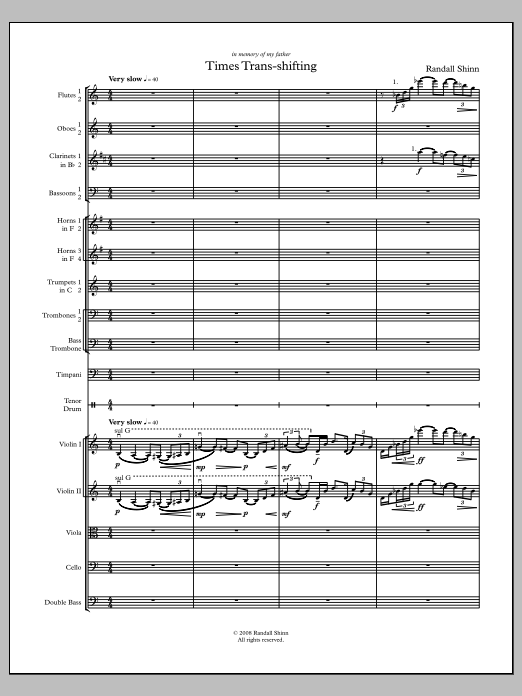

Times Trans-shifting for orchestra: Full Orchestra Conductor Score & Parts
By Randall Shinn
Item: 35-PK00288701
$11.15
Pickup currently not available
Buy Extra Parts (Digital PDF Download)
Parts Added to Cart!
Description
A expressive, elegiac work dedicated to the memory of the composer's father. Orchestra: 2222 4220 timp 1perc strings Duration: 07:00


Times Trans-shifting for orchestra: Full Orchestra Conductor Score & Parts isn't in MakeMusic Cloud just yet...but it could be. Let us know you'd like to see it, and you'll help shape what comes next. In the meantime, start a free trial and dive into thousands of interactive titles your students can play along with today.
Request This Title
Tell us you want it.
Start Your Free Trial
Explore everything that's ready to play right now.
Sample Audio
No sample audio found.
Sample Video
No sample videos found.
Additional Details
Publisher:
Hal Leonard
SKU:
35-PK00288701
More about this title
Why we love this
Shinn writes orchestration that breathes. The instrumental palette here unfolds gradually, allowing each section to emerge with purpose rather than assault the listener. Programming a work of genuine emotional weight gives your orchestra something to pour themselves into beyond technical display.
What to expect
The work unfolds with the quality of memory itself: moments of clarity shifting into reflection, themes returning transformed by what came before. Its elegiac character invites players to listen to one another with intention, creating an atmosphere of collective remembrance.
Who it's for
Orchestras at the advanced high school or college level seeking repertoire with emotional maturity and accessible orchestration. Directors looking to program a contemporary piece that honors deep feeling without requiring avant-garde technique from their ensemble.
How to get the most out of it
- Balance the strings carefully in the opening passages; they carry both the harmonic and emotional architecture before other instruments enter.
- Watch the timpani entries closely. They function as punctuation, not percussion color, so let them speak with clarity and restraint.
- Resist the urge to rush through passages of sustained writing. The piece's power lives in its pacing and space between ideas.
How to use it
This works powerfully as a centerpiece for a program exploring loss, legacy, or introspection. Position it after lighter fare to give the audience room to settle into contemplation, or lead with it as a statement of artistic purpose for your concert.
Skills your students will build
- Balancing sustained orchestral textures across multiple choirs
- Responding to conductor pacing and gesture in expressive (non-metric) passages
- Understanding how thematic material can be developed through orchestral color rather than rhythmic variation
- Executing ensemble entrances with precision when instruments join sustained textures