Time's A-Wastin' Sheet Music Preview

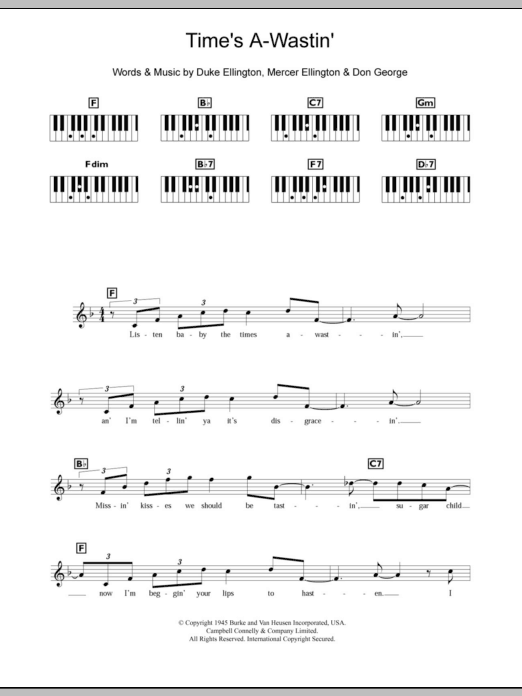
Time's A-Wastin': Piano Chords/Lyrics

As performed by Duke Ellington

Item: 35-DS00185438

Digital Download
$2.99
One moment…
Description

Discover MakeMusic Cloud: thousands of interactive titles your students can play along with today.

Sample Audio
No sample audio found.
Sample Video
Additional Details
Publisher: Hal Leonard
Page Count: 2
SKU: 35-DS00185438

More about this title

About the Artist: Duke Ellington

Duke Ellington stands as one of the most prolific composers in American music, with a catalog spanning over a thousand works across jazz, popular song, and extended concert pieces. His compositional voice balanced sophisticated harmonic language with accessibility, making his music equally at home in dance halls, concert halls, and classrooms. Ellington's influence on jazz pedagogy remains foundational; his works teach musicians how to think harmonically, orchestrate for small and large ensembles, and balance structure with spontaneity.

Beyond his role as a bandleader and performer, Ellington shaped how we understand jazz composition itself. His approach to arranging and thematic development provides endless teaching moments for students learning how great composers handle melody, counterpoint, and instrumental color. His legacy continues to inspire musicians to pursue compositional ambition within the jazz tradition.

Why we love this

Ellington's compositions work beautifully in educational settings because they reward careful listening and multiple hearings. The harmonic vocabulary and melodic sophistication in "Time's A-Wastin'" give students something genuine to sink their teeth into, rather than simplified or watered-down material. Programming this piece signals that you take your ensemble's musical growth seriously.

What to expect

There's an urgent, almost conversational quality to "Time's A-Wastin'" that keeps energy moving forward without sacrificing sophistication. The piece has the feel of musicians in dialogue, trading ideas with wit and precision. Underneath runs a steady swing foundation that anchors the harmonic exploration happening above.

Who it's for

Musicians comfortable with jazz harmony and swing feel will find this piece accessible and rewarding. It works well for upper-level jazz ensembles, small combos, and groups studying Ellington's orchestrational approach. Students who have played stride piano or studied Ellington's other works will recognize his harmonic fingerprint immediately.

How to get the most out of it

  • Attend closely to the harmonic language and find the common tones between chord changes; Ellington often uses voice leading that rewards intentional phrasing rather than mechanical execution.
  • Shape the melody with the architecture of the composition in mind. This is not a tune to simply state and move on; every phrase contributes to the larger emotional arc.
  • Balance ensemble blend against the solo voices. The arrangement should breathe, with supporting voices in clear hierarchy to the featured lines.

How to use it

Pair this with other Ellington standards to build a concert segment devoted to his compositional practice across different eras. It works as an excellent follow-up to studying his extended works, offering a more concise example of the same harmonic thinking. Consider programming it when you want to showcase the ensemble's ability to handle jazz with nuance and maturity.

Skills your students will build

  • Recognizing and executing chord substitutions common in Ellington's harmonic language
  • Balancing solo and ensemble voices in small group jazz contexts
  • Interpreting stylistic articulation and phrasing in swing-era composition
  • Understanding voice leading across jazz changes
  • Listening for and responding to harmonic tension and resolution

You May Also Like