
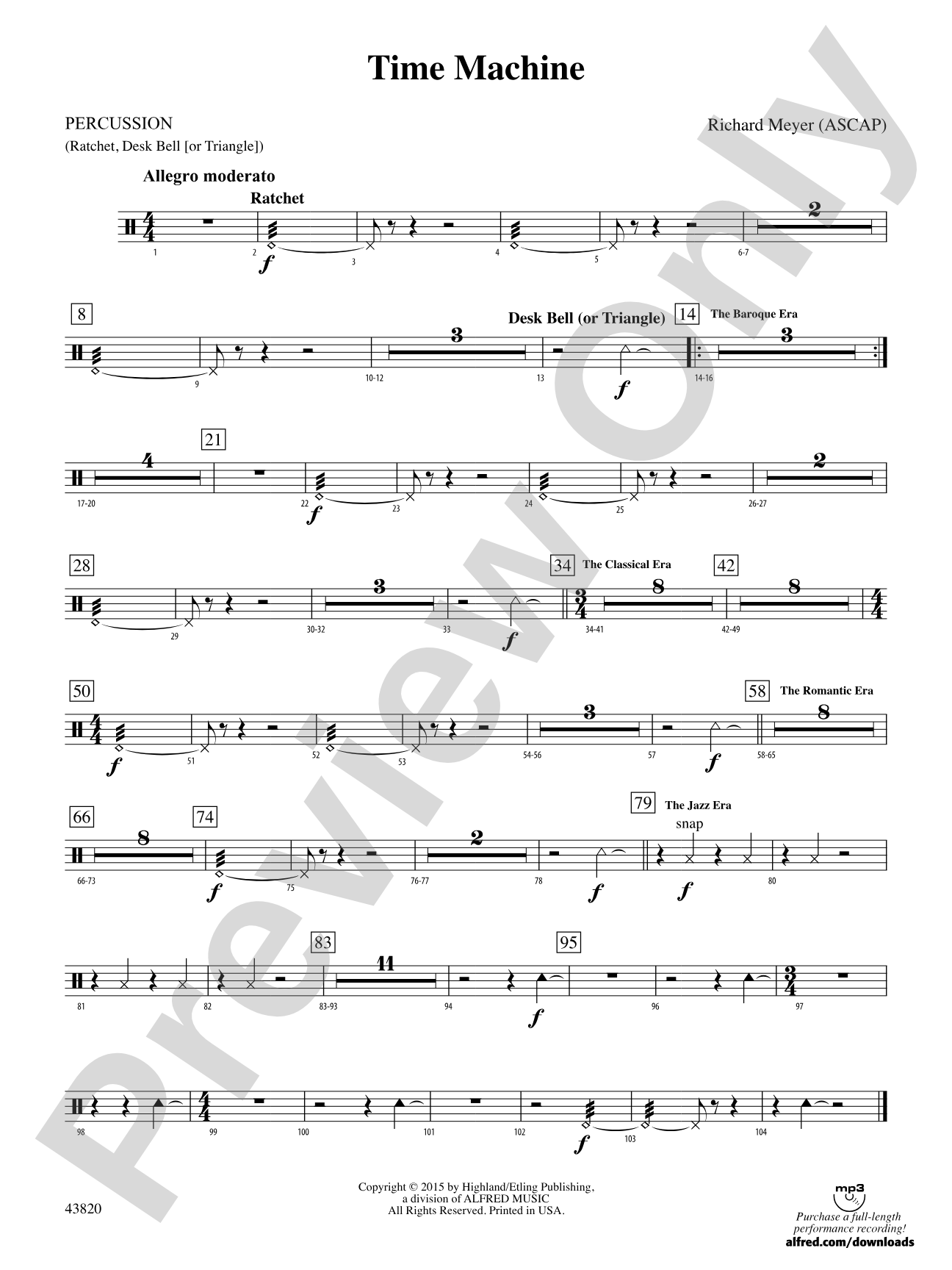

Time Machine: 1st Percussion
By Richard Meyer
Grade: 1.5
Item: 00-PC-0016916_PC1
$5.99
Pickup currently not available
Description
Your orchestra will have a blast working on this fun selection that introduces the time periods of music and the playing styles that go with them. As students climb aboard the time machine, they will "travel" far and wide! (3:30)


Don't just read it, hear it, play along with it, and watch your students grow with it. In MakeMusic Cloud, Time Machine: 1st Percussion comes alive with professional accompaniment, adjustable tempo, and built-in practice tools that turn solo practice into real progress.
Open in the Player
Jump straight in and assign it today.
Start Your Free Trial
Open this title and explore the full library in minutes.
Sample Audio
1
Audio File
--:--
0:00
0:00
Sample Video
No sample videos found.
Additional Details
Series:
Highland/Etling String Explorer
Publisher:
Alfred Music
Page Count:
144
SKU:
00-PC-0016916_PC1
More about this title
About the Composer: Richard Meyer

Richard Meyer has spent decades shaping young string musicians and building robust orchestra programs from the ground up. Over 35 years in public school music education, he grew the Oak Avenue Intermediate School orchestra from 29 students to 200, then expanded his reach as music director of the Pasadena Youth Symphony Orchestra for 16 years, leading ensembles to performances across North America, Europe, and Australia. His "Giving Bach" program, launched in 2009, earned national recognition for its creative use of interactive concerts to serve students with special needs and underserved communities throughout Southern California.
Meyer's contributions extend well beyond the rehearsal room. He has served as string editor for Alfred Publishing Company, clinician at the A.S.T.A. National Conference and multiple state orchestra director conferences, and guest conductor for All-State and Honor Orchestras nationwide. As a composer and arranger, he has created over 190 works in print, many designed specifically for developing ensembles. He is coauthor of the String Explorer Series and Sight-read It for Strings, resources widely used in string programs across the country.
Why we love this
Meyer writes with genuine affection for what young string orchestras can accomplish, and this piece proves it. The time-period concept gives students a real reason to shift their sound and approach from section to section, transforming what could be a routine etude into genuine musical exploration. At 1.5 grade level, it delivers engaging content without requiring advanced technique, so your students stay focused on the learning goal rather than fighting the notes.
What to expect
The piece unfolds like a guided tour through music history, with each room offering its own character and mood. Your orchestra will feel the lightness of baroque articulation, the symmetrical phrasing of the classical era, the warmth of romantic expression, and the energy of contemporary sound, all stitched together by the clever time-machine narrative that keeps the work playful rather than academic.
Who it's for
This work is ideal for middle school string orchestras or early high school programs building foundational repertoire. Students new to style differentiation will find the contrasts clear and achievable, while programs with solid ensemble experience can explore historical authenticity more deeply.
How to get the most out of it
- Identify the specific playing style associated with each time period before you rehearse that section. Have students listen to a brief recorded example of baroque ornaments, classical clarity, romantic expression, or contemporary sound so they have a sonic reference point.
- Layer the time-travel concept visually during rehearsals. Show students an image or video clip of each era's instruments or concert hall to deepen their connection to the musical context they're learning.
- Mark clear transitions between periods in the score so your ensemble knows exactly when the musical character shifts. This prevents muddy handoffs and keeps the journey feel intact.
- Conduct the style changes explicitly. Your gesture and energy should reflect the baroque precision, classical formality, romantic sweep, and modern energy Meyer includes, giving students a physical model to imitate.
How to use it
Program this as a concert centerpiece that demonstrates your orchestra's versatility and historical awareness in a single piece. It works beautifully in an educational concert format where narration or visual accompaniment can enhance the time-travel story, or as a lighter selection that showcases style shifts alongside more traditional repertoire.
Skills your students will build
- Distinguishing and executing baroque, classical, romantic, and contemporary playing styles
- Adjusting articulation, vibrato, and tone production based on historical context
- Following stylistic direction changes within a single piece
- Listening for period-specific harmonic and textural traits