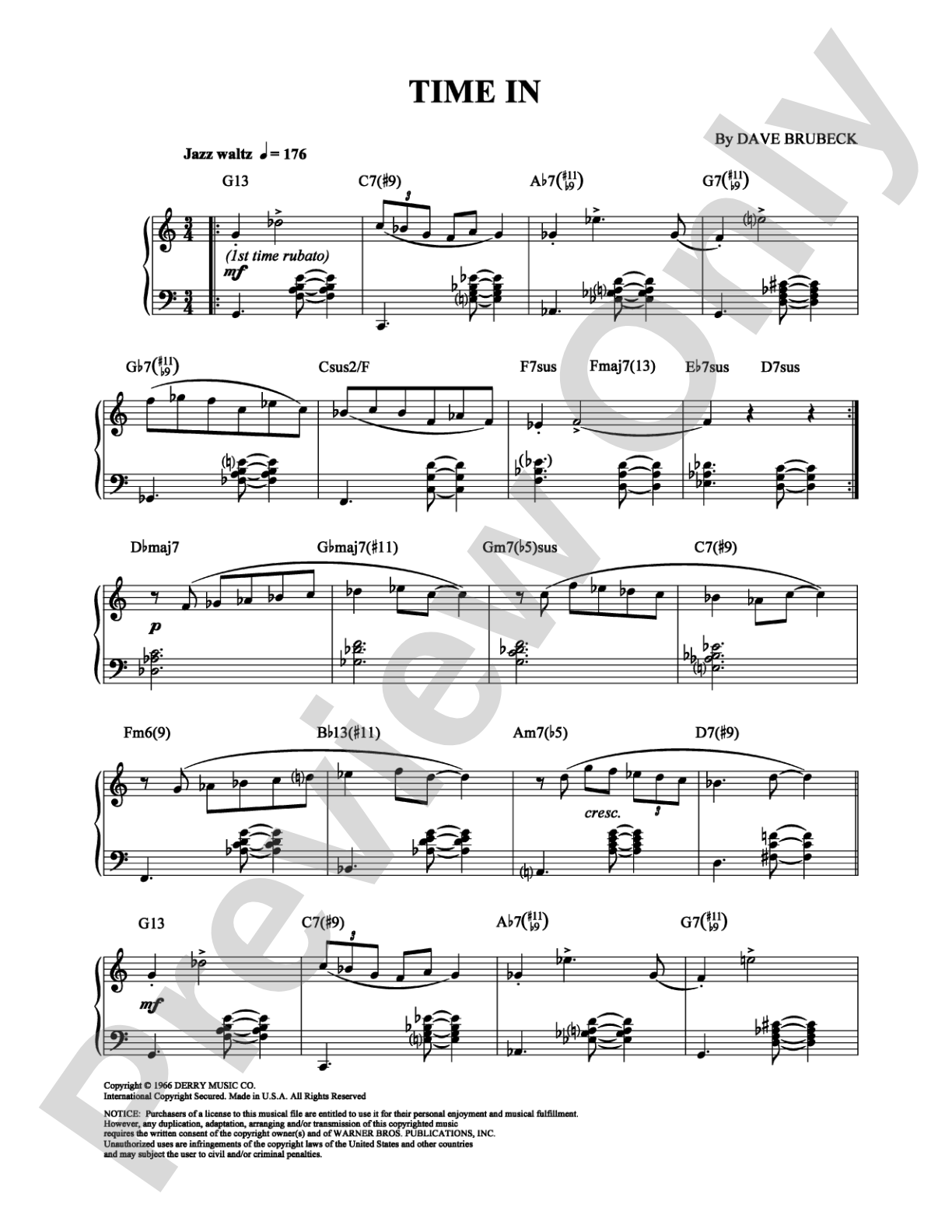
Time In: Piano Digital Sheet Music

Time In: Piano Digital Sheet Music

Dave Brubeck

Item: 00-PS-0003831

Digital Download
$3.99
Description

Time In: Piano Digital Sheet Music isn't in MakeMusic Cloud just yet...but it could be. Let us know you'd like to see it, and you'll help shape what comes next. In the meantime, start a free trial and dive into thousands of interactive titles your students can play along with today.

Sample Audio
No sample audio found.
Sample Video
Additional Details
SKU: 00-PS-0003831

More about this title

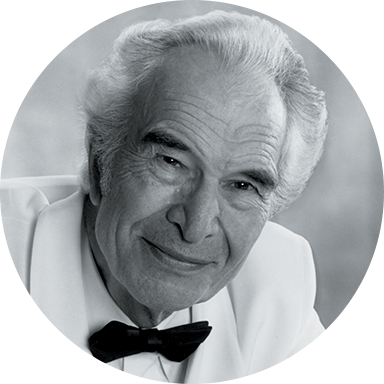
About the Artist: Dave Brubeck

Dave Brubeck

Dave Brubeck stands as one of jazz's most consequential figures, equally celebrated for his work at the piano and his prolific output as a composer. Beyond his improvisational mastery, he created a vast catalog spanning choral works, hymns, orchestral compositions, chamber music, ballet suites, and large-scale choral-orchestral pieces. His album "Time Out" became the first jazz recording to exceed a million copies in sales, and "Take Five" remains an enduring standard.

Brubeck studied composition with Darius Milhaud at Mills College following World War II, and Milhaud's influence encouraged him to synthesize jazz vernacular with classical structural thinking. His large-scale sacred works, including the oratorio "To Hope!" and works like "Pange Lingua Variations," have been recorded by ensembles including the London Symphony Orchestra and performed internationally. Beyond music, Brubeck was instrumental in dismantling racial barriers in mid-20th-century American jazz and received the Presidential Medal of the Arts from President Clinton, as well as lifetime achievement honors from the Grammy Awards and the London Symphony Orchestra.

Why we love this

Brubeck's piano writing balances sophisticated harmonic thinking with immediate accessibility, making this piece rewarding for intermediate pianists ready to explore jazz vocabulary without requiring virtuosic technique. The notated score gives students insight into how a master improviser structures melody and accompaniment, offering a gateway into jazz repertoire that respects both the classical training most pianists bring and the rhythmic freedom jazz demands.

What to expect

The piece carries the unhurried sophistication Brubeck became known for, blending lyrical melody with understated harmonic richness. There's a sense of intelligent ease in the writing, as though a reflective conversation is unfolding at the keyboard, neither rushed nor overly sentimental.

Who it's for

Pianists with solid classical training who are beginning to explore jazz vocabulary and improvisational thinking will find this a natural entry point into Brubeck's world. Intermediate students ready to develop independence between hands and comfort with swing feel will benefit from learning a composition by one of jazz's canonical figures in notated form.

How to get the most out of it

  • Approach the rhythmic placement with flexibility; Brubeck's notation preserves space for rubato and conversational phrasing, so treat strict metronomic timing as a foundation rather than a ceiling.
  • Listen closely to recorded versions to understand how Brubeck voices chords and handles reharmonization, then experiment with similar harmonic substitutions in repeated sections.
  • Balance the written melody with an accompaniment that breathes; resist the urge to fill every beat, allowing silence and space to heighten the piece's forward momentum.

How to use it

This works well in a recital exploring 20th-century piano literature or as part of a jazz-focused student concert that showcases composed rather than purely improvisational work. It also pairs naturally with classical repertoire from the same era, offering a stylistic bridge between concert tradition and jazz idiom.

Skills your students will build

  • Reading and executing swing rhythms and jazz articulation
  • Interpreting chord symbols and voicing decisions within a notated score
  • Balancing metric precision with expressive freedom and rubato
  • Understanding Brubeck's approach to melody writing and harmonic reharmonization

You May Also Like