Time After Time Sheet Music Preview

Time After Time: Jazz Ensemble Conductor Score & Parts

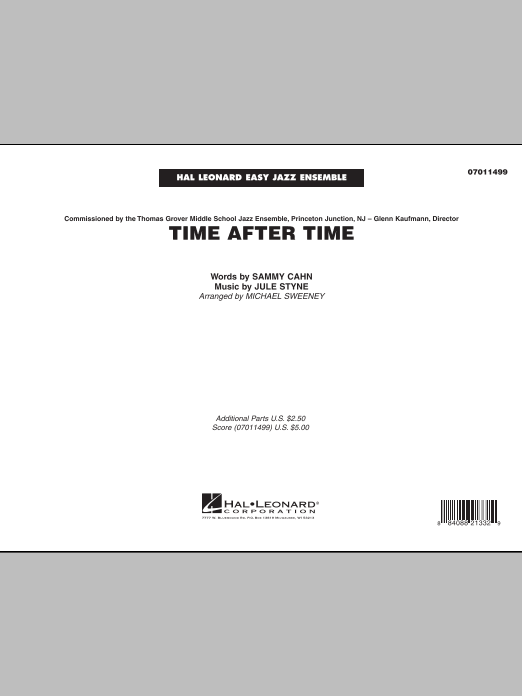
By Jule Styne / By Sammy Cahn / Arranged by Michael Sweeney

Grade: 2

Item: 35-PK00118132

Digital Download
$40.00

One moment…

Description
This often-recorded standard from the '40s features a distinctive melody and jazz-based harmonies. Michael Sweeney's skillfully designed arrangement works through a couple of key changes, and includes a sax soli and flexible solos, all at an easy level.

Time After Time: Jazz Ensemble Conductor Score & Parts isn't in MakeMusic Cloud just yet...but it could be. Let us know you'd like to see it, and you'll help shape what comes next. In the meantime, start a free trial and dive into thousands of interactive titles your students can play along with today.

Sample Audio
No sample audio found.
Sample Video
Additional Details
Publisher: Hal Leonard
SKU: 35-PK00118132

More about this title

About the Composer: Jule Styne

Jule Styne (1905–1994) was a prolific composer whose work shaped the sound of American musical theater and jazz standards. His melodies are instantly singable yet harmonically sophisticated, built to endure; "Time After Time" stands as proof of his gift for writing material that sounds fresh across generations and genres.

Why we love this

Sweeney's arrangement respects the tune's elegance while giving it real ensemble teeth. The sax soli sparkles, the key changes feel earned rather than gimmicky, and the flexible solo section means students at different levels can all have their moment. It's the rare Grade 2 jazz piece that teaches real musicianship without feeling like a training exercise.

What to expect

Elegant and buoyant, with just enough harmonic color to feel modern. The melody sits naturally in the voice, the changes catch you gently, and the sax soli glides with the kind of coolness that makes students actually want to practice their parts.

Who it's for

Grade 2 jazz ensembles ready to step beyond simple swing patterns into a piece with harmonic substance and arranging sophistication. It works for programs wanting to feature soloists of varying skill levels without compromising the ensemble's collective sound.

How to get the most out of it

  • Balance the melody line carefully during the opening statement. The supporting voices should sit behind the lead, creating depth rather than muddiness.
  • Nail the rhythmic precision in the head before tackling solos. A tight ensemble foundation makes improvisation sound composed.
  • Use the key changes as structural signposts for your students. Call attention to how the modulation resets the energy and keeps the form from feeling static.
  • Coach the sax section to blend as a unit during the soli. Tone matching matters as much as note accuracy here.

How to use it

Pair this with a more uptempo burner on a jazz or pops concert to showcase tonal control and musicality. It also fits naturally into a "standards" set alongside other timeless tunes, giving students a repertoire that extends beyond the practice room.

Skills your students will build

  • Balancing ensemble texture with featured melodic lines
  • Playing through key modulations while maintaining ensemble cohesion
  • Improvising over changes in a structured solo section
  • Blending within a section (especially saxophone section voicing)
  • Interpreting swing articulation and phrasing at a lyrical tempo

You May Also Like