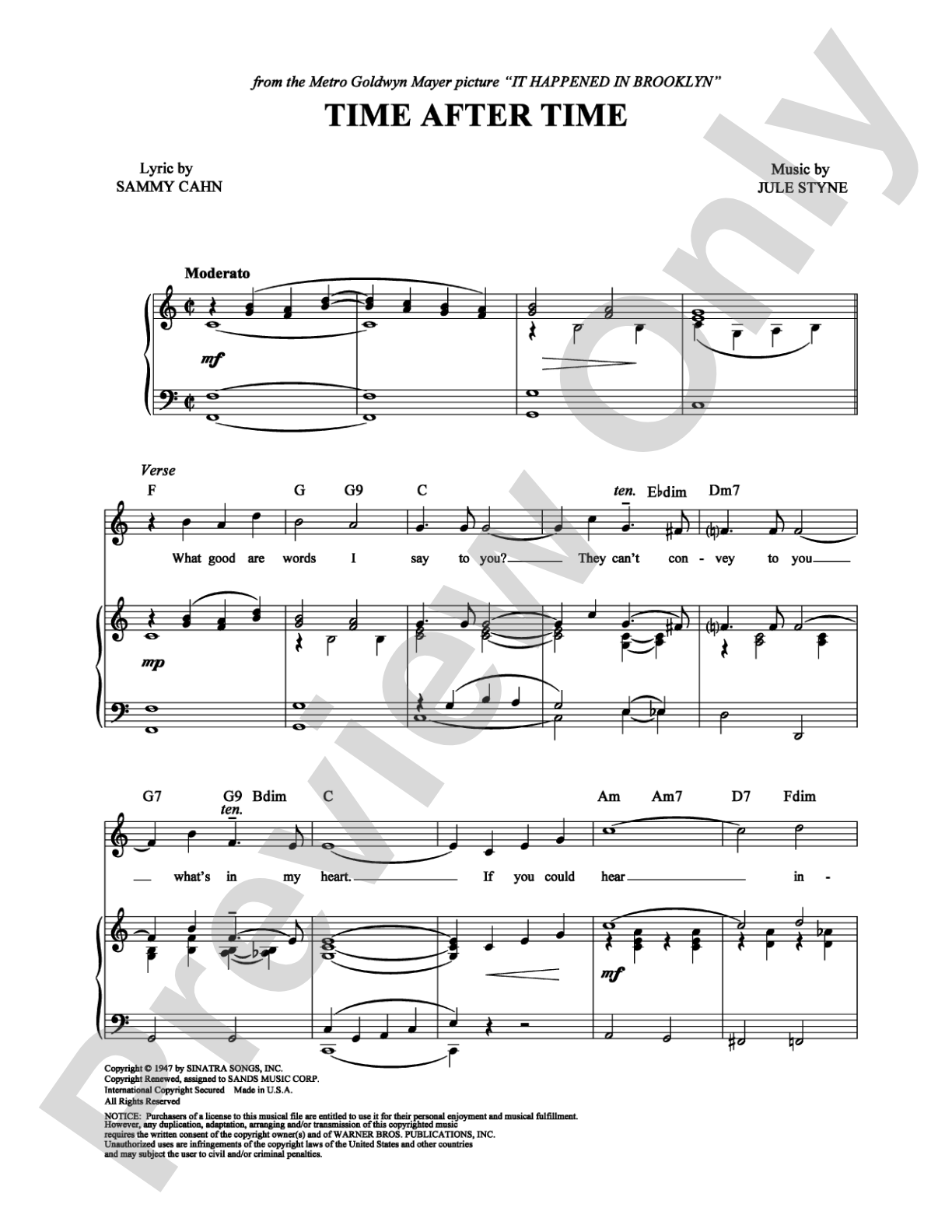
Time After Time: Piano/Vocal/Chords Digital Sheet Music

Time After Time: Piano/Vocal/Chords Digital Sheet Music

Jule Styne, Frank Sinatra, Chet Baker

Item: 00-PS-0008949

Digital Download
$2.95
Description

Time After Time: Piano/Vocal/Chords Digital Sheet Music isn't in MakeMusic Cloud just yet...but it could be. Let us know you'd like to see it, and you'll help shape what comes next. In the meantime, start a free trial and dive into thousands of interactive titles your students can play along with today.

Sample Audio
No sample audio found.
Sample Video
Additional Details
SKU: 00-PS-0008949

More about this title

About the Artist: Frank Sinatra

Frank Sinatra shaped American vocal music across seven decades, setting the standard for phrasing, interpretation, and emotional directness that student singers still study. His approach to melody, how he bent a line, when he breathed, the exact weight he gave a lyric, became a master class in storytelling through song.

Why we love this

This standard has earned its place in countless recitals, jazz combos, and vocal studio sessions because the melody sits naturally for singers while remaining engaging for accompanists. The harmonic language is sophisticated enough to sustain interest across repeated hearings yet accessible enough for intermediate pianists to navigate with confidence.

What to expect

Wistful and introspective, with an underlying current of acceptance. The melody moves in gentle arcs, and the harmonic progression creates moments of tension and resolution that feel unhurried and conversational. There's a warmth here, the quality of looking back without bitterness.

Who it's for

Singers preparing recital repertoire, jazz vocalists building their standard repertoire, and pianists accompanying lessons or performances. This digital download works equally well for formal classical recitals and intimate jazz settings.

How to get the most out of it

  • Treat the piano accompaniment as a conversation partner, not background texture; the chords suggest harmonic color and rhythmic flexibility that invites responsiveness from the vocalist.
  • Shape the melody through subtle dynamic shaping rather than vibrato alone; Sinatra's interpretations reveal how much expression lives in breath placement and note length.
  • Experiment with rubato in the verses while keeping the chorus more metered; this mirrors how the standard was recorded across different eras and gives singers ownership over phrasing.
  • Balance chord voicings so they support but never obscure the vocal line; this is particularly important in the bridge where harmonic movement intensifies.

How to use it

Include this in a standards-focused recital alongside other Rodgers and Hart or American Songbook selections to create a cohesive evening. It also serves as an excellent anchor piece for a jazz vocal concert, pairing naturally with both uptempo swingers and reflective ballads.

Skills your students will build

  • Shaping long melodic phrases with harmonic awareness
  • Reading piano/vocal/chord notation and realizing chord symbols
  • Balancing vocal expression with accompaniment support
  • Understanding interpretive flexibility within a defined harmonic structure

You May Also Like