
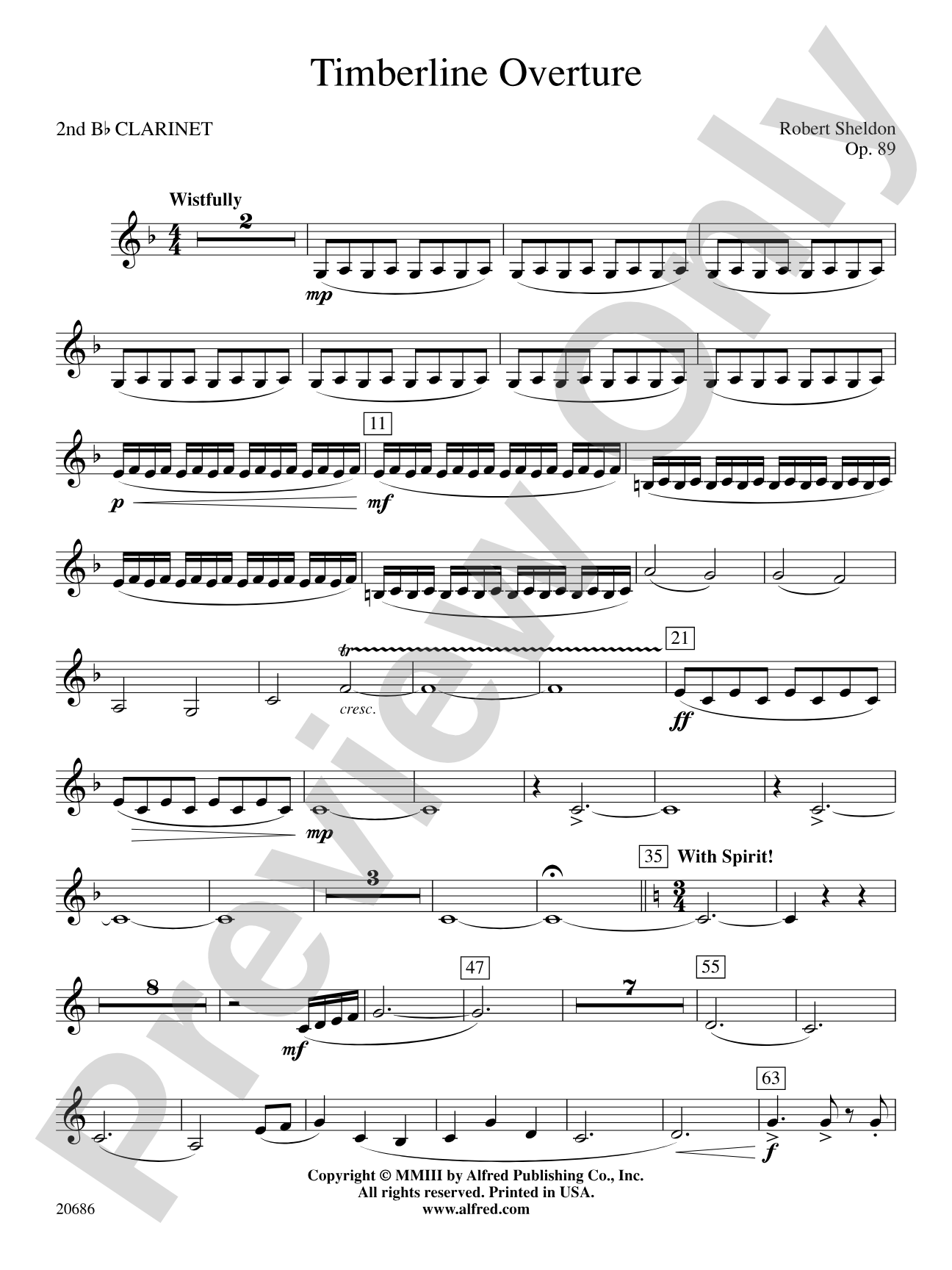

Timberline Overture: 2nd B-flat Clarinet
By Robert Sheldon
Grade: 2 (Medium Easy)
Item: 00-PC-0000433_C2
$3.00
Pickup currently not available
Description
Timberline Overture is a highly original musical portrait of the southern Appalachian forest. An impressionistic opening transitions to an Allegro that embodies the spirit of the American settlers from this region. Lydian motifs and dreamy textures combined with tuneful melodies and catchy rhythms create a very enjoyable concert or contest selection.


Don't just read it, hear it, play along with it, and watch your students grow with it. In MakeMusic Cloud, Timberline Overture: 2nd B-flat Clarinet comes alive with professional accompaniment, adjustable tempo, and built-in practice tools that turn solo practice into real progress.
Open in the Player
Jump straight in and assign it today.
Start Your Free Trial
Open this title and explore the full library in minutes.
Sample Audio
1
Audio File
--:--
0:00
0:00
Sample Video
No sample videos found.
Additional Details
Series:
Young Symphonic
Publisher:
Alfred Music
Page Count:
250
SKU:
00-PC-0000433_C2
More about this title
About the Composer: Robert Sheldon

Robert Sheldon stands among the most frequently performed composers in the wind band repertoire today. His works have earned recognition from the American School Band Directors Association, Phi Beta Mu, and ASCAP, and they appear regularly on festival and contest programs worldwide. Beyond composing, Sheldon co-authored Sound Innovations for Concert Band, establishing himself as a major voice in music education publishing.
As a clinician and guest conductor, Sheldon has worked with ensembles across the United States and internationally in Japan, Canada, Italy, Germany, Australia, and China. He has led performances in Carnegie Hall, Orchestra Hall, Boston Symphony Hall, the Sydney Opera House, and the Kennedy Center. VanderCook College of Music awarded him an honorary doctorate in 2020, recognizing his sustained contributions to wind band music and education.
Why we love this
Sheldon's gift for writing accessible yet sophisticated concert band music shines throughout this overture. The piece balances impressionistic soundscaping with straightforward rhythmic energy, giving your band a work that sounds polished and intentional without requiring virtuosic technique. Its regional musical character and moderate length make it ideal for programming alongside standard classical fare or contemporary works.
What to expect
The opening paints a serene forest landscape through impressionistic harmonies and flowing textures, then brightens considerably as the Allegro introduces folk-inspired melodies and rhythmic vitality. There's a sense of discovery in how Appalachian musical character emerges from the dreamlike beginning, making the piece feel like a journey through both landscape and cultural heritage.
Who it's for
This piece suits bands at the high school or mature middle school level with solid fundamentals in rhythm reading and balance. Contest directors and concert programmers value it for its originality and accessibility: it's substantive enough to impress adjudicators yet approachable enough for bands working on intermediate concert band skills.
How to get the most out of it
- Shape the impressionistic opening with careful attention to blend and balance; let the ensemble breathe together through the dreamy textures before the Allegro arrives.
- Emphasize the Lydian inflections in the main theme to highlight the regional character Sheldon intended; these shifts create the piece's distinctive harmonic color.
- Lock the rhythmic energy during the Allegro section to propel the tuneful melodies forward; crisp articulation and rhythmic precision transform the catchy phrases into compelling musical statements.
- Balance melody across sections as themes pass between parts; this interweaving of lines deserves clarity so the audience follows the musical narrative.
How to use it
Program this as an opener or second piece on a concert to set a sophisticated but welcoming tone; its moderate length and appealing character work well before or after heavier classical or contemporary selections. For contest, it demonstrates musicianship and stylistic range while keeping focus on the ensemble's ability to balance texture and articulate melodic ideas clearly.
Skills your students will build
- Blending and balancing textured passages
- Reading and performing Lydian modal inflections
- Articulation control in rhythmically driven sections
- Sustaining focused tone during impressionistic opening sections
- Melodic independence as thematic material passes between instrumental families