Timber City Trilogy: Tuba Sheet Music Preview

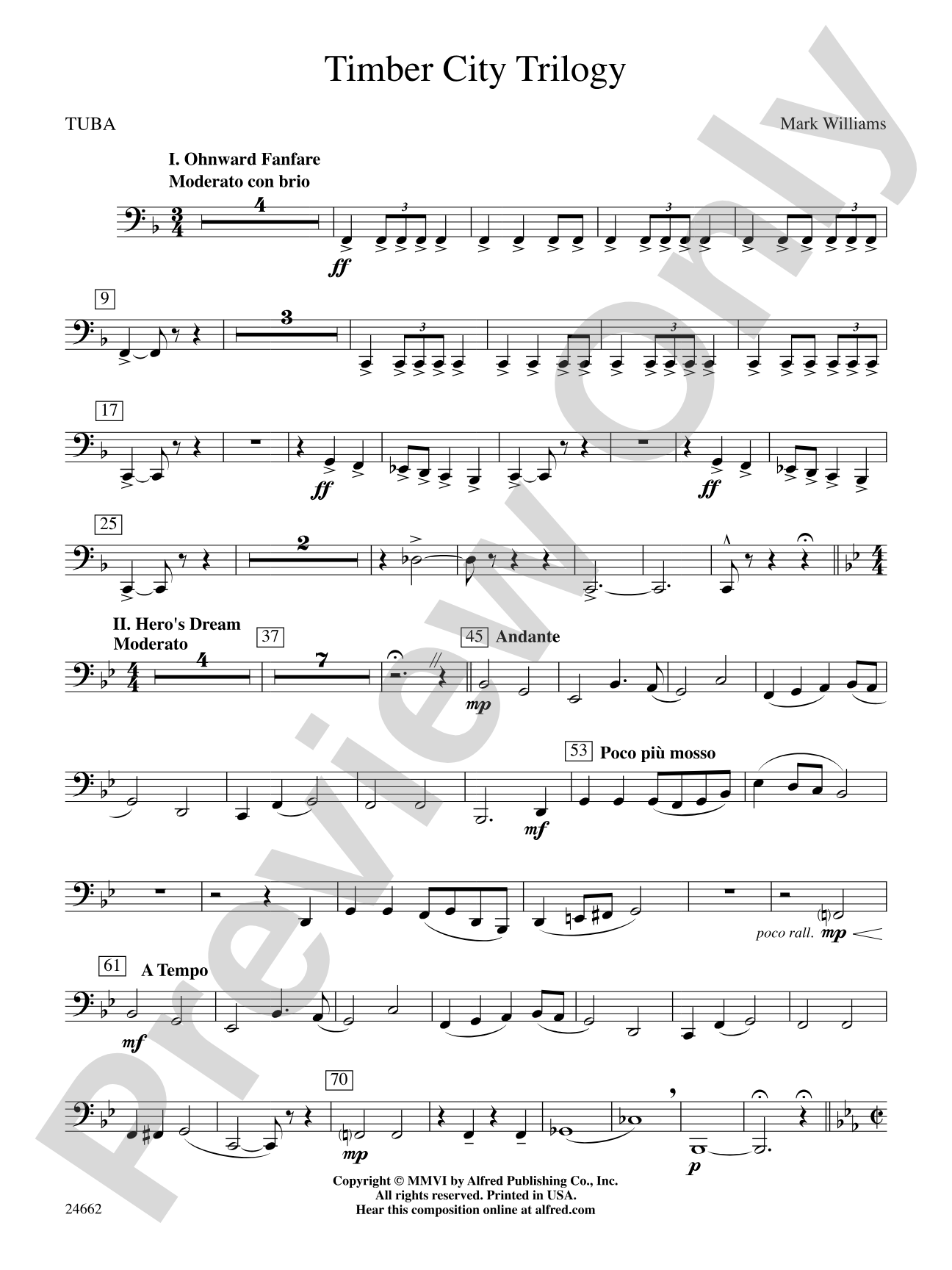
Timber City Trilogy: Tuba

By Mark Williams

Grade: 2.5 (Medium Easy)

Item: 00-PC-0000830_TB1

Digital Download
$3.00
Description
This three-movement work contains a variety of styles and teaching opportunities. A fanfare opens the work, followed by a lyrical, floating section. The final section of the work is a ragtime strut with lots of comedy and style!

Don't just read it, hear it, play along with it, and watch your students grow with it. In MakeMusic Cloud, Timber City Trilogy: Tuba comes alive with professional accompaniment, adjustable tempo, and built-in practice tools that turn solo practice into real progress.

Sample Audio
0:00
0:00
Sample Video
Additional Details
Series: Young Symphonic
Publisher: Alfred Music
Page Count: 286
SKU: 00-PC-0000830_TB1

More about this title

About the Composer: Mark Williams

Mark Williams

Mark Williams spent his career composing works that respected the realities of school music programs while never compromising musical integrity. With over 200 published compositions for band, orchestra, and choir to his name, he shaped the repertoire that generations of directors relied on. His co-authorship of the Accent on Achievement Band Method cemented his understanding of how student musicians actually learn.

Beyond the page, Williams was a tireless advocate for school music. He served as clinician and guest conductor across 34 states, five Canadian provinces, and Australia, bringing his insights directly to programs large and small. His own background included elementary band instruction in Washington, performances on bassoon with the 560th Air Force Band, and artistic direction of the Spokane British Brass Band. Williams held degrees from Eastern Washington University and received recognition through the Western International Band Clinic's Gralia Competition and multiple ASCAP Special Awards.

Why we love this

Williams designed this three-movement work with a conductor's eye for what middle-level bands actually need: a piece that opens with confident flair, settles into musical storytelling, and closes with genuine personality. The ragtime finale gives students rhythmic precision and style work without requiring advanced technical chops, and the variety across movements keeps rehearsals engaging across your full program.

What to expect

The piece opens with theatrical flair and announces itself confidently. You move then into a suspended, almost dreamlike middle section where the band plays with quiet control and gentle independence. The finale erupts with syncopated charm and lighthearted character, the kind of closing moment that leaves an audience smiling.

Who it's for

This work sits perfectly for Grade 2.5 concert bands that have secure fundamentals and can balance lyrical playing with rhythmic drive. Directors preparing a varied concert program will find three distinct musical challenges rolled into one 286-page score, making efficient use of rehearsal time.

How to get the most out of it

  • Balance the fanfare texture so the opening creates real impact; support the lead voices without burying the harmonic foundation.
  • Shape the lyrical section with vocal phrasing in the woodwinds. This floating quality depends on singers' breath control, not just long note values.
  • Nail the ragtime groove in the finale by locking the rhythm section (low winds and percussion) first, then layer the melodic and harmonic elements on top.

How to use it

Program this as your anchor work on a spring concert where you want to showcase range without overwhelming your ensemble. The three movements give you natural concert pacing: the opening commands attention, the middle movement provides breathing room, and the ragtime strut delivers a satisfying, upbeat finale that doesn't require the technical firepower of a Grade 4 closer.

Skills your students will build

  • Fanfare articulation and brass-woodwind balance in exposed textures
  • Sustained legato phrasing and dynamic control in lyrical contexts
  • Ragtime rhythm and syncopation with accurate eighth-note subdivision
  • Sectional independence within a unified ensemble sound

You May Also Like