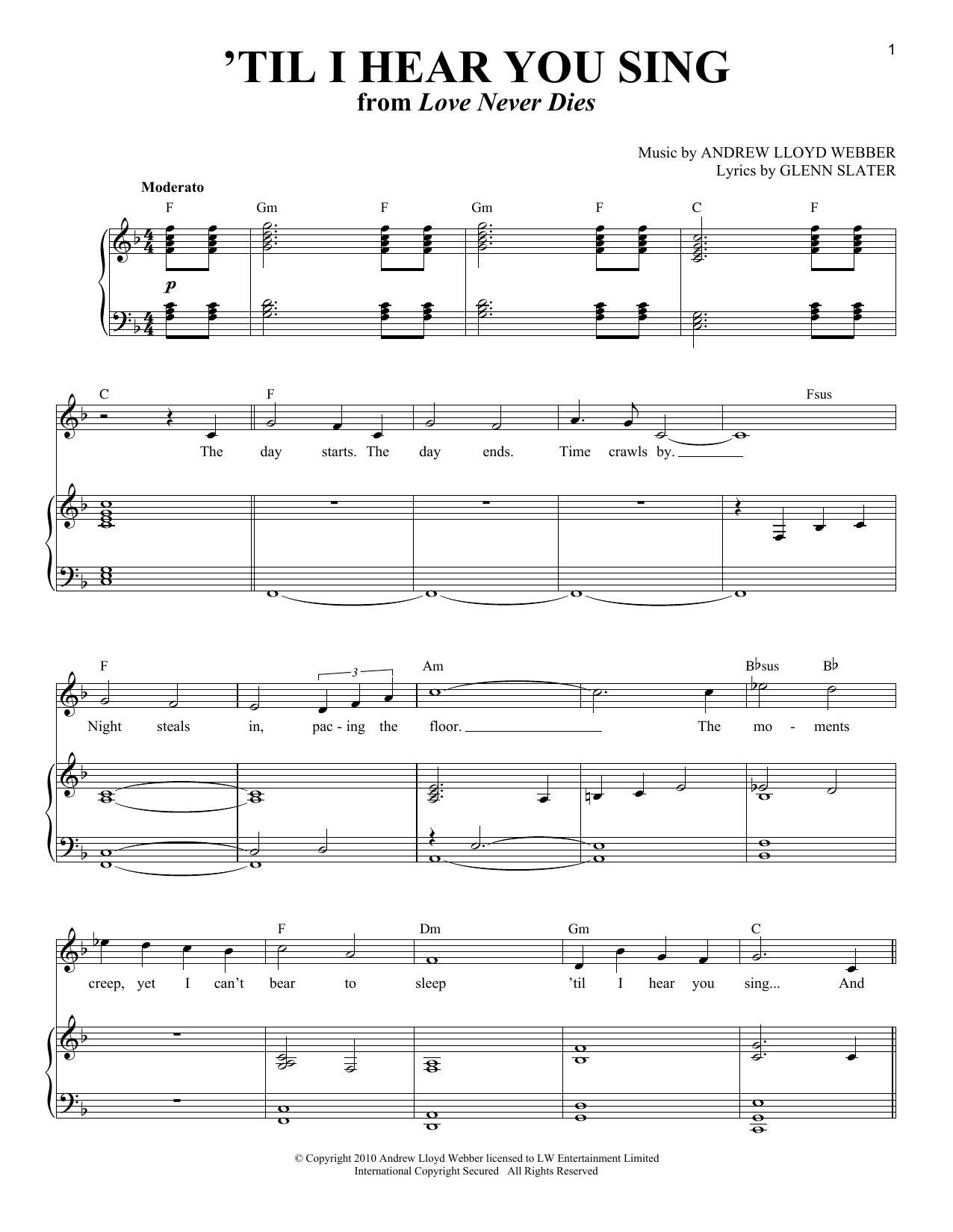
'Til I Hear You Sing (from Love Never Dies) Sheet Music Preview

'Til I Hear You Sing (from Love Never Dies): Piano Vocal

Item: 35-DS01829324

Digital Download
$5.99
Description

'Til I Hear You Sing (from Love Never Dies): Piano Vocal isn't in MakeMusic Cloud just yet...but it could be. Let us know you'd like to see it, and you'll help shape what comes next. In the meantime, start a free trial and dive into thousands of interactive titles your students can play along with today.

Sample Audio
No sample audio found.
Sample Video
Additional Details
Publisher: Hal Leonard
Page Count: 5
SKU: 35-DS01829324

More about this title

About the Creator: Andrew Lloyd Webber

Andrew Lloyd Webber stands as one of the most performed composers in theater history, with a catalog spanning five decades of musical innovation. His gift for melody combined with sophisticated harmonic language has shaped how audiences experience contemporary musical theater, making his works staples in both professional and educational settings.

Love Never Dies, Webber's sequel to The Phantom of the Opera, deepens the emotional complexity of its predecessor. The score showcases his mature compositional voice, blending romantic lyricism with darker, more introspective moments that demand vulnerability from performers.

Why we love this

This is a baritone-friendly showstopper that sits perfectly for mature singers navigating the Broadway catalog without requiring the extremes of the Phantom's range. The five-page arrangement gives you enough musical substance to make an impact while remaining practical for rehearsal time and staging flexibility.

What to expect

Tender and aching, with an undercurrent of longing that deepens as the song unfolds. The music captures the fragility of connection across distance, supported by Webber's lush harmonic palette and writing that prizes emotional specificity over vocal display.

Who it's for

Baritones building a mature audition book who want material with theatrical substance and emotional depth. Voice students and music theater performers looking for character pieces that showcase legit singing rather than belting technique.

How to get the most out of it

  • Build the emotional arc gradually through the first half; Webber scores restraint as carefully as he scores climax, and rushing the journey costs you the payoff.
  • Honor the piano accompaniment as a dramatic partner rather than a backdrop. The keyboard writing carries psychological weight and should breathe with the vocalist.
  • Mark the moments where the melody sits lower in your range and resist the urge to push volume. The intimacy of this song depends on proximity, not projection.
  • Shape long phrases across the bar line; avoid punctuating every musical phrase as if it were a sentence ending.

How to use it

Pair this with other Webber material for a thematic evening, or use it to anchor a contemporary musical theater showcase where vocalists can demonstrate lyrical control. It works particularly well for recitals that blend classical song with musical theater, offering singers a piece that demands real interpretive maturity.

Skills your students will build

  • Sustaining long phrases without compensatory tension
  • Reading and interpreting sophisticated harmonic movement in the accompaniment
  • Balancing legit vocal technique with emotional storytelling
  • Responding to nuanced dynamic markings and tempo variations in dramatic context
  • Managing the vocal demands of a baritone part written in the upper portion of the range without straining

You May Also Like