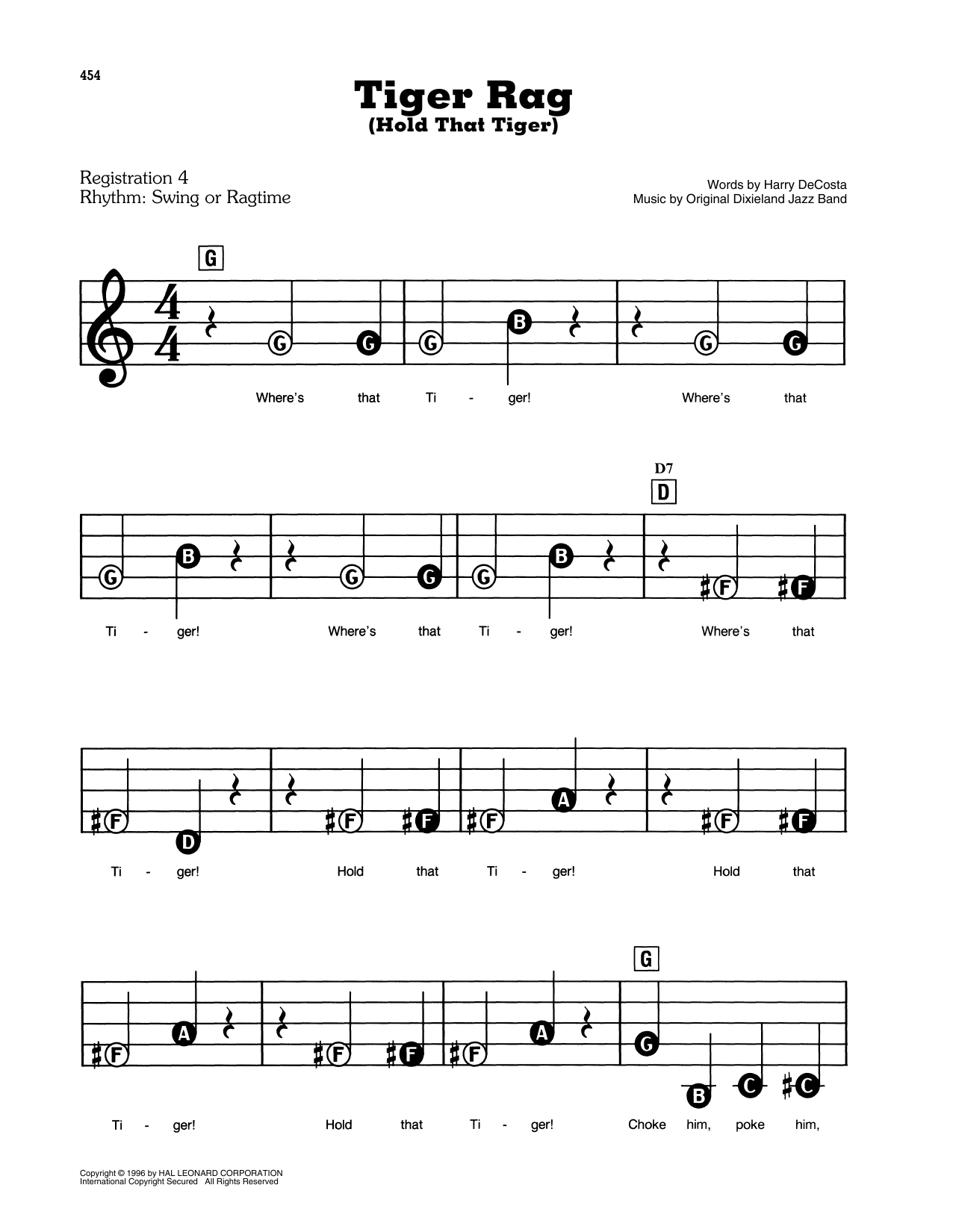
Tiger Rag (Hold That Tiger) Sheet Music Preview

Tiger Rag (Hold That Tiger): E-Z Play Today

Item: 35-DS00455590

Digital Download
$4.99
Description

Tiger Rag (Hold That Tiger): E-Z Play Today isn't in MakeMusic Cloud just yet...but it could be. Let us know you'd like to see it, and you'll help shape what comes next. In the meantime, start a free trial and dive into thousands of interactive titles your students can play along with today.

Sample Audio
No sample audio found.
Sample Video
Additional Details
Publisher: Hal Leonard
Page Count: 2
SKU: 35-DS00455590

More about this title

About the Creator

Tiger Rag emerged from the New Orleans jazz scene in 1917, composed by the Original Dixieland Jass Band during their pioneering recordings. The composition became one of the earliest jazz standards to gain widespread recognition, capturing the raw energy and improvisational spirit that defined early jazz. Its authorship reflects the collaborative nature of early jazz, where multiple musicians contributed to the arrangement and evolution of the melody that would become iconic.

Why we love this

This E-Z Play arrangement strips away the complexity without sacrificing the piece's infectious momentum. The condensed format works perfectly for pianists building jazz vocabulary or for programming a quick, crowd-pleasing number that doesn't require extensive rehearsal time.

What to expect

Irrepressible and buoyant. Tiger Rag bounces with the restless spirit of New Orleans clubs, where the band plays with barely contained exuberance. The tune practically propels itself forward, inviting any pianist to join in the celebration.

Who it's for

Pianists in their early stages of jazz repertoire exploration will find this version approachable without being simplistic. It also suits teachers looking for a short, high-energy piece to introduce students to swing rhythm and the vocabulary of early jazz standards.

How to get the most out of it

  • Keep the tempo brisk and maintain steady swing feel throughout. This piece thrives on forward motion rather than careful articulation.
  • Emphasize the rhythmic drive in the left hand; those accompaniment figures should feel propulsive, not ornamental.
  • Balance energy with clarity in the melody line so the familiar tune remains recognizable even when played at performance tempo.
  • Consider adding subtle rubato in longer note values if the arrangement permits, but never let it compromise the groove.

How to use it

Pair this with other early jazz standards for a retrospective concert set, or use it as a finale to a program exploring jazz history. Its brevity and instant recognizability make it ideal for filling a concert slot or creating a palate-cleansing moment between more substantial works.

Skills your students will build

  • Reading and executing swing rhythm and syncopation
  • Maintaining steady tempo under the influence of swung feel
  • Distinguishing between jazz and classical articulation
  • Building confidence with jazz standards through a manageable entry point

You May Also Like