
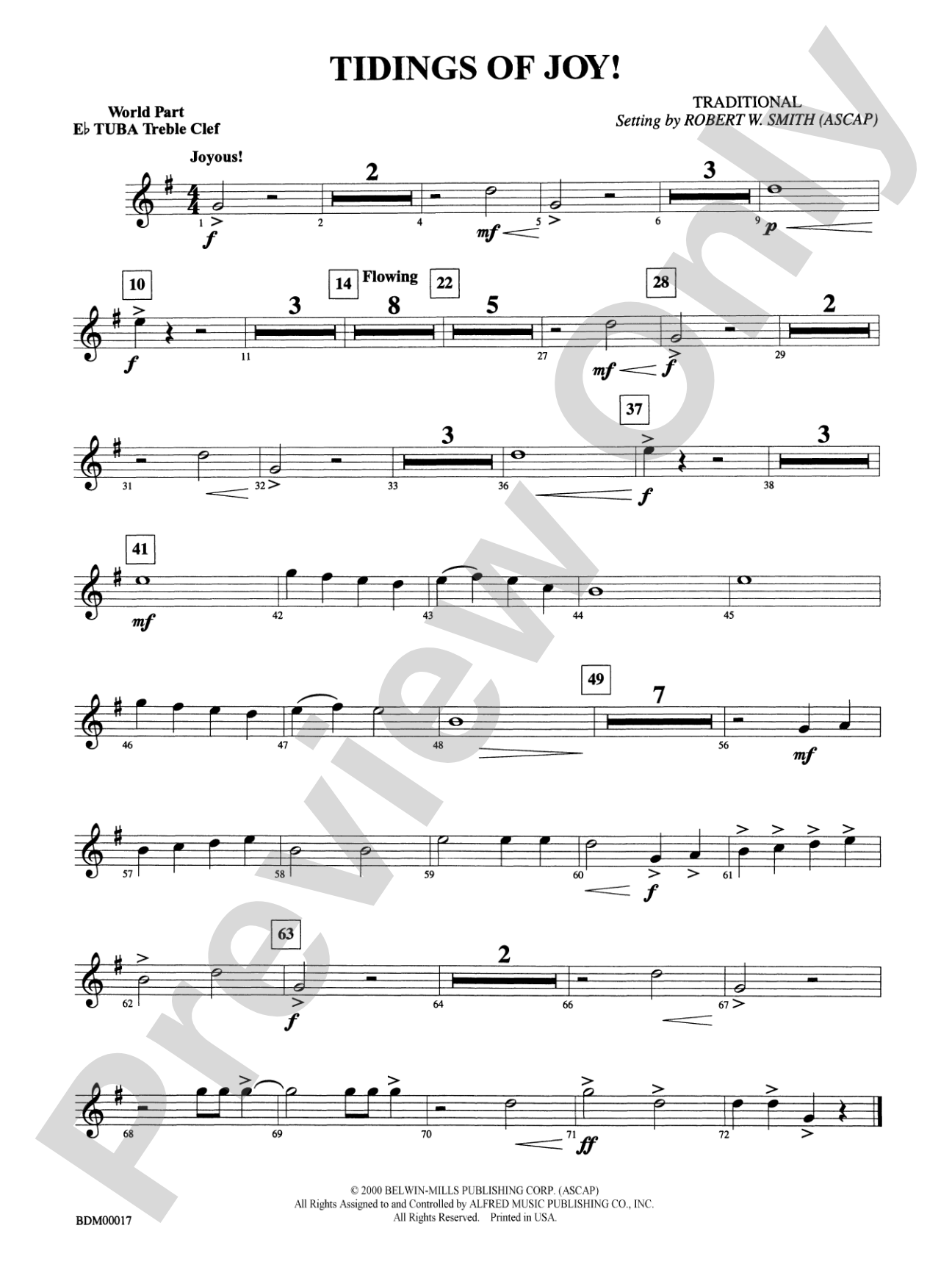

Tidings of Joy!: (wp) E-flat Tuba T.C.
Arr. Robert W. Smith
Grade: 0.5 (Very Easy)
Item: 00-PC-0014664_wpTBETC
$3.00
Pickup currently not available
Description
This reworked classic, based on "God Rest Ye Merry Gentlemen," is intertwined with repetitive fundamental rhythmic figures. It is accessible by every beginning band in the winter of their first year. Use this piece for your holiday performance after only a few months of instruction.


Don't just read it, hear it, play along with it, and watch your students grow with it. In MakeMusic Cloud, Tidings of Joy!: (wp) E-flat Tuba T.C. comes alive with professional accompaniment, adjustable tempo, and built-in practice tools that turn solo practice into real progress.
Open in the Player
Jump straight in and assign it today.
Start Your Free Trial
Open this title and explore the full library in minutes.
Sample Audio
1
Audio File
--:--
0:00
0:00
Sample Video
Additional Details
Series:
Belwin Very Beginning Band
Publisher:
Alfred Music
Page Count:
182
SKU:
00-PC-0014664_wpTBETC
More about this title
About the Arranger: Robert W. Smith

Robert W. Smith stands among the most frequently performed composers of concert band and orchestra music in America, with over 400 published works distributed primarily through Alfred Music. He holds degrees from Troy State University and the University of Miami, and his original compositions for band and orchestra have reached audiences across North America, Europe, Australia, and Asia. His symphonic works, including The Divine Comedy and The Odyssey, alongside adaptations like The Tempest, have become central to the developing band repertoire.
Beyond the concert hall, Smith's arrangements and compositions have appeared in major television broadcasts, Olympic ceremonies, the Macy's Thanksgiving Day Parade, and performances honoring world leaders. His work as a conductor and clinician has taken him across the United States, Canada, Japan, Australia, and Western Europe, making him a respected voice in contemporary band pedagogy and performance.
Why we love this
Smith has designed this arrangement specifically for the realities of a beginning band's calendar. The repetitive rhythmic foundation gives students genuine success within weeks of instruction, while the familiar melody carries enough musical substance that audiences hear a real concert, not a novelty. That combination of genuine accessibility and respectable musicality is what separates this from countless other starter pieces.
What to expect
Warm and processional, with a gentle confidence that comes from knowing a melody everyone recognizes. The repetitive rhythmic scaffolding creates a sense of forward motion without complexity, allowing the familiar tune to shine as the emotional center. There's a celebratory lightness here, neither precious nor overly simplified.
Who it's for
Every first-year concert band, particularly those starting in the fall and needing a performance-ready piece by winter. Conductors leading mixed-ability groups will appreciate how the fundamentals sit within each player's technical range while still sounding intentional and complete. This is also ideal for programs serving younger or newer ensembles that benefit from early confidence and celebratory momentum.
How to get the most out of it
- Establish the rhythmic patterns early in rehearsal as a ensemble ground. Have all sections lock the fundamental figures before layering in the melody, which prevents rhythmic drift during performance.
- Balance the melody carrier (likely clarinets or trumpets) against the harmonic foundation so the familiar tune cuts through without drowning out the textural depth Smith has written into the accompaniment.
- Take the tempo as a comfortable march. Rushing drains the holiday character; a steady, confident pace gives young musicians room to play cleanly and lets the arrangement breathe.
- Assign the rhythmic figures deliberately across your sections. Smith's repetitive patterns reward careful distribution, creating dialogue between parts rather than monotony.
How to use it
Program this as your primary holiday offering if you're performing in December and have only weeks of rehearsal time available. It also works as a strong opener for a winter concert featuring mixed repertoire, establishing an accessible, inviting tone before moving to more demanding works. Consider pairing it with another accessible arrangement to build band confidence and audience goodwill early in the season.
Skills your students will build
- Sustained ensemble rhythm through repetitive figures
- Balance between melody and harmonic support
- Reading at Grade ½ level across all concert band instruments
- Sight-reading confidence in early-season preparation
- Intonation in mixed homophonic and unison passages