Tidings! (A Christmas Carol Fantasy): 3rd B-flat Trumpet Sheet Music Preview

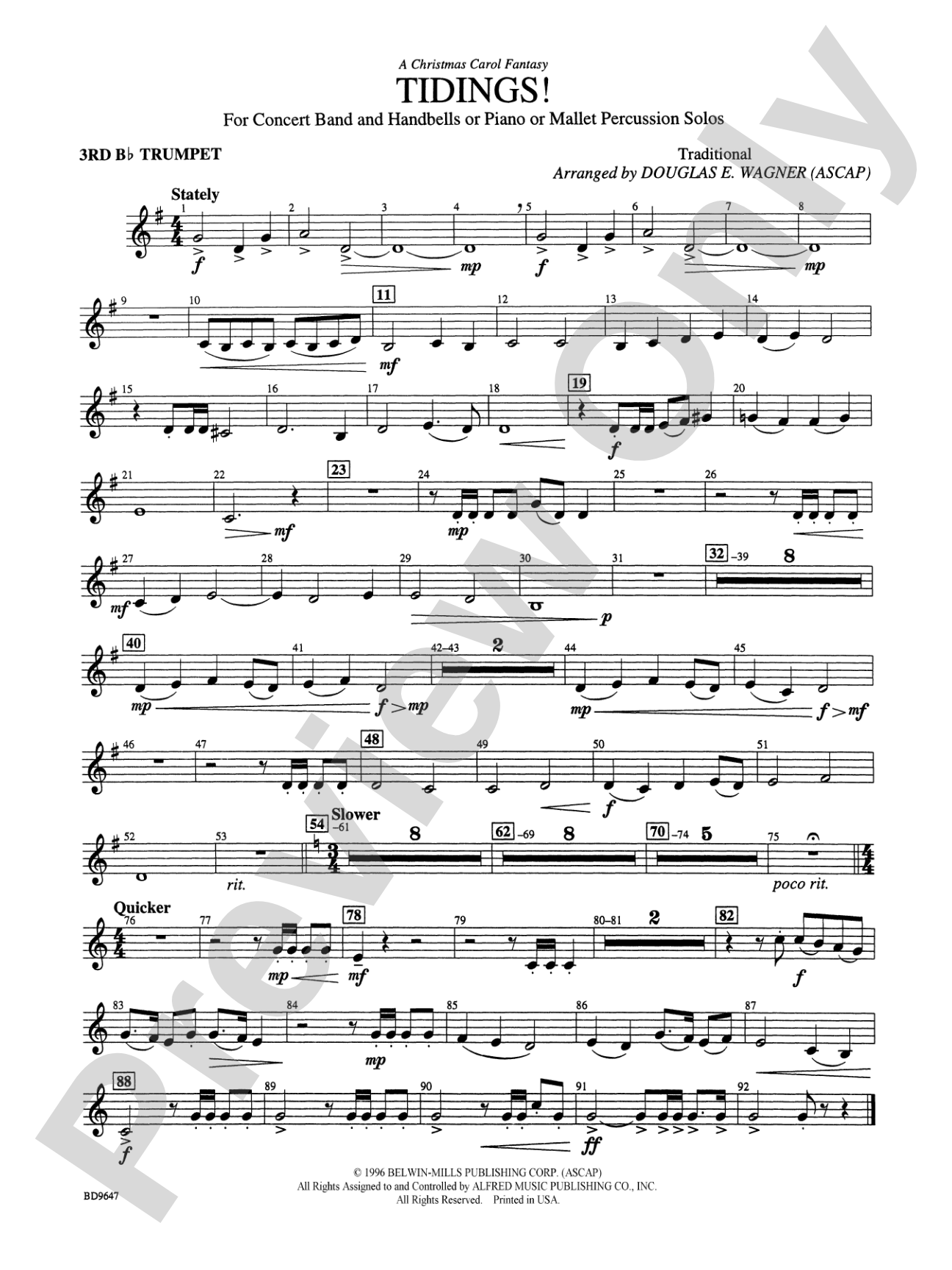
Tidings! (A Christmas Carol Fantasy): 3rd B-flat Trumpet

For Concert Band and Handbells, Piano, or Mallet Percussion Solos

Arr. Douglas E. Wagner

Grade: 4 (Medium)

Item: 00-PC-0014657_T3

Digital Download
$3.00
Description
Never before have you heard such a glorious collage of holiday carols---"O Come, All Ye Faithful," "He Is Born," "Silent Night," and "Joy to the World"---scored for concert band with solo handbells. What a magnificent sound! If you prefer, you may use the optional piano solo or solo mallet percussion parts in place of handbells. Douglas Wagner has created a true celebration in sound---a history-making holiday concert tour de force! (3:15)

Don't just read it, hear it, play along with it, and watch your students grow with it. In MakeMusic Cloud, Tidings! (A Christmas Carol Fantasy): 3rd B-flat Trumpet comes alive with professional accompaniment, adjustable tempo, and built-in practice tools that turn solo practice into real progress.

Sample Audio
0:00
0:00
Sample Video
Additional Details
Series: Belwin Symphonic Band
Publisher: Alfred Music
Page Count: 120
SKU: 00-PC-0014657_T3

More about this title

About the Arranger: Douglas E. Wagner

Douglas E. Wagner

Douglas E. Wagner grew up in Chicago and studied music at Butler University, earning both undergraduate and graduate degrees. He spent three decades as a high school music director and administrator before dedicating himself full-time to composition and arranging in the mid-1990s.

Since 1973, Wagner has published more than 3,500 works across virtually every ensemble and format: school and church choirs, concert and symphonic bands, orchestras, handbell ensembles, organ, piano, and vocal music. His compositions have sold well over seventeen million copies worldwide and appear regularly on concert programs, broadcasts, and recordings throughout the United States and internationally. Wagner lives in Indianapolis with his wife, Sandy.

Why we love this

Wagner's approach to holiday programming treats familiar carols as sophisticated musical material rather than seasonal decoration. The optional handbells add genuine textural variety to the band sound, while the alternatives (piano or mallet percussion) make the piece adaptable to any program setting. At Grade 4, this sits in the sweet spot where students play challenging material that still feels celebratory and accessible to audiences.

What to expect

A stained-glass window rendered in sound: four beloved carols woven together in a structure that feels both rich and radiant. The arrangement maintains the spiritual weight of the original hymns while creating moments of surprising harmonic color and textural shimmer.

Who it's for

Concert bands at the intermediate to advanced level who want substantive holiday programming with genuine musical depth. Directors seeking a piece that honors familiar melodies while giving students rewarding technical and textural challenges.

How to get the most out of it

  • Balance the handbell voices carefully against the band's full texture; these solo lines need definition without drowning the harmonic foundation.
  • Let the transitions between carol sections breathe slightly; each melody shift is an opportunity to reset the ensemble's sound and energy.
  • Treat the hummable carol melodies as anchor points for younger players who might find the harmonic complexity demanding. Secure those hymn tunes first, then layer the arrangement's details.

How to use it

This works as a centerpiece for a holiday concert, especially alongside shorter seasonal pieces or a traditional carol sing. Its three-minute-fifteen-second length makes it ideal for the middle section of a program where you want to shift mood and still maintain musical substance.

Skills your students will build

  • Playing against exposed harmonic writing (each voice contributes to the vertical sonority)
  • Balancing independent lines within a larger ensemble texture
  • Interpreting stylistic shifts between familiar melodies and arrangemental context
  • Working with optional instrumentation and making intelligent substitutions

You May Also Like