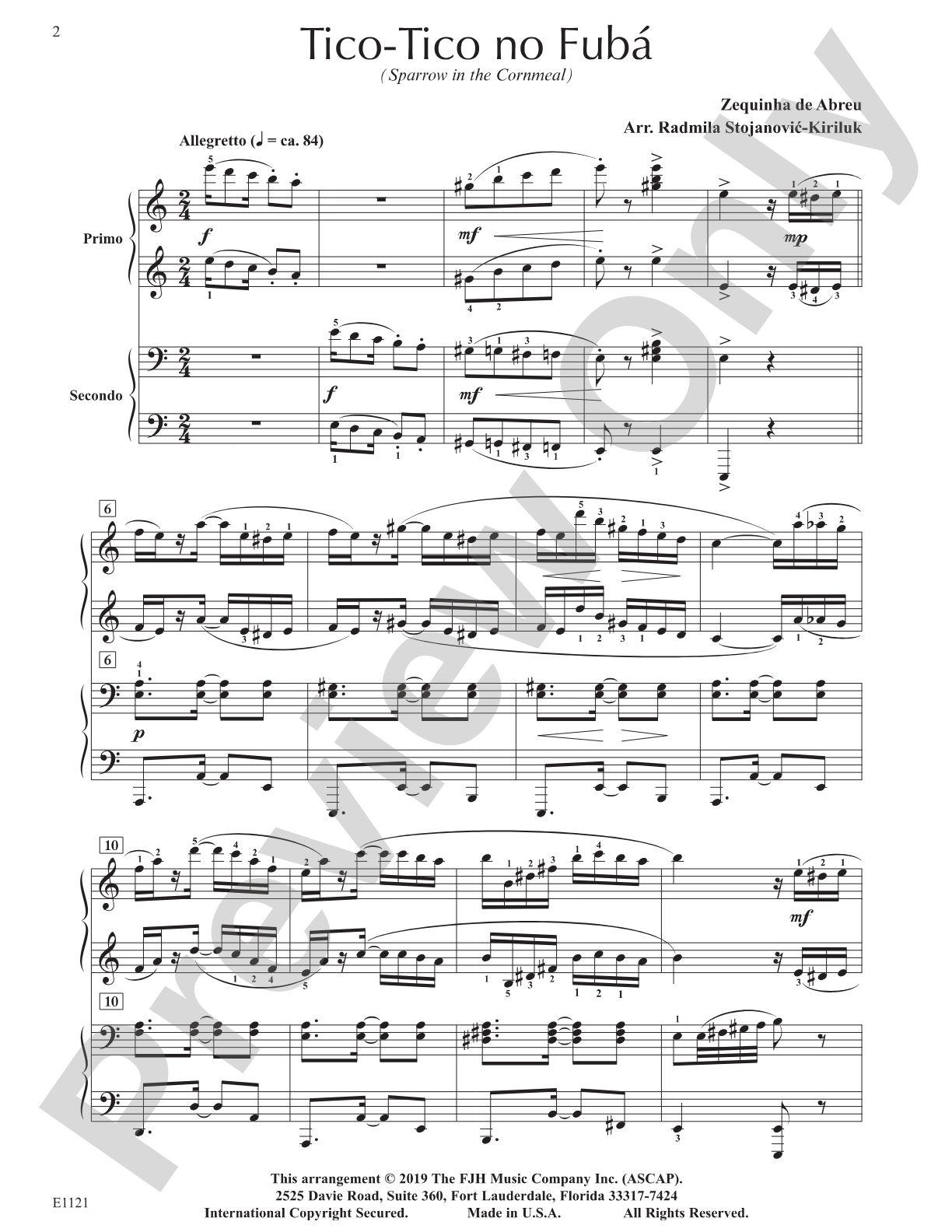
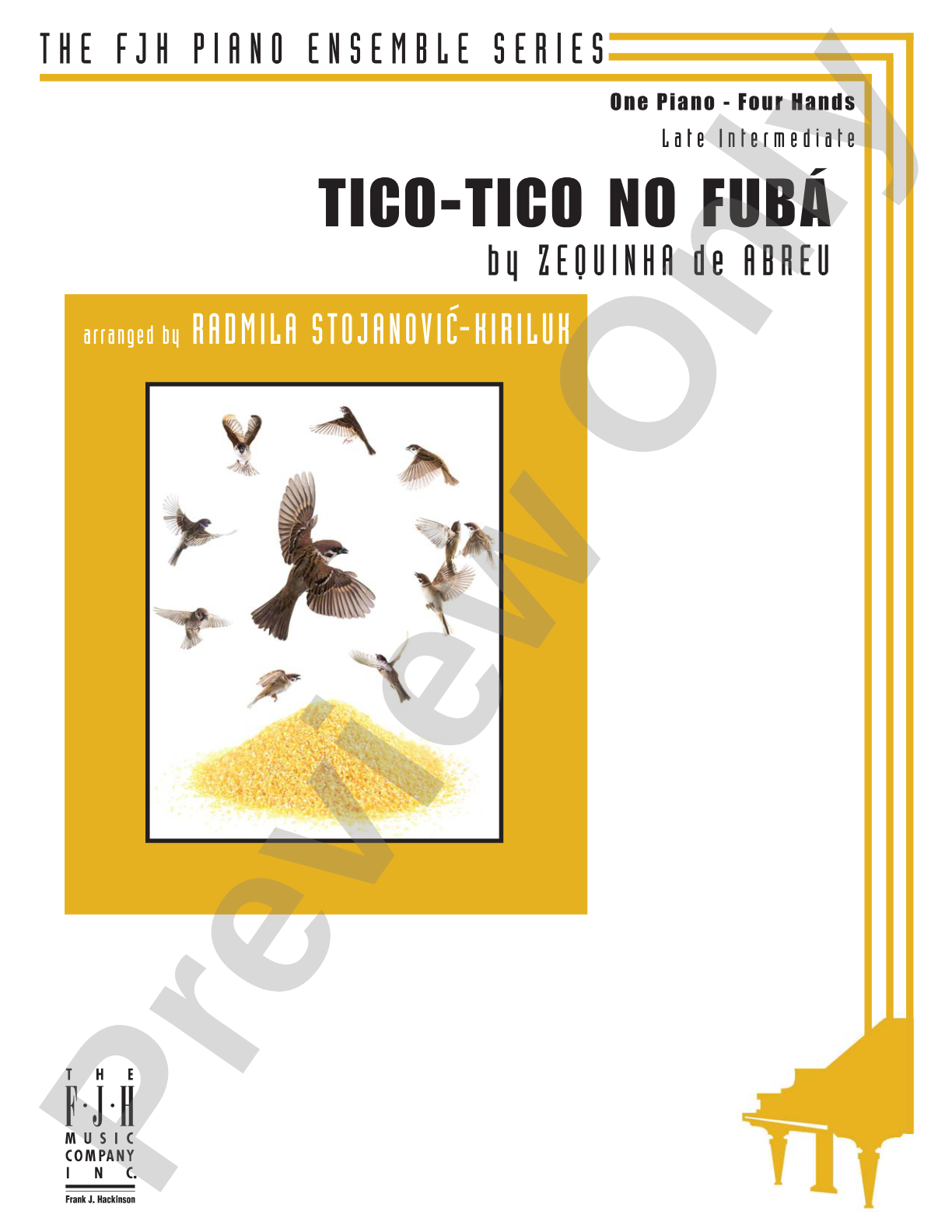
Tico-Tico no Fubá Sheet Music Preview

Tico-Tico no Fubá: Piano

By Zequinha de Abreu / arr. Radmila Stojanovic-Kiriluk

Item: 98-DE1121

Digital Download
$7.95
Description
Translated from the Portuguese as “Sparrow in the Cornmeal,” Tico-Tico no Fubà is a Brazilian choro song. Originally composed by Zequinha de Abreu, and arranged by Radmila Stojanovic-Kiriluk, the familiar tune of Tico-Tico no Fubá is shared by both performers throughout this lively one piano, four hand duet. Performers are asked to tap rhythmically while the other performers at various points in the piece as the duet crescendos to an exciting conclusion. This is an excellent piece to expose students to cultural rhythms and melodies.

Tico-Tico no Fubá: Piano isn't in MakeMusic Cloud just yet...but it could be. Let us know you'd like to see it, and you'll help shape what comes next. In the meantime, start a free trial and dive into thousands of interactive titles your students can play along with today.

Sample Audio
No sample audio found.
Sample Video
Additional Details
Series: The FJH Piano Ensemble Series
Publisher: The FJH Music Company, Inc.
SKU: 98-DE1121

More about this title

About the Composer: Zequinha de Abreu

Zequinha de Abreu (1880-1935) was a Brazilian pianist and composer who became one of the most important figures in choro music during the early twentieth century. His compositions captured the spirit of Brazilian popular music with sophisticated harmonies and infectious rhythmic vitality, making him a bridge between folk traditions and concert hall sophistication.

Why we love this

Tico-Tico no Fubá works brilliantly as a four-hand duet because both pianists share equal musical weight and get to carry the famous melody. The rhythmic tapping passages add physical engagement and break up what could otherwise be a straightforward arrangement, giving students a real reason to stay locked in together.

What to expect

Bright, rhythmically playful, and impossible not to smile through. The piece has the infectious energy of street music, with enough harmonic sophistication to keep musicians engaged without becoming labored.

Who it's for

Late-intermediate pianists ready to tackle ensemble playing and explore music outside the European canon. This duet works for studios that pair students of similar levels, or for a teacher and student to perform together at a recital.

How to get the most out of it

  • Establish the rhythmic tapping as a conversation between the two players. These moments aren't decoration; they're structural markers that push the piece forward.
  • Keep the underlying choro rhythm steady and unhurried through the opening section. Brazilian music breathes differently than classical repertoire, so resist the urge to rush.
  • Balance the melody between primo and secondo so the tune remains audible even when both hands are active. One player shouldn't disappear into accompaniment.
  • Build the crescendo gradually over the final section rather than jumping to full volume too early. You need room to grow toward that exciting conclusion.

How to use it

Schedule this for a concert or recital that includes Latin American or world music selections. It's short enough to pair with another duet and engaging enough to anchor a casual performance where the audience wants to clap along.

Skills your students will build

  • Four-hand ensemble coordination and listening
  • Rhythmic independence between primo and secondo parts
  • Brazilian choro rhythm patterns and phrasing
  • Dynamic shaping and crescendo control over extended phrases
  • Maintaining rhythmic precision while adding physical tapping elements

You May Also Like