Thunder and Lightning Polka: Timpani Sheet Music Preview

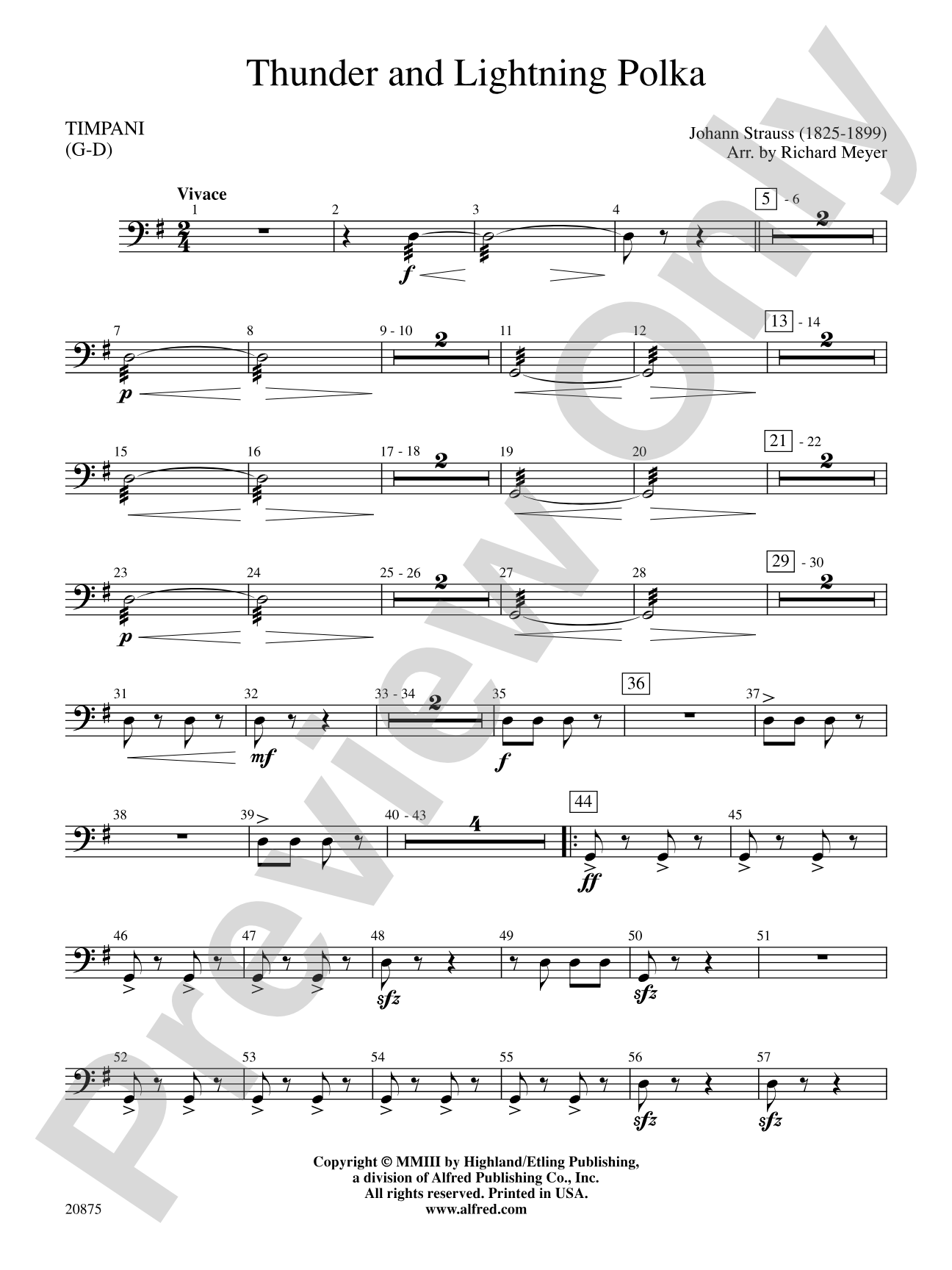
Thunder and Lightning Polka: Timpani

By Johann Strauss / arr. Richard Meyer

Grade: 2

Item: 00-PC-0000464_TMP

Digital Download
$3.00
Description
Johann Strauss depicts the powerful forces of nature through accents, sforzandi, and a percussion section in one of the most popular polkas ever written. Your audience will delight in the colorful orchestration and your students will love the chance to "pump up" the tempo in this sure-fire concert closer. With all string parts in first position throughout and winds in their most practical ranges, this arrangement is accessible to the young orchestra, but will also sound great when played by more mature groups. Includes parts for alto sax, bass clarinet, violin III, and piano accompaniment. A Federation Festivals 2020-2024 selection.

Don't just read it, hear it, play along with it, and watch your students grow with it. In MakeMusic Cloud, Thunder and Lightning Polka: Timpani comes alive with professional accompaniment, adjustable tempo, and built-in practice tools that turn solo practice into real progress.

Sample Audio
No sample audio found.
Sample Video
Additional Details
Series: Highland/Etling First Philharmonic
Publisher: Alfred Music
Page Count: 200
SKU: 00-PC-0000464_TMP

More about this title

About the Composer: Johann Strauss

Johann Strauss II (1825-1899) earned his reputation as the "Waltz King" by composing over 500 dances that defined the sound of 19th-century Vienna. His gift for melody, sophisticated orchestration, and rhythmic vitality made him a master of the polka, waltz, and quadrille—forms that demanded both technical precision and infectious charm. Strauss's works remain central to orchestral repertoire because they teach young musicians how to balance clarity with energy, individual voices with ensemble unity, and technical demands with pure musical joy.

Why we love this

This arrangement captures everything that makes Strauss irresistible: propulsive rhythms, brilliant orchestration that sits perfectly for young players, and a structure built for dramatic tempo acceleration. The piece gives your strings and winds genuine musical satisfaction while remaining manageable in the young orchestra setting, and audiences respond to its unabashed exuberance every single time.

What to expect

The piece crackles with kinetic energy from the opening: bright, propulsive, and full of orchestral color. Storm-like accents and sforzandi suggest nature's dramatic power, while the polka's inherent swing keeps the music grounded in joy and momentum. It's a piece that makes young musicians feel like they're conducting a genuine celebration.

Who it's for

Young orchestras at Grade 2 level will find accessible string writing (first position throughout) and practical wind ranges, while more experienced groups can tackle the piece's rhythmic drive and nuanced orchestration with greater sophistication. This is the perfect choice for ensembles seeking a high-energy finale that challenges musicianship without requiring advanced technique.

How to get the most out of it

  • Build the tempo gradually through the piece rather than jumping to the marked tempo immediately; let the accumulation of energy feel organic and earned
  • Emphasize the sforzandi and accents in the winds and brass without rushing the pulse; these articulations create sparkle, not haste
  • Bring out the counter-melodies in the second violin and viola parts to showcase the colorful orchestration that makes this arrangement special
  • Balance the percussion section carefully so that the timpani and cymbals enhance rather than overshadow the melodic voices

How to use it

Reserve this for your final piece on any concert; its infectious tempo and orchestral brilliance provide the perfect send-off for your audience. The piece also fits naturally into a program celebrating Romantic-era orchestral music or works that highlight percussion and character.

Skills your students will build

  • Executing crisp, unified accents and sforzandi across the full orchestra
  • Responding to conductor tempo changes and accelerando markings without losing rhythmic integrity
  • Balancing transparent orchestration and counter-melodies across multiple sections
  • Reading and performing typical Romantic-era polka rhythms with stylistic accuracy
  • Coordinating special instrument parts (alto sax, bass clarinet, violin III) with the main ensemble

You May Also Like