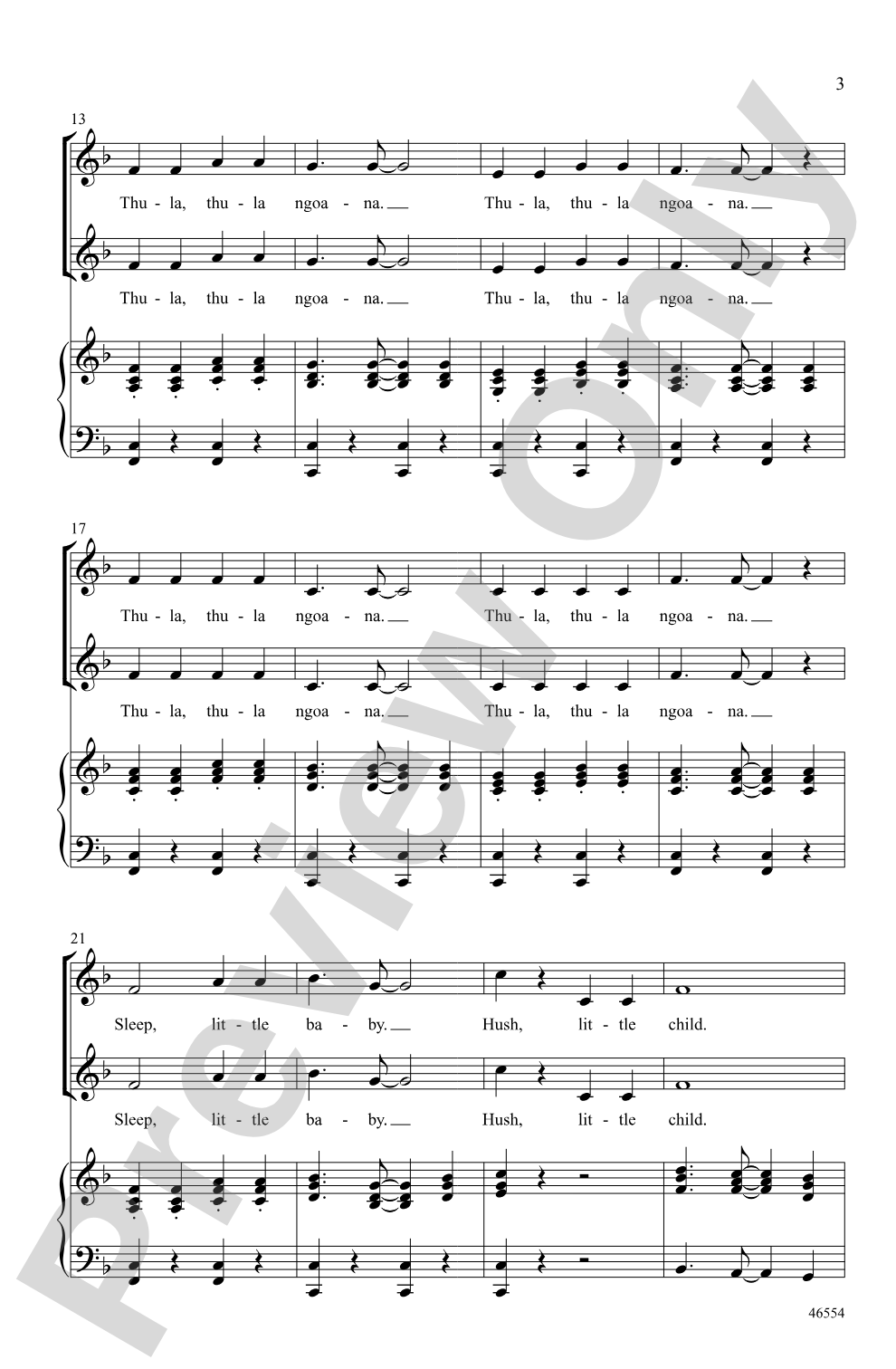
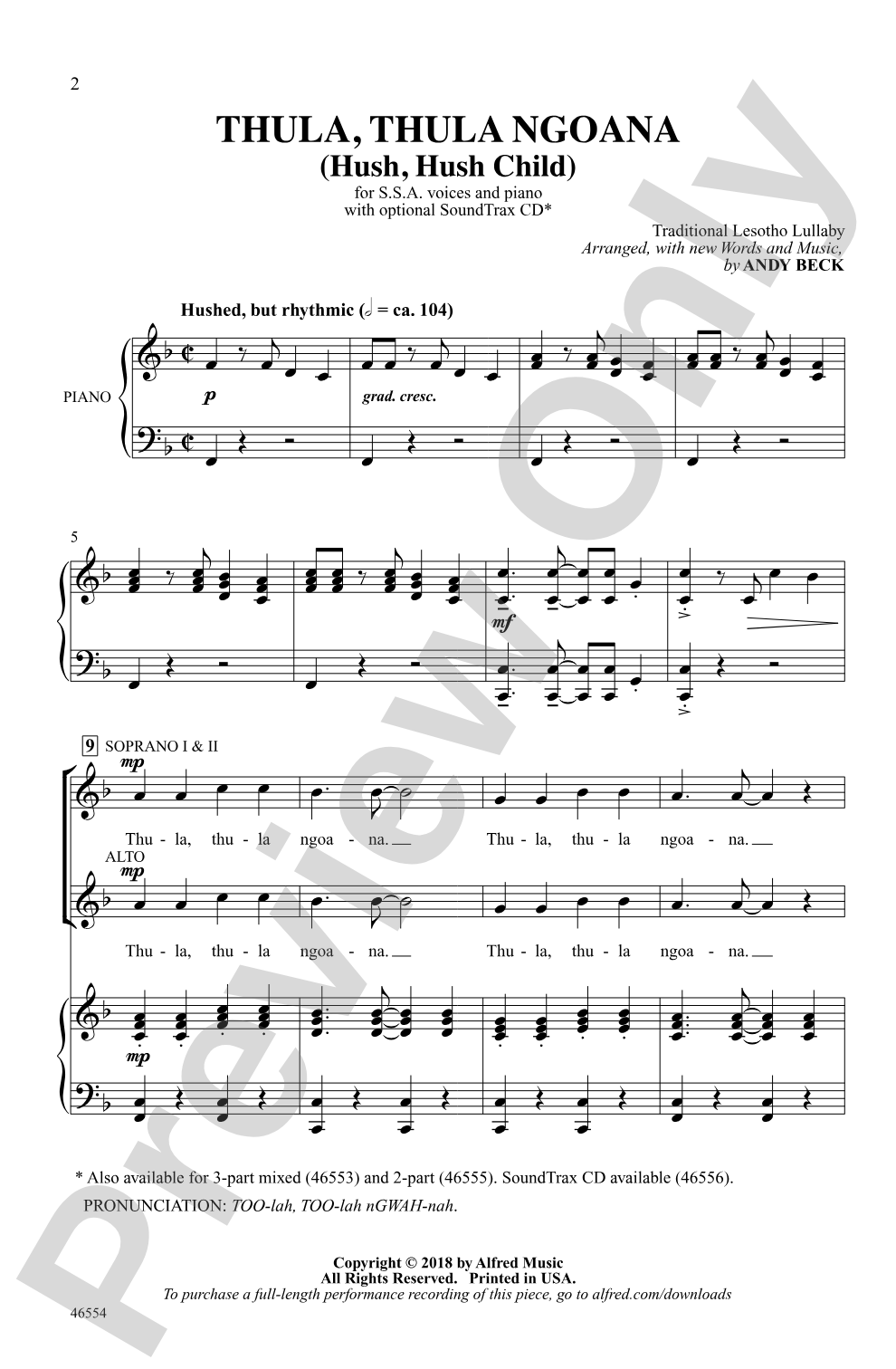
Thula, Thula Ngoana  Sheet Music Preview

Thula, Thula Ngoana: SSA Choral Octavo

(Hush, Hush Child)

Traditional Lesotho Lullaby / arr., with new words and music, by Andy Beck

Item: 00-PO-0005726

Digital Download
$2.05

Minimum order quantity: 20 copies

Description
A combination of the traditional Lesotho lullaby with some original words and music, this arrangement pairs a simple African text with English lyrics on the same topic. All parts sing in unison first, laying the groundwork for both two and three part canons which soon develop. Legato verses and a hushed bridge provide nice contrast to the form. Choreography is on Alfred's Movin' DVD.

Thula, Thula Ngoana: SSA Choral Octavo isn't in MakeMusic Cloud just yet...but it could be. Let us know you'd like to see it, and you'll help shape what comes next. In the meantime, start a free trial and dive into thousands of interactive titles your students can play along with today.

Sample Audio
0:00
0:00
Sample Video
Additional Details
Series: Alfred Choral Designs
Publisher: Alfred Music
Page Count: 12
SKU: 00-PO-0005726

More about this title

About the Composer: Andy Beck

Andy Beck

Andy Beck directs choral publications at Alfred Music and has composed and arranged over 450 choral works now in active performance worldwide. His output spans secular and sacred repertoire, children's musicals, and foundational choral resources including Sing at First Sight and Vocalize! 45 Vocal Warm-Ups That Teach Technique. He holds degrees in Music Education from Ithaca College and Northwest Missouri State University.

Beyond the page, Beck works regularly as a guest conductor, choreographer, and clinician for honor choirs, all-state groups, and music education conferences across the United States and internationally. A trained tenor, he performs with the North Carolina Master Chorale Chamber Choir and has served as a studio vocalist for Alfred Music since 1992, bringing firsthand performance experience into every piece he writes.

Why we love this

Beck gives you a genuine multicultural experience without overcomplicating the mechanics. The unison opening builds ownership of the text in both languages, then the canon development naturally layers sophistication onto something your singers already know. The choreography integration and the legato/hushed contrast create moments that feel theatrical without demanding elaborate staging.

What to expect

The piece settles in like a true lullaby, grounded in the simplicity of a Lesotho melody. When the canons emerge, they create gentle layering and forward motion while the hushed sections pull you back into intimate warmth, building a form that mirrors the comfort and quiet power of the text itself.

Who it's for

Treble choirs at the middle school through early high school level benefit most from this piece. The unison foundation and progressive canon structure suit singers developing ensemble blend and rhythmic independence without requiring advanced part-singing experience.

How to get the most out of it

  • Establish the unison section with confidence before introducing canon entrances. Let singers feel secure with the melody first; they'll enter the staggered parts with more precision when they own the tune.
  • Shape the legato verses with breath awareness. Even in SSA writing, slight phrase breaks between sections prevent lines from sounding one-dimensional.
  • Use the hushed bridge to reset dynamics and mood. This section works best when it feels like a genuine pullback, not just another verse.

How to use it

This works beautifully in programs centered on world cultures, multicultural traditions, or seasonal celebrations that honor diverse music. The choreography element makes it equally at home on a concert where movement and staging are part of your school's choral identity.

Skills your students will build

  • Canon singing and rhythmic independence
  • Singing in two and three parts with clear voice leading
  • Legato line control and phrase shaping
  • Pronunciation and expression in African and English languages
  • Movement integration with singing

You May Also Like