
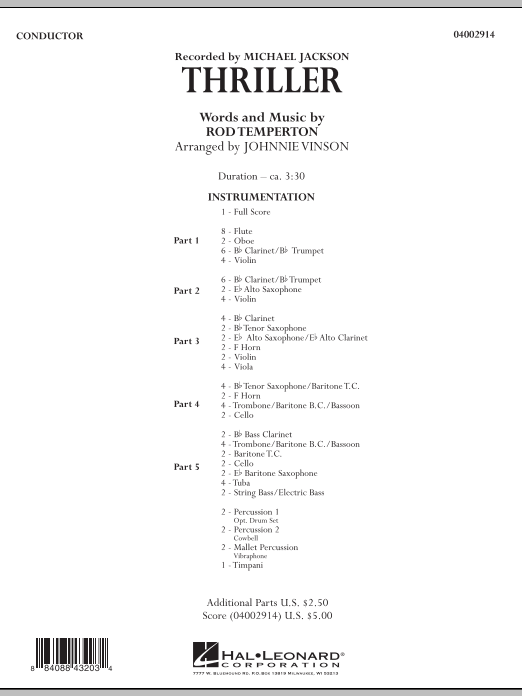

Thriller: Flex Ensemble Conductor Score & Parts
By Rod Temperton / As performed by Michael Jackson / Arranged by Johnnie Vinson
Grade: 2
Item: 35-PK00131949
$70.00
Pickup currently not available
Buy Extra Parts (Digital PDF Download)
Parts Added to Cart!
Description
Written in a format playable with just about any combination of instruments (including strings), here is Michael Jackson's "monster" hit solidly scored by Johnnie Vinson. Dur: 3:30


Thriller: Flex Ensemble Conductor Score & Parts isn't in MakeMusic Cloud just yet...but it could be. Let us know you'd like to see it, and you'll help shape what comes next. In the meantime, start a free trial and dive into thousands of interactive titles your students can play along with today.
Request This Title
Tell us you want it.
Start Your Free Trial
Explore everything that's ready to play right now.
Sample Audio
No sample audio found.
Sample Video
No sample videos found.
Additional Details
Publisher:
Hal Leonard
SKU:
35-PK00131949
More about this title
About the Composer: Rod Temperton
Rod Temperton was the keyboardist and primary songwriter for the funk and R&B group The Commodores before launching a prolific career as a composer and producer. He became one of Michael Jackson's most trusted collaborators, writing or co-writing some of Jackson's most iconic songs including "Rock with You," "Off the Wall," and "Thriller." Temperton's gift for crafting infectious melodies and sophisticated pop arrangements made him instrumental in shaping Jackson's sound throughout the 1970s and 1980s.
Beyond his work with Jackson, Temperton composed for film and television and continued to influence popular music production for decades. His understanding of how to layer instruments and build emotional intensity in a pop song remains a masterclass for music educators and arrangers.
Why we love this
Johnnie Vinson's arrangement distills one of pop music's most recognizable songs into something Grade 2 ensembles can actually perform without sacrificing the iconic vibe. The flex scoring means you're not scrambling to find instrumentation or cutting students from the section; you build the ensemble you have. It's the kind of arrangement that gets genuine excitement from audiences while remaining genuinely playable.
What to expect
Spooky and propulsive at once. The arrangement captures "Thriller's" theatrical menace while keeping the groove locked tight; it's fun to play and fun to hear, with just enough harmonic sophistication to feel complete rather than skeletal.
Who it's for
Any ensemble director working with musicians reading at Grade 2 level who wants genuine contemporary pop repertoire without dumbing down the arrangement. It works equally well for middle school bands, string orchestras, jazz ensembles, or mixed groups where flexibility is the name of the game.
How to get the most out of it
- Nail the rhythmic precision in the opening riff; it's instantly recognizable, so any sloppiness reads as incomplete preparation rather than interpretive choice.
- Balance the bass line with careful attention to what's carrying the harmonic foundation at any given moment, especially if your instrumentation shifts between sections.
- Shape the dynamic arc across all three and a half minutes; "Thriller" has natural peaks and valleys that feel lazy if you play it at one volume level.
- Isolate the most exposed passages (sections where fewer instruments carry the harmony) in sectionals to build confidence before full ensemble rehearsals.
How to use it
Position this as a concert closer or special event highlight, especially for Halloween programs or pops concerts where the audience knows this song intimately. The three and a half minute duration fits neatly into a mixed program, and it gives students the rare opportunity to perform music they've actually heard on the radio in their own version.
Skills your students will build
- Reading and executing syncopated rhythmic figures within a consistent groove
- Maintaining ensemble cohesion across frequent dynamic and textural shifts
- Balancing rhythmic precision with expressive phrasing in a pop idiom
- Adapting instrumental roles based on available ensemble instrumentation
- Understanding how bass lines and harmonic instruments interact to define chord changes