
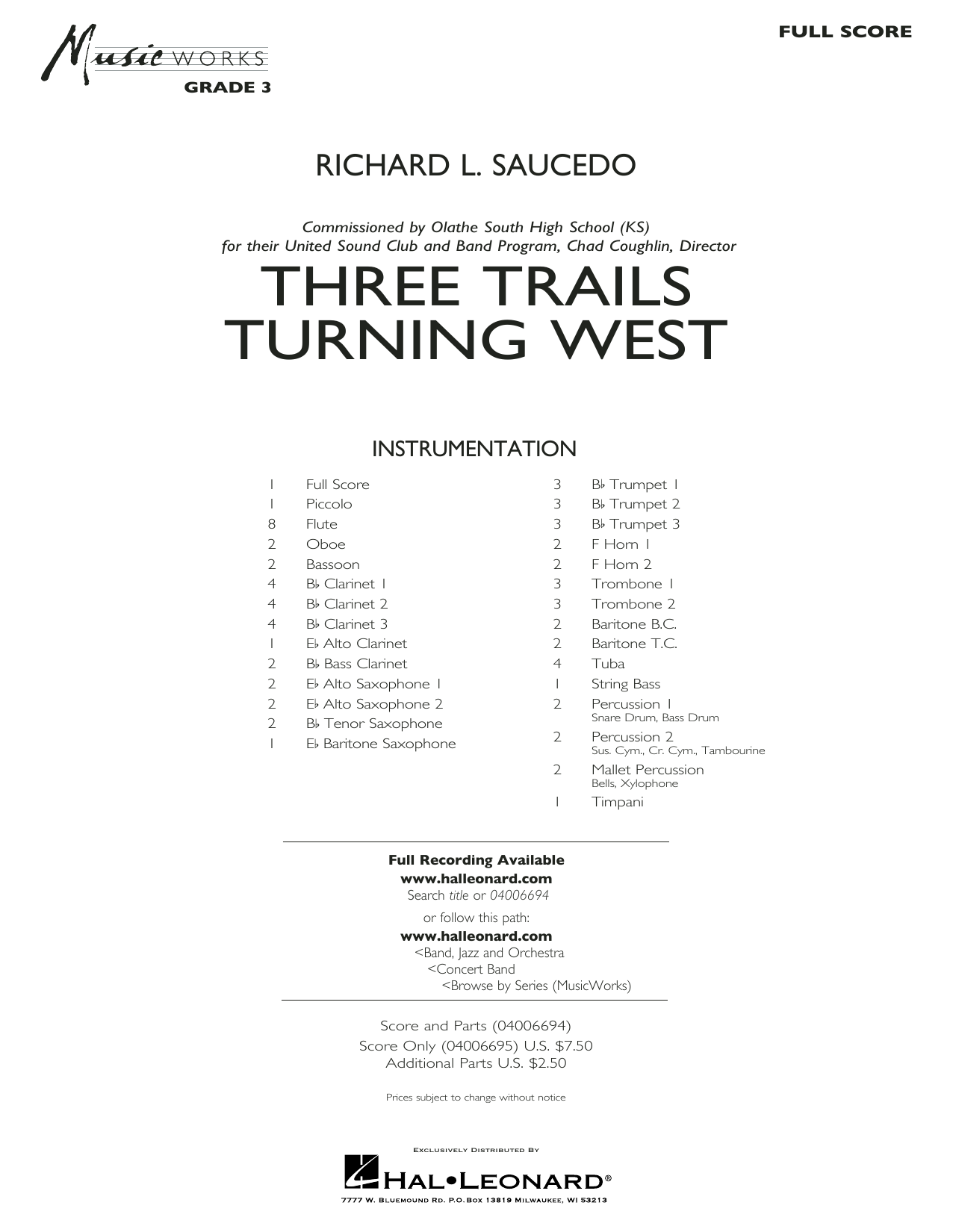

Three Trails Turning West: Concert Band Conductor Score & Parts
By Richard L. Saucedo
Grade: 3
Item: 35-PK00465068
$70.00
Pickup currently not available
Buy Extra Parts (Digital PDF Download)
Parts Added to Cart!
Description
Near present day Olathe, KS three trails from pioneer days (the Santa Fe, Oregon and California trails) diverged on their way further West. Richard's exciting work "Three Trails Turning West" captures the adventurous spirit of our country's Western expansion with fanfares and sweeping themes bringing to mind the open prairies and grand vistas experienced by the early settlers.


Discover MakeMusic Cloud: thousands of interactive titles your students can play along with today.
Sample Audio
No sample audio found.
Sample Video
Additional Details
Publisher:
Hal Leonard
SKU:
35-PK00465068
More about this title
About the Composer: Richard L. Saucedo

Richard L. Saucedo shaped Indiana's competitive band culture for three decades as Director of Bands at Carmel High School, where his ensembles earned consistent recognition at state, regional, and national festivals. His tenure included multiple appearances at the Music for All National Concert Band Festival, state championships, and a Bands of America National Championship in 2005 alongside a simultaneous Midwest Clinic performance—a rare institutional achievement.
Beyond the high school podium, Saucedo has influenced the activity at the highest levels. He served as Brass Arranger and Composer for the Cavaliers Drum and Bugle Corps, contributing to five DCI world championships, and currently coordinates the Blue Devils ensemble. His recognition includes induction into both the Music for All Hall of Fame (2015) and Drum Corps International Hall of Fame (2022), election to the American Bandmasters Association, and honors as Indiana's Bandmaster of the Year and Outstanding Music Educator. As a composer and arranger, he writes across marching bands, concert bands, choral works, and orchestral literature.
Why we love this
Saucedo taps into something genuinely stirring here: the mythology of westward expansion becomes a vehicle for accessible, energetic band writing. Grade 3 doesn't mean thin orchestration or hesitant pacing; the fanfares have real punch and the thematic material feels substantial enough to engage serious musicians while remaining playable by developing ensembles. Programs looking for festival repertoire that balances historical narrative appeal with genuine musical meat will find this compelling.
What to expect
Open horizons, brass calls echoing across prairie distances, and forward momentum without sentimentality. The music captures genuine excitement and adventure in a direct, unfussy way; it swells and drives rather than introspects.
Who it's for
Concert bands at the Grade 3 level preparing festival or contest repertoire. The work suits ensembles with solid fundamentals but doesn't demand virtuosic execution, making it accessible for programs that include younger or developing players alongside more experienced musicians.
How to get the most out of it
- Balance the ensemble so the sweeping melodic lines carry over the accompaniment layers; this isn't a piece where the brass should dominate through volume alone.
- Lock in the rhythmic energy of the transitions between sections to maintain the sense of forward momentum that propels the narrative.
- Let the fanfare passages breathe slightly to give them ceremonial weight rather than rushing through for speed.
How to use it
Program this as a centerpiece in a concert exploring American history or identity through wind band literature. It pairs naturally with other regional or historical works and works equally well as a festival opening number that sets an energetic, confident tone for the concert.
Skills your students will build
- Balancing melodic lines with harmonic accompaniment across full ensemble textures
- Executing clear articulation in fanfare passages and rhythmically precise transitions
- Sustaining musical energy through longer thematic statements
- Ensemble blend and blend adjustment within sections