
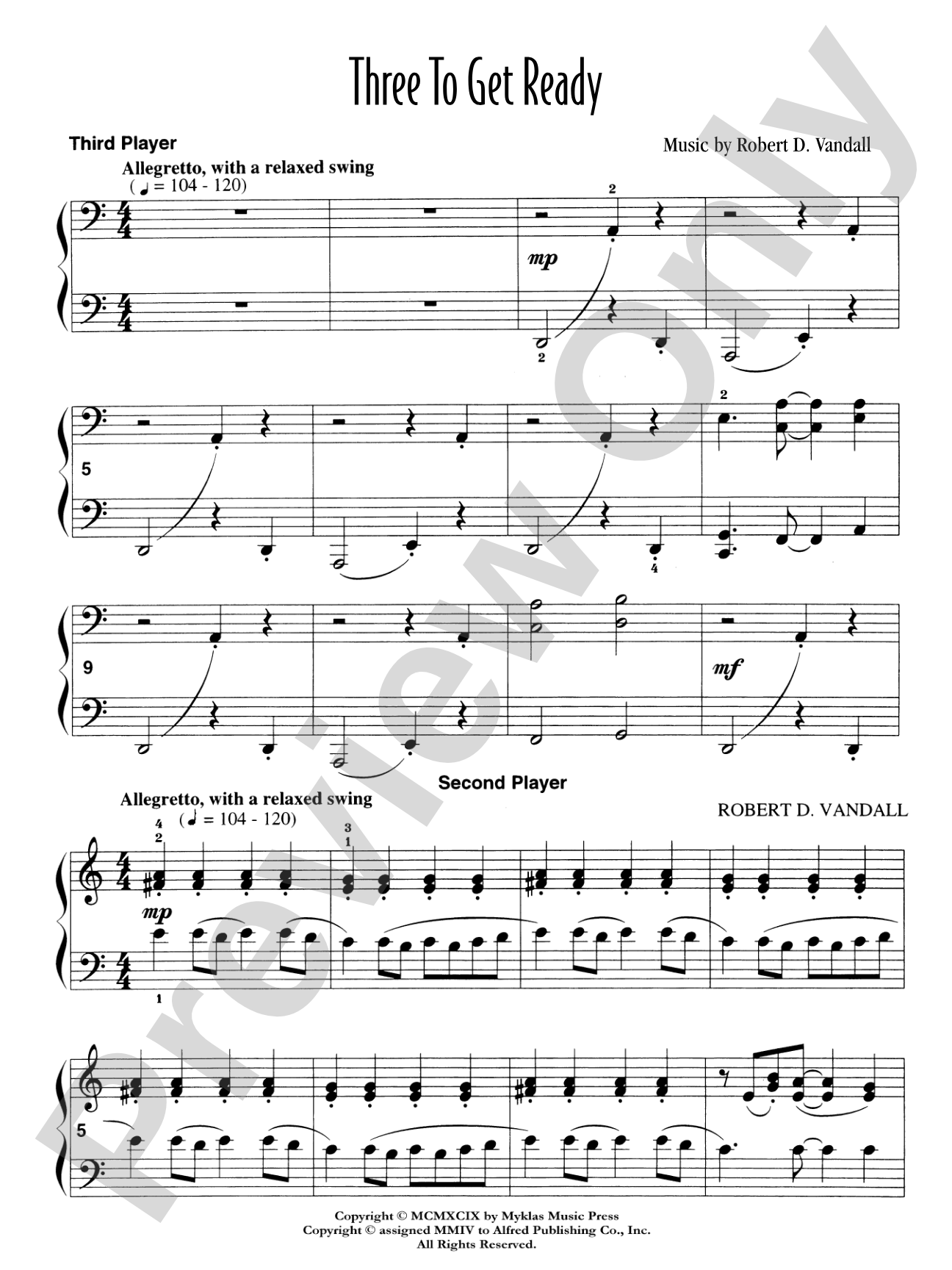
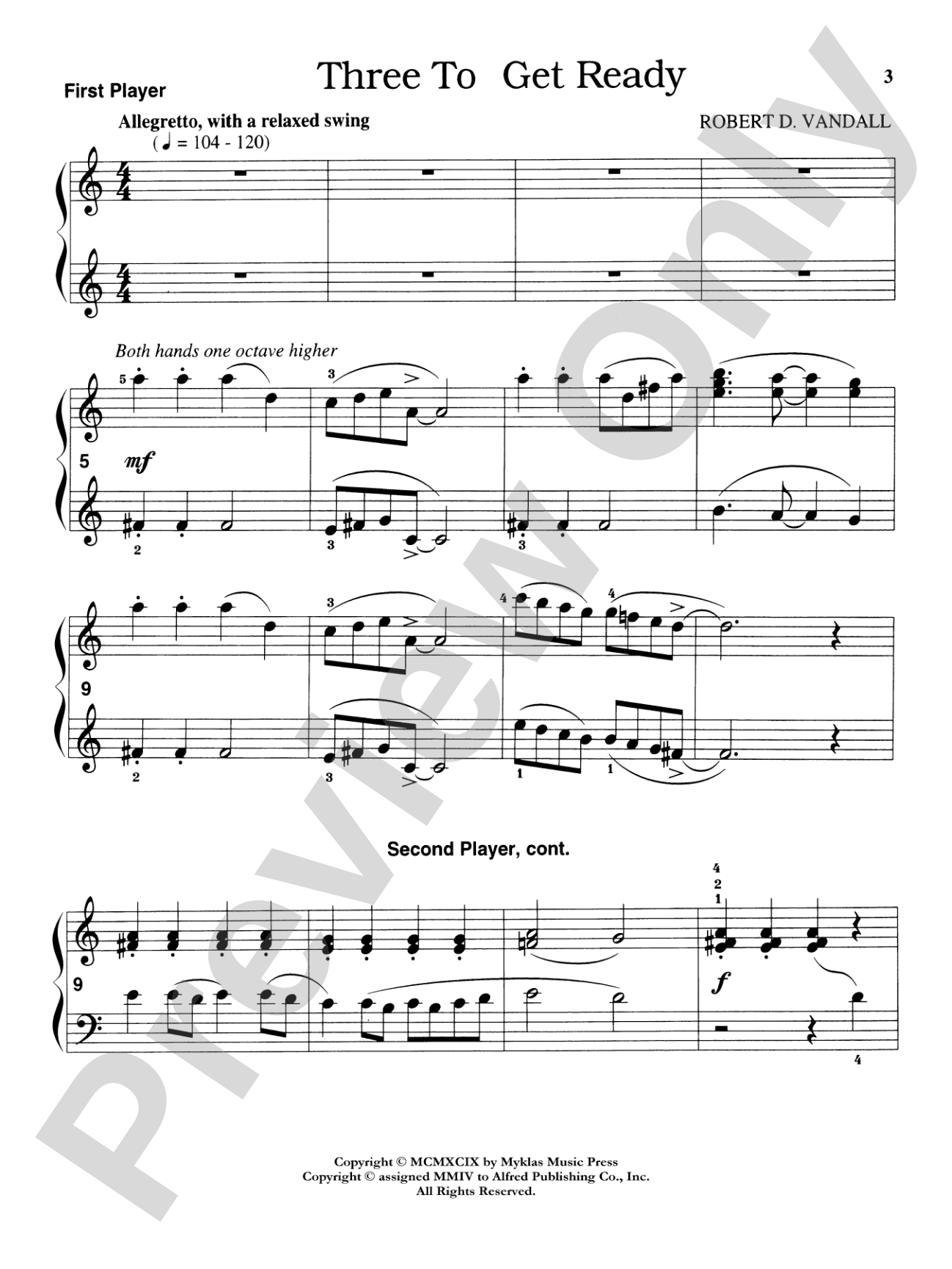

Three to Get Ready - Piano Trio (1 Piano, 6 Hands): Piano
By Robert D. Vandall
Level: Early Intermediate
Item: 00-PB-0000685
$5.50
Pickup currently not available
Related Items
Three to Get Ready: Piano Trio (1 Piano, 6 Hands) Sheet |
$5.50
|
View |
Description
Syncopated swing rhythms set a jazzy, happy-go-lucky tone to this early intermediate piano trio---one piano, six hands. This trio is slightly more advanced than the renowned "Triple Dip," also by Robert Vandall. This piece is in D Mixolydian and 4/4 meter. All performers read from the same score. A Federation Festivals 2024-2028 selection.


Three to Get Ready - Piano Trio (1 Piano, 6 Hands): Piano isn't in MakeMusic Cloud just yet...but it could be. Let us know you'd like to see it, and you'll help shape what comes next. In the meantime, start a free trial and dive into thousands of interactive titles your students can play along with today.
Request This Title
Tell us you want it.
Start Your Free Trial
Explore everything that's ready to play right now.
Sample Audio
No sample audio found.
Sample Video
No sample videos found.
Additional Details
Series:
The Myklas Trio Series
Publisher:
Alfred Music
Page Count:
12
SKU:
00-PB-0000685
More about this title
About the Composer: Robert D. Vandall
Robert D. Vandall is a prolific composer and arranger whose catalog spans decades of music education repertoire. His work consistently targets the early intermediate through intermediate levels, where he demonstrates a gift for writing that feels both playful and musically substantial. Vandall's pieces appear regularly on festival lists and in ensemble curricula because they engage students without talking down to them.
Known especially for accessible small ensemble writing, Vandall has built a body of work that teachers trust. His compositions balance technical clarity with genuine musical interest, making them reliable choices for building ensemble skills and student confidence.
Why we love this
Vandall crafts this trio with rhythmic personality that keeps all three players engaged simultaneously. The swing idiom feels natural here rather than forced, and the fact that performers read the same score eliminates page-turning logistics while maintaining the collaborative energy that makes six-hand repertoire special. Its Federation Festivals selection confirms it meets rigorous standards for both musicality and pedagogical value.
What to expect
The syncopated swung rhythms create forward motion from the opening measure. There's genuine joy in the writing, a lighter-than-air quality that makes the piece feel spontaneous and conversational, as if three musicians are riffing together rather than reading a score.
Who it's for
This works best with three committed early intermediate pianists who have some comfort with jazz idioms and can navigate syncopation without stress. It's equally valuable for a studio teacher balancing multiple students or a school ensemble class looking for repertoire that rewards collaborative focus without overwhelming individual musicians.
How to get the most out of it
- Lock the swing feel early in rehearsal by establishing the ride cymbal feel in your head before adding the syncopated lines. Vandall's rhythms read more easily than they sound, so accurate subdivision is your foundation.
- Balance the three voices by assigning the pianist and two hand-sharers clear roles in texture. Someone plays foundation, someone plays melody, someone plays accompaniment; rotating these responsibilities across rehearsals strengthens everyone's ear.
- Bring out the D Mixolydian color by letting that raised fourth degree ring through where it appears. It's the harmonic seasoning that gives this piece its slightly unexpected, happy character.
- Record yourselves early and often. Hearing the syncopation back reveals exactly where the three parts drift apart, and students almost always correct themselves once they hear the collective rhythm.
How to use it
Feature this as a lighter moment between heavier solo repertoire at a studio recital or young artist showcase. It also works well as an opener on a chamber concert program, setting an accessible, energetic tone that draws the audience in before moving to more serious material. Since it's a Federation selection, consider pairing it with another ensemble piece on a festival program.
Skills your students will build
- Swing rhythms and syncopation in a playable context
- Reading and maintaining independence within a unified harmonic framework
- Mixolydian mode listening and intonation
- Collaborative ensemble balance across three pianists at a single instrument
- Rhythmic accuracy without sacrificing musicality