
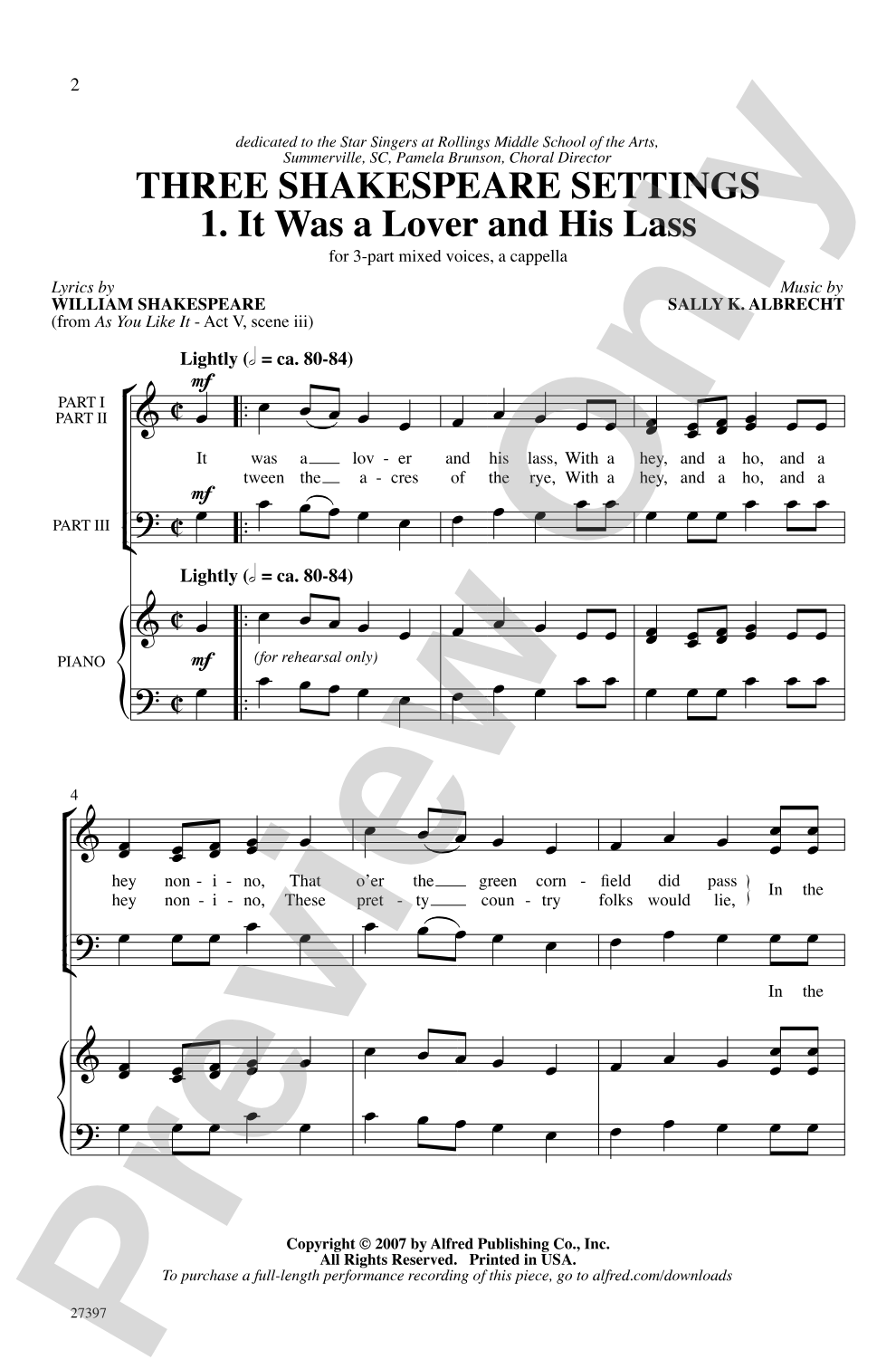
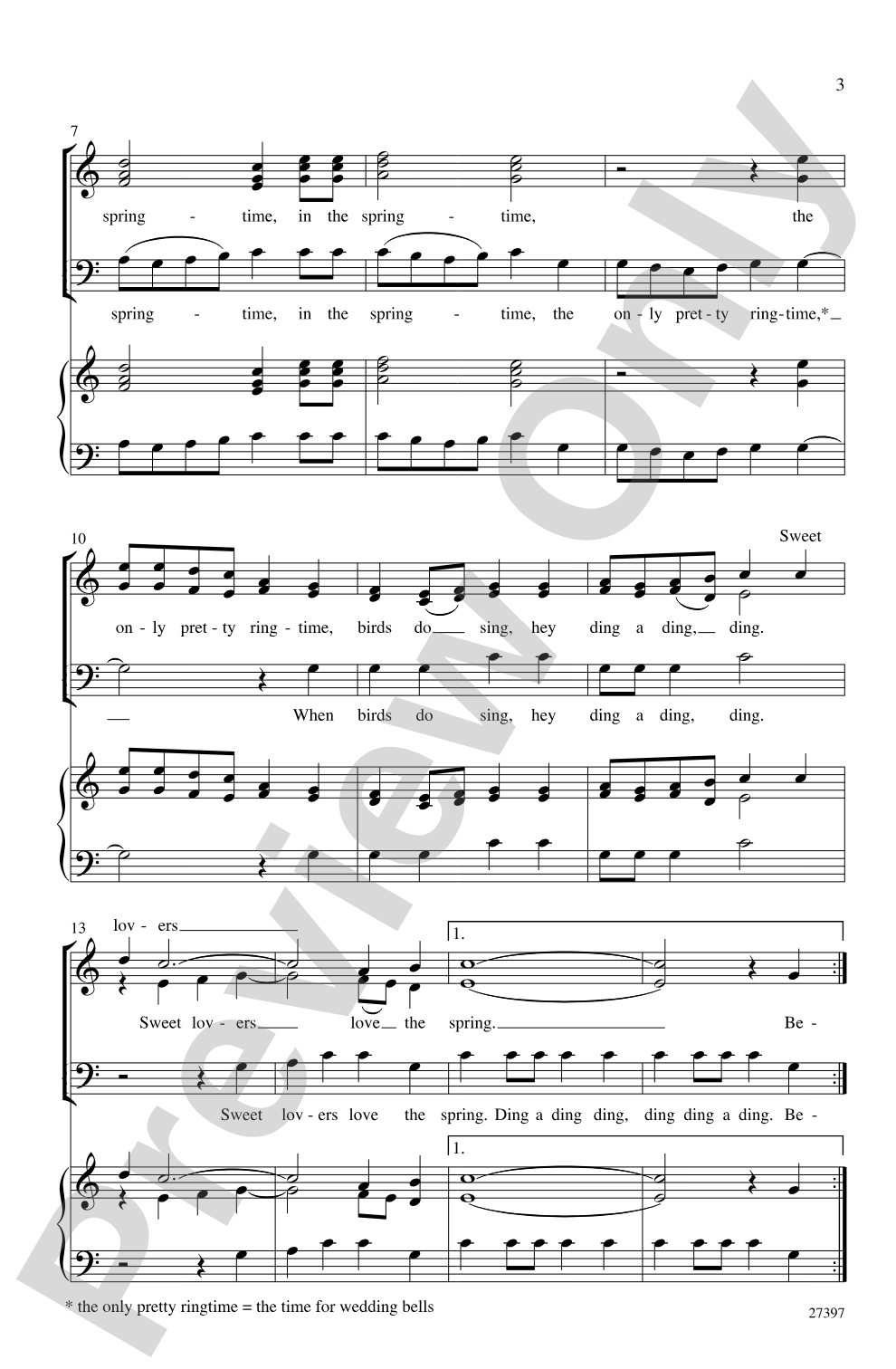
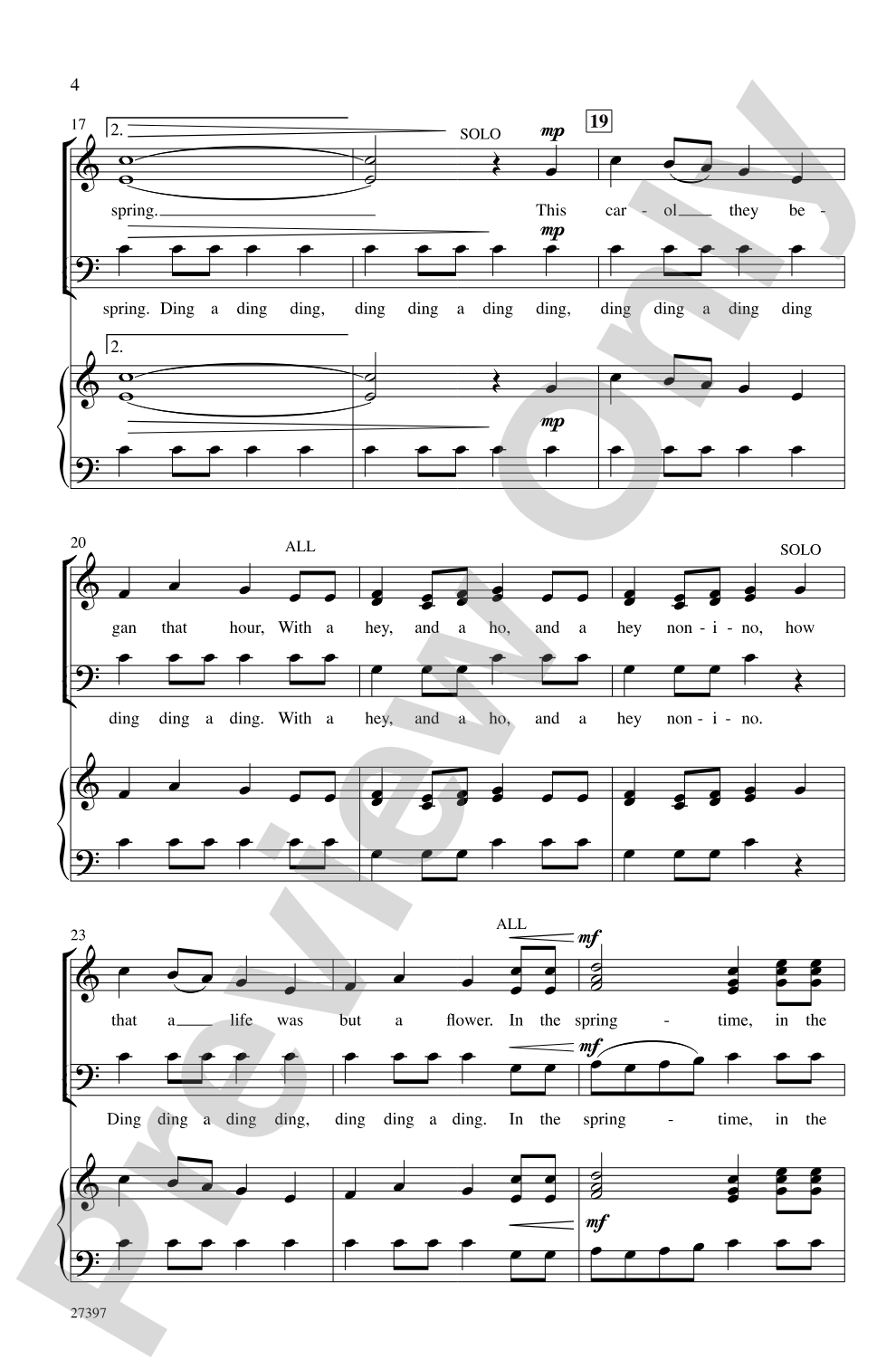

Three Shakespeare Settings: 3-Part Mixed, a cappella Choral Octavo
It Was a Lover and His Lass / Take, O, Take Those Lips Away / Under the Greenwood Tree
Lyrics by William Shakespeare, music by Sally K. Albrecht
Item: 00-PO-0000403
$2.95
Minimum order quantity: 20 copies
Pickup currently not available
Related Items
Three Shakespeare Settings: 3-Part Mixed, a cappella Choral Octavo |
$2.95
|
View |
Description
This three-in-one publication includes choral settings of three Shakespeare texts: "It Was a Lover and His Lass" (in a madrigal style), "Take, O, Take Those Lips Away" (a lush, slow setting), and "Under the Greenwood Tree" (a light, energetic 6/8 piece). These works are written exclusively for 3-part mixed voices and are very accessible for today's developing choirs. Outstanding literature for concert, festivals, or adjudications.


Three Shakespeare Settings: 3-Part Mixed, a cappella Choral Octavo isn't in MakeMusic Cloud just yet...but it could be. Let us know you'd like to see it, and you'll help shape what comes next. In the meantime, start a free trial and dive into thousands of interactive titles your students can play along with today.
Request This Title
Tell us you want it.
Start Your Free Trial
Explore everything that's ready to play right now.
Sample Audio
1
Audio File
--:--
0:00
0:00
Sample Video
No sample videos found.
Additional Details
Series:
Alfred Archive Edition: Alfred Choral Designs
Publisher:
Alfred Music
Page Count:
16
SKU:
00-PO-0000403
More about this title
About the Composer: Sally K. Albrecht

Sally K. Albrecht has shaped American choral music for over three decades, first as Director of School Choral, Vocal, and Elementary Publications at Alfred Music and beyond, then as a prolific composer whose catalog exceeds 600 published works. Her commitment to accessible, singable choral literature has earned her ASCAP Special Music Awards annually since 1987, and her conducting has taken her to honor choirs at Lincoln Center, Carnegie Hall, and The Kennedy Center.
Educated at Rollins College (B.A. in Music and Theater, 1976) and the University of Miami (M.A. in Drama, 1977; M.M. in Accompanying, 1979), Albrecht has taught choral and vocal music at Oakland University, Jersey City State College, and Meredith College. She lives in Wake Forest, North Carolina, with her husband, composer and arranger Jay Althouse. In 2021, she received the Distinguished Alumna Award from both the University of Miami Frost School of Music and Rollins College.
Why we love this
Albrecht delivers three distinct musical characters within one package, each showcasing her gift for writing idiomatic lines that sit naturally in developing SAB ensembles. The progression from madrigal to lush ballad to energetic dance gives directors programming flexibility and variety without requiring multiple purchases, and the literary pedigree of Shakespeare ensures these pieces bring genuine substance to any concert.
What to expect
These settings honor Shakespeare's language while making it sing naturally in three-part harmony. The madrigal sparkles with Renaissance charm, the slow piece unfolds with intimate warmth, and the energetic dance lifts the room with straightforward joy; together they create a mini-survey of choral color and character.
Who it's for
Choirs at the developing level who are ready to tackle authentic literature but need parts that sit comfortably in SAB voicing. Directors looking for concert or festival material that combines accessibility with genuine artistic substance will find these settings ideal; the three-in-one format makes it a smart choice for programming variety without overwhelming your singers.
How to get the most out of it
- Balance the madrigal's overlapping voices by rehearsing each part separately first, then bringing them together gradually so singers hear how their line relates to the whole texture.
- In the slow setting, encourage singers to sustain legato lines without sacrificing clarity of diction on the text; mark breath points carefully to maintain phrases across longer spans.
- Shape the 6/8 piece with a sense of forward momentum and rhythmic precision; the energy comes not from rushing but from locked ensemble and crisp articulation on syllables.
- Use the variety of three pieces as an opportunity to demonstrate different interpretive approaches; discuss how the same language (Shakespeare) yields entirely different moods depending on harmonic and rhythmic setting.
How to use it
Program these as a complete suite to anchor a concert section focused on vocal literature or Shakespeare adaptations, or mix and match them alongside other secular choral works to build a varied first half. The contrasting tempos and moods make them excellent for festival performances where programmers appreciate cohesion without monotony.
Skills your students will build
- Reading and balancing three-part mixed voicing (SAB)
- Sustaining legato lines while maintaining textual clarity
- Ensemble precision and rhythmic lock in compound meter (6/8)
- Interpreting literary text across different harmonic and tonal contexts
- A cappella intonation and blend without instrumental support