Three Rivers March: Oboe Sheet Music Preview

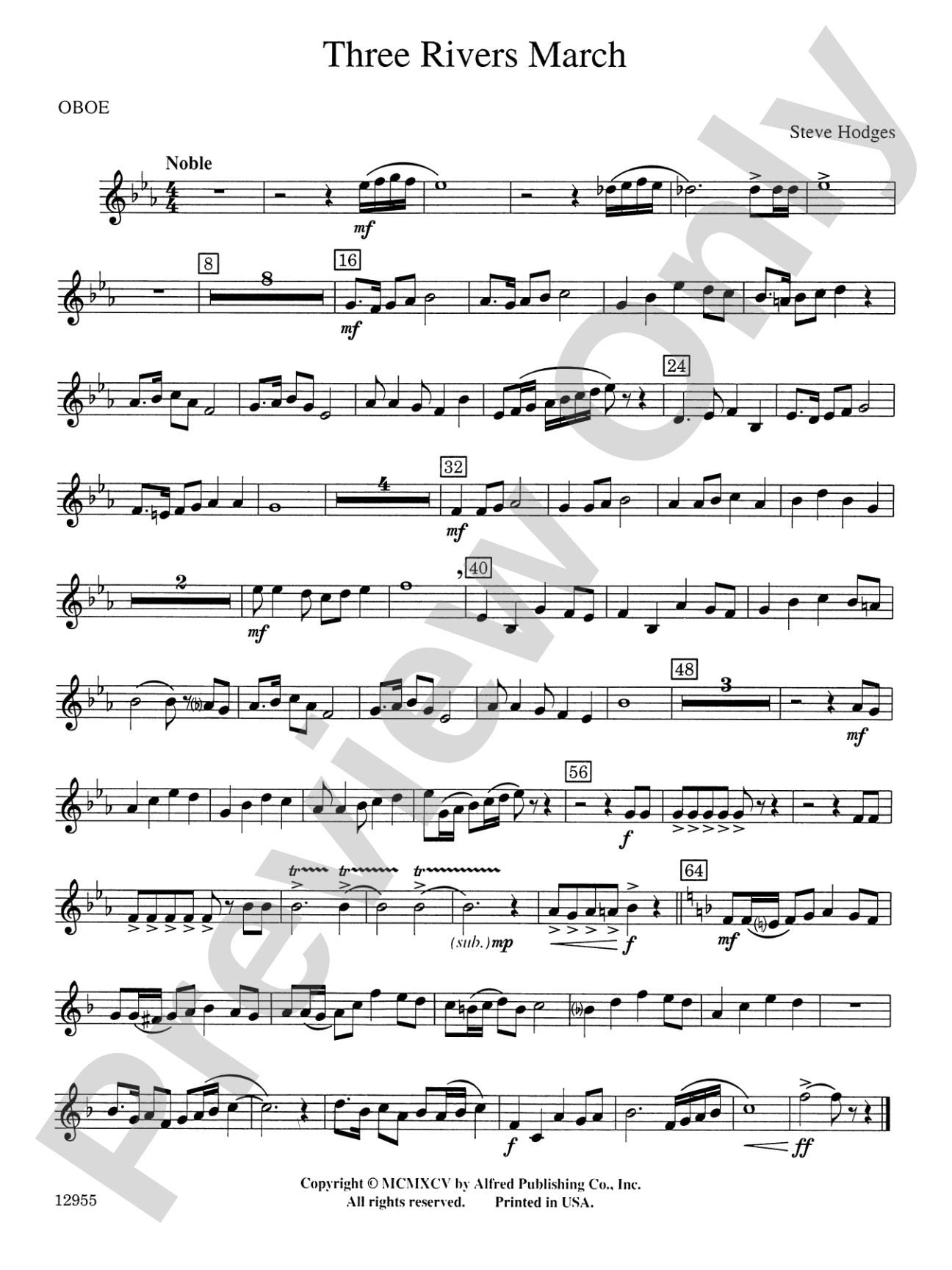
Three Rivers March: Oboe

Music by Steve Hodges

Grade: 2 (Medium Easy)

Item: 00-PC-0000128_O1

Digital Download
$3.00
Description

Don't just read it, hear it, play along with it, and watch your students grow with it. In MakeMusic Cloud, Three Rivers March: Oboe comes alive with professional accompaniment, adjustable tempo, and built-in practice tools that turn solo practice into real progress.

Sample Audio
0:00
0:00
Sample Video
Additional Details
Series: Young Symphonic
Publisher: Alfred Music
Page Count: 1
SKU: 00-PC-0000128_O1

More about this title

About the Composer: Steve Hodges

Steve Hodges

Steve Hodges holds degrees from Western Oregon University (Bachelor of Science) and Central Washington University (Master of Music Education). After four decades directing bands, choirs, and small ensembles across public schools, he has channeled his classroom experience into composing and arranging, with over 120 concert band works published by Alfred Music since 1986.

Hodges' compositions have earned performances at festivals and state conventions throughout North America, and his works have been commissioned by honor bands and schools in Virginia, Iowa, Winnipeg, British Columbia, Oregon, Washington, and North Carolina. His music has also been featured by TBS and ESPN. An ASCAP member, Hodges continues to engage with community music in The Dalles, Oregon, alongside his wife, Teddie, and now watches his grandchildren perform his pieces in their own school bands.

Why we love this

Hodges writes marches that respect the fundamental strengths of developing ensembles: clear harmonic progressions, logical phrase structures, and rhythmic independence that doesn't demand impossible coordination. This piece carries authentic march character without requiring elaborate section balance or intricate dynamics, making it genuinely playable at Grade 2 while staying musically satisfying for everyone in the room.

What to expect

Three Rivers March unfolds with the crisp, forward-moving energy of a traditional American march. The writing is clean and direct, letting young musicians experience the satisfaction of playing a complete musical form without distraction or unnecessary complexity. There's genuine joy in the straightforward melody and bright harmonic movement.

Who it's for

Developing concert bands in their first or second year of repertoire study will find this accessible and rewarding. The piece works equally well for ensembles building march technique, programs seeking Grade 2 material with genuine musical character, and any band looking to program something solid without excessive rehearsal demands.

How to get the most out of it

  • Establish a steady, marcato articulation in the woodwind sections to anchor the march rhythm; crisp attacks will naturally tighten ensemble response without excessive rehearsal time.
  • Let the brass melody sing through with confident dynamics; this piece relies on straightforward sonority, so avoid the temptation to over-blend or reduce the lead voice.
  • Keep the tempo consistent and march-like (typically around 120 BPM); any hesitation in pulse will undermine the piece's forward motion and style.
  • Balance the percussion section so that snare drum and bass drum support the harmonic movement without overwhelming the wind parts; a light touch conveys style effectively at this level.

How to use it

This works beautifully as a concert opener, setting an energetic and organized tone for your program while allowing the audience to settle in with something familiar and welcoming. It pairs well alongside other grade-appropriate concert fare or serves as the anchor piece on a festival program where march style is expected.

Skills your students will build

  • march articulation and style (marcato tonguing, crisp attacks)
  • steady pulse and ensemble precision in a traditional march form
  • fundamental four-part band balance (woodwinds, brass, low brass, percussion)
  • reading and executing simple dynamic changes across an ensemble
  • melodic phrasing in both melody and supporting parts

You May Also Like